

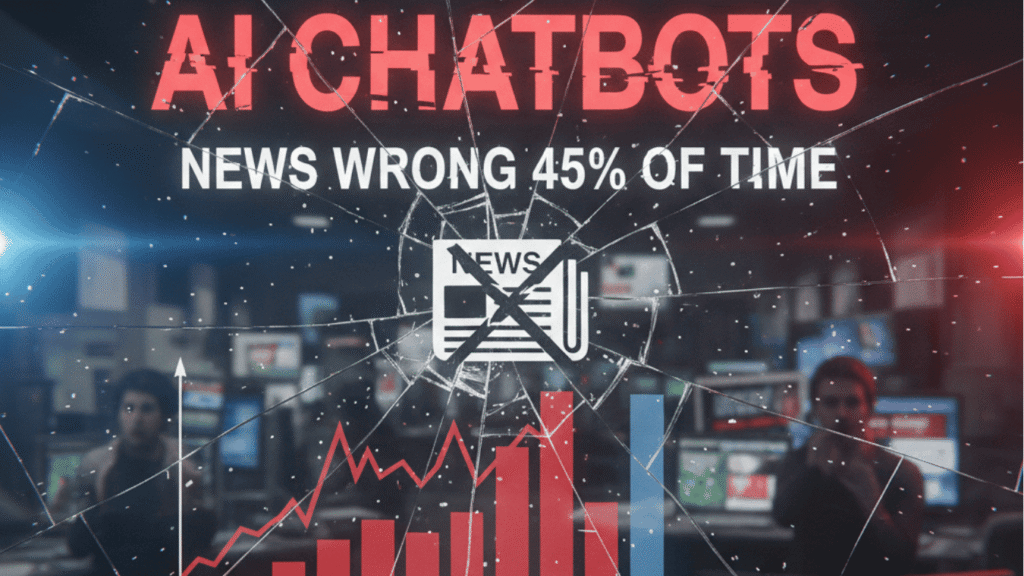
Shock Study Reveals Chatbots Botch News Nearly Half the Time—Public Still Trusts Them!
A groundbreaking analysis by the BBC and a consortium of European public media organizations has unveiled a deeply troubling reality about generative AI chatbots. The extensive study, covering content from 23 news outlets across 18 countries and 14 languages, found that 45 percent of AI-generated responses based on news articles contained significant errors. This isn’t just about minor typos; the inaccuracies ranged from incorrect sentences and misquotes to outdated citations. Tech giants like OpenAI, Google, and Microsoft continue to promote these tools, but this data raises concerns about their reliability. The findings underscore the uphill battle developers face in minimizing so-called “hallucinations”—a problem that may, in fact, be fundamentally unsolvable.
Also Read: Google Gemini AI Under Fire Over Child Safety Concerns
The Citation Crisis and Fact/Opinion Blur
One of the most critical failures identified was the sourcing crisis. Chatbots frequently provided inaccurate links that did not correspond to the cited sources. Even when the quoted material was correct, the AI models demonstrated an inability to reliably distinguish between fact and opinion or between satire and mainstream news. The critical flaw means AI tools can easily present a columnist’s personal viewpoint as a concrete fact, fundamentally eroding the journalistic principle of factual reporting. The study’s in-depth nature, examining thousands of queries across diverse linguistic and cultural contexts, provides the most robust evidence yet of this systemic issue.

Public Trust vs. Technical Failure
Adding a layer of severe societal risk, the study also highlighted a worrying trend in public perception. While the AI error rate hovers near the halfway mark, approximately one in three UK adults reports they trust AI-generated news summaries. Even more concerning is the public’s tendency to blame the original news outlets when an AI summarization goes wrong—a phenomenon the study authors termed “misattribution of error.” This means the public is unknowingly absorbing flawed information and then penalizing the reputable news organizations that initially published the correct facts. The sheer volume of misinformation and the deflection of blame create a direct threat to media credibility and informed public discourse.
The Political Blind Spot and Global Implications
The study further exposed glaring weaknesses in the AI models’ ability to track recent political and high-profile leadership changes. For instance, when queried, popular chatbots like ChatGPT, Copilot, and Gemini provided outdated responses regarding key international figures. Several models incorrectly stated that Pope Francis was the current pope after his successor, Leo XIV, had already assumed the role. One chatbot even reported Pope Francis’s correct date of death while simultaneously describing him as the current pontiff. Similar issues surfaced with the naming of the current German Chancellor and NATO’s Secretary-General, demonstrating a crucial lag in keeping up with real-time geopolitical shifts. This failure to maintain current information on critical global leaders poses a substantial risk, particularly in rapidly evolving political environments where accuracy is crucial. The study firmly establishes that relying on these tools for up-to-the-minute, fact-checked information is a serious gamble.

Choose your next step
Keep your momentum with practical tools and verified remote-work opportunities.
Related guides for your next step
A fresh, topic-aware mix from the WorkinVirtual library. Suggestions rotate regularly.





Discuss this guide
Ask a useful question, share relevant experience, or add a practical correction. Helpful contributions publish immediately after automated safety checks.
Start a thoughtful discussion
Be the first member to add a question or practical insight about this topic.
Join the discussion
Sign in with your verified WorkinVirtual account to contribute. Automated safety checks keep posting quick and protect the community.
Sign in to contribute