

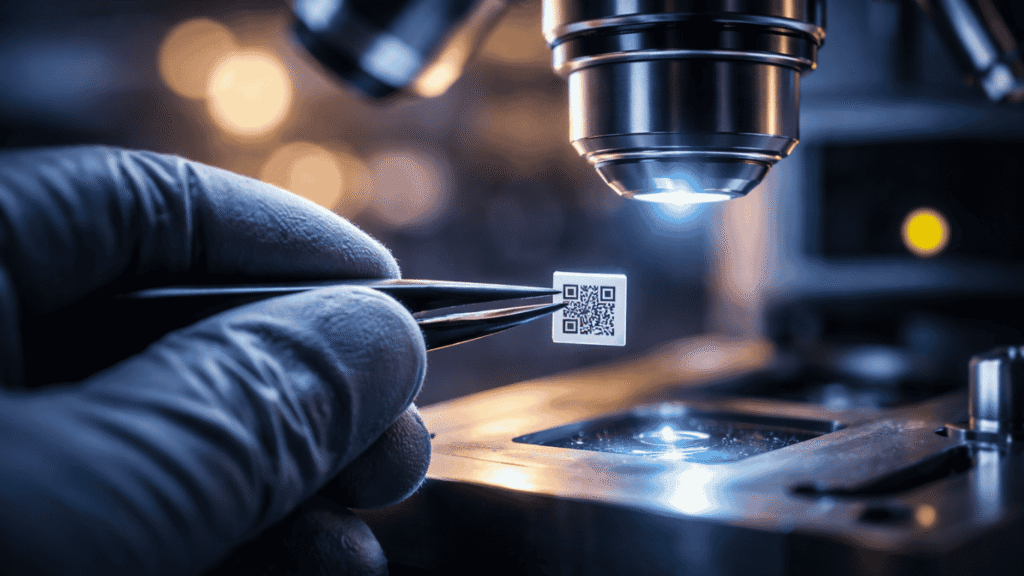
Forget the Silicon Valley giants, a microscopic ceramic sliver from Vienna now holds the future of human history in a space smaller than a single bacterium.
Can you imagine a library containing every book ever written fitting inside a sugar cube? While that sounds like the fever dream of a science fiction novelist, researchers in Austria just turned that fantasy into a microscopic reality. They successfully etched a functional QR code so incredibly small that visible light literally cannot touch it. This breakthrough signals the death of fragile digital storage as we know it.
The Ghost in the Machine
Scientists at the Vienna University of Technology, or TU Wien, collaborated with the tech firm Cerabyte to achieve this feat. They utilized a specialized ion beam to carve a matrix into a ceramic film. This material usually coats heavy-duty industrial tools, yet here it serves as a digital canvas. The resulting QR code measures a staggering 1.977 square micrometers. To put that in perspective, the average human hair is roughly 70,000 nanometers wide, while the pixels in this code are a mere 49 nanometers.
Also Read: Google’s DeepSomatic Cracks Cancer’s Genetic Code, Revolutionizing Treatment
Because these features are smaller than the wavelength of light, the code remains forever hidden from the naked eye. No standard magnifying glass or high-end optical microscope can find it. It exists in a visual “blind spot” of the universe, requiring the sheer power of an electron microscope to be decoded. This isn’t just a gimmick, because the team proved the data remains perfectly readable and stable despite its hauntingly small stature.
A Ceramic Fortress for Human Knowledge
Modern data centers are notorious energy hogs, often requiring massive cooling systems to prevent silicon melt-downs. These facilities consume nearly 2% of the world’s total electricity. In contrast, this new ceramic method offers a sustainable cold-storage solution. Ceramic is inert, meaning it does not rust, degrade, or react to the environment like traditional hard drives or magnetic tapes.
The researchers look toward the past to protect the future. Just as ancient stone tablets have endured for millennia, these ceramic films are designed to last for thousands of years without losing a single bit of information. The density is equally shocking. Experts estimate that a single A4-sized sheet of this material could hold over 2,000 gigabytes of data. If we transitioned to this technology, the massive, heat-spewing server farms of today could eventually shrink into a single filing cabinet.
Beyond the Guinness World Record
On December 3, 2025, the team officially entered the Guinness World Records, having shrunk the previous record by a factor of three. This achievement marks a turning point in humanity’s perception of “space.” We no longer need massive warehouses to store our digital lives. Instead, we can etch our legacy into the very fabric of matter itself. This tiny square represents a giant leap toward a permanent, carbon-neutral digital heritage.

Choose your next step
Keep your momentum with practical tools and verified remote-work opportunities.
Related guides for your next step
A fresh, topic-aware mix from the WorkinVirtual library. Suggestions rotate regularly.




Discuss this guide
Ask a useful question, share relevant experience, or add a practical correction. Helpful contributions publish immediately after automated safety checks.
Start a thoughtful discussion
Be the first member to add a question or practical insight about this topic.
Join the discussion
Sign in with your verified WorkinVirtual account to contribute. Automated safety checks keep posting quick and protect the community.
Sign in to contribute