


To screen remote candidates consistently, separate four questions that hiring teams often mix together: Is the person eligible for this remote role? Do they meet the essential job requirements? What evidence supports those requirements? And what still needs to be tested in an assessment or interview?
Do not start by deciding which résumé “looks strongest.” Start with the criteria the role actually requires, apply the same relevant criteria to each candidate, record the evidence and unresolved gaps, and preserve human responsibility for every employment decision.
For remote roles, this matters because eligibility is not the same as professional fit. A highly qualified applicant may still be unable to accept a role because of location, work-authorization, schedule, travel or other genuine employment constraints. Conversely, living in the right country or time zone does not demonstrate that someone can perform the work.
A practical remote candidate screening process
A useful screening sequence is:
- Confirm remote-work eligibility.
- Define the essential job criteria before reviewing applicants.
- Map each criterion to candidate evidence.
- Separate demonstrated evidence from assumptions and gaps.
- Use job-related assessments only where additional proof is necessary.
- Move selected candidates into a structured interview.
- Score evidence consistently before discussing candidates as a group.
- Keep the final shortlist and hiring decision under accountable human review.
This creates a traceable path from the job requirements to the hiring decision instead of allowing each reviewer to use a different interpretation of “good candidate.”
1. Screen remote eligibility before professional fit
For a remote vacancy, begin with conditions that determine whether the employment arrangement can actually work.
| Screening area | Question to resolve | What counts as evidence |
|---|---|---|
| Eligible location | May the employer hire someone where this candidate will perform the work? | Candidate-stated residence or work location compared with the employer’s documented eligible locations |
| Work authorization | Does the role have a material authorization requirement? | Information requested through the employer’s appropriate hiring process |
| Schedule | Can the candidate meet genuine working-hour or overlap requirements? | Candidate-confirmed availability against the published schedule |
| Employment arrangement | Can the employer support the intended employee, contractor or other arrangement in the applicable location? | Employer’s approved hiring arrangement and candidate circumstances |
| Travel or attendance | Does the role require occasional travel, training or another physical activity? | Published role requirement and candidate confirmation |
| Equipment or security | Are there legitimate device, connectivity or security conditions for performing the work? | Role-specific requirements rather than assumptions about the candidate’s home environment |
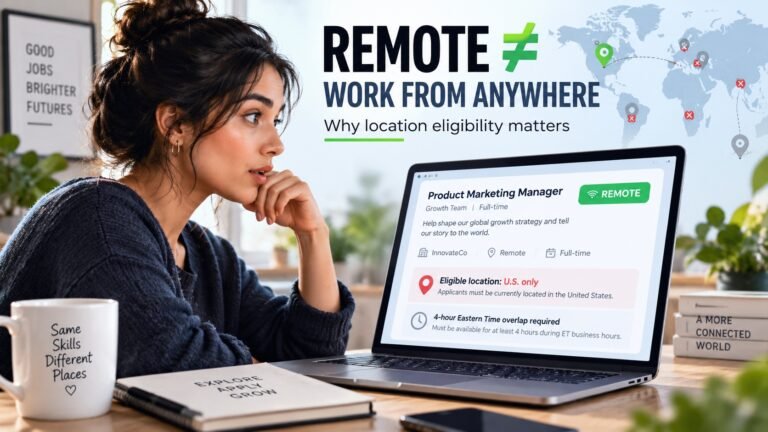
Remote does not mean work from anywhere. WorkinVirtual’s August 2026 Remote Job Eligibility Index found that only 13 of 112 active listings in its snapshot were classified as worldwide. That is a WorkinVirtual platform sample, not a measurement of the entire remote labour market, but it demonstrates why geography should be resolved explicitly rather than inferred from the word “remote.”
Employers should define these conditions when writing the vacancy, rather than discovering them after interviewing an otherwise strong candidate. WorkinVirtual’s remote hiring guidance separates remote eligibility from the broader assessment of candidate fit.
2. Convert the job description into screening criteria
Once eligibility is resolved, turn the role into a short list of criteria that reviewers can actually evaluate.
Start with essential requirements: conditions or capabilities a person genuinely needs to perform the role. Keep preferences separate.
For example, a remote customer success role might require:
- experience managing customer relationships;
- clear professional written communication;
- the ability to investigate and coordinate customer issues;
- experience documenting work in a CRM or similar system; and
- four hours of daily overlap with a specified working window.
The employer might prefer SaaS experience or familiarity with a particular CRM. Those can still contribute useful evidence, but they should not quietly become mandatory halfway through screening if they were originally optional.
Avoid screening on vague personality labels
Terms such as “rockstar,” “energetic,” “great culture fit” or “self-starter” do not tell a reviewer exactly what evidence to look for.
Translate them into observable work requirements.
| Vague criterion | More assessable version |
|---|---|
| Excellent communicator | Can explain a complex issue clearly in writing and adapt the explanation to the recipient |
| Self-starter | Can progress independently, identify missing information and escalate blockers appropriately |
| Great team player | Can coordinate work, document decisions and complete handoffs across a distributed team |
| Handles pressure well | Can prioritize competing requests and explain the reasoning behind those priorities |
The aim is not to eliminate judgment. It is to give that judgment a relevant evidence base.
3. Build a requirement-evidence matrix
A screening matrix does not need to be complicated. For each essential criterion, record what evidence the candidate supplied and what remains unresolved.
| Requirement | Candidate evidence | Status | Next step |
|---|---|---|---|
| Eligible location | Candidate states they will work from an eligible country | Confirmed for screening | Follow normal employer verification process if selected |
| Customer account management | Three years managing a stated portfolio of B2B customers | Relevant evidence | Probe scope and responsibilities in interview |
| Written communication | Résumé states “excellent communication” but gives no example | Unresolved | Use job-related written question or work sample |
| Required schedule overlap | Candidate confirms stated overlap window | Confirmed | No additional screen required unless circumstances change |
| Preferred software | No experience with named CRM; adjacent CRM experience documented | Preference gap | Do not treat as automatic failure if it is not essential |
The useful distinction is between evidence, gap and inference.
If the résumé says a candidate managed customer escalations, that is evidence supplied by the candidate. If the employer needs to know how complex those escalations were, that is an unresolved question. Concluding that the person “must be good under pressure” would be an inference that has not yet been tested.
4. Do not confuse résumé screening with candidate evaluation
A résumé is a source of evidence, not the complete hiring decision.
It can identify relevant experience, qualifications, projects, responsibilities and claimed results. It may not establish the quality of the person’s reasoning, the precise scope of previous work or how they would handle a representative situation in the new role.
This is where employers can use proportionate additional methods such as:
- a short job-related screening question;
- a portfolio or appropriate existing work sample;
- a carefully scoped work simulation;
- a structured interview; or
- reference or credential verification when relevant and appropriate.
The method should match the requirement being investigated. Do not make candidates complete an elaborate exercise merely because the hiring team can create one.
5. Make work samples representative rather than performative
If a work sample is necessary, test something recognizably connected to the job.
A customer-support candidate might be asked to draft a response to a fictional customer problem. An analyst might interpret a small synthetic dataset. A project coordinator might prioritize a fictional set of conflicting deadlines and explain the decision.
The exercise should establish what the employer is trying to learn before candidates begin.
For example:
Criterion: Can the candidate turn incomplete information into a clear customer response?
Evidence sought: identifies the unresolved issue, avoids inventing facts, communicates the next step clearly and maintains an appropriate professional tone.
That is more useful than asking reviewers whether they simply “liked the answer.”
Employers should also consider accessibility, candidate time and applicable employment rules when designing assessments. Legal obligations differ by jurisdiction, so high-stakes screening procedures should receive appropriate qualified review.
6. Use structured interviews for questions that remain unresolved
A structured interview is designed around predetermined, job-related questions and consistent evaluation criteria.
The U.S. Office of Personnel Management describes structured interviews as an approach in which candidates receive the same predetermined questions and responses are evaluated using common rating standards. This makes candidate evidence easier to compare than a process in which every interviewer follows a different conversational path.
For a remote role, interview questions can test relevant distributed-work situations without trying to diagnose someone’s personality.
Example: written coordination
Question: Tell us about a time you needed information from someone who was not immediately available. What did you do, what did you communicate and what happened next?
Useful evidence: the candidate identifies what was missing, explains what could continue independently, records or communicates the blocker appropriately and describes an observable outcome.
Example: asynchronous handoff
Question: Describe a task you had to hand to another person who was working at a different time or location. What information did you include so they could continue without you?
Useful evidence: context, current status, outstanding work, risks, ownership and a clear next action.
Example: prioritization
Question: You begin your shift with three requests marked urgent. How would you decide what to handle first?
Useful evidence: relevant urgency criteria, business or customer impact, dependencies, communication and escalation rather than simply “work faster.”
The same question may produce very different examples across professions. The purpose is not to search for one memorized answer; it is to compare evidence against the role’s predetermined criteria.
7. Score before the group discussion
Where several people participate in hiring, ask each reviewer to record their evidence and score before the group debrief.
This helps prevent the first or most senior speaker from becoming the unofficial answer key for everyone else.
A simple scale can work if its meaning is defined in advance:
| Rating | Meaning |
|---|---|
| 1 — Insufficient evidence | The response does not demonstrate the required capability or leaves a material requirement unresolved. |
| 2 — Partial evidence | Some relevant evidence is present, but important parts of the criterion remain unclear. |
| 3 — Meets criterion | The candidate provides relevant evidence that demonstrates the required capability at the level needed for the role. |
| 4 — Strong evidence | The response demonstrates the required capability clearly, with particularly relevant scope, reasoning or results. |
The scale should describe evidence quality, not whether an interviewer personally liked the candidate.
8. Keep screening questions job-related
Consistency alone does not make a screening process appropriate.
Employers must still ensure their criteria and questions relate to the work and comply with applicable employment law. In the United States, Equal Employment Opportunity Commission guidance warns employers against asking applicants about protected personal characteristics and explains that employment tests and other selection procedures can create discrimination concerns depending on how they are designed and used.
Jurisdiction matters. Employers hiring across countries, states or regions should confirm the requirements that apply to their own organization and the worker’s location rather than treating one jurisdiction’s guidance as universal law.
When information is not necessary to determine whether someone can perform the role, consider why the hiring process is collecting it at all.
9. Treat remote experience as evidence, not a universal prerequisite
A remote role may require capabilities associated with distributed work, but that does not mean previous remote employment must automatically be mandatory.
If the actual requirement is clear written communication, evaluate clear written communication.
If the requirement is independent task management, ask for evidence of independent task management.
If the requirement is asynchronous collaboration, assess how the person documents, hands off and escalates work.
A candidate may have demonstrated those capabilities in an office, freelance project, education, volunteer work or another environment. The employer can decide what level of evidence the particular role requires without substituting “previously worked from home” for every underlying competency.
10. Use AI as hiring assistance, not the hiring authority
AI can help organize hiring information, generate role-related questions, summarize candidate-provided evidence or support consistent workflows. It should not be presented as the accountable employer making the hiring decision.
WorkinVirtual’s current employer workflow follows this separation. Its structured AI-assisted interview workspace can generate consistent role-specific questions, collect candidate responses and prepare evidence summaries for human review. WorkinVirtual states that its AI does not automatically reject candidates; employers remain responsible for shortlisting, review and the final employment decision.
That boundary is important even when technology makes parts of the process faster.
A reusable remote candidate screening checklist
Before moving a candidate forward, ask:
- Have we confirmed the material remote eligibility requirements separately from professional fit?
- Did we define the essential criteria before reviewing this candidate?
- Are preferred qualifications still being treated as preferences?
- Can we point to evidence for each criterion rather than relying on an impression?
- Have we labelled unresolved questions instead of filling the gaps with assumptions?
- Is any assessment representative of work the person could actually perform in the role?
- Are interview questions job-related and substantially consistent across comparable candidates?
- Do reviewers use defined evidence standards?
- Do reviewers record their judgment before group discussion where practical?
- Are accessibility, privacy and applicable employment-law requirements accounted for?
- If AI assists the process, is a human still accountable for the employment decision?
The goal is comparable evidence, not automated certainty
Remote candidate screening works best when employers stop treating eligibility, qualifications, evidence and interviews as the same question.
First establish whether the remote arrangement is workable. Then evaluate essential requirements. Identify the evidence already available, test only the meaningful gaps, compare candidates using consistent job-related criteria and let accountable humans make the employment decision.
The resulting workflow is straightforward:
remote eligibility → essential criteria → candidate evidence → targeted assessment → structured interview → human review → hiring decision.
Employers ready to put that process behind a clearly defined remote vacancy can post a remote job on WorkinVirtual, where structured eligibility information, applicant workflows and human-controlled hiring tools are part of the current employer offering.
Choose your next step
Keep your momentum with practical tools and verified remote-work opportunities.
Related guides for your next step
A fresh, topic-aware mix from the WorkinVirtual library. Suggestions rotate regularly.




Discuss this guide
Ask a useful question, share relevant experience, or add a practical correction. Helpful contributions publish immediately after automated safety checks.
Start a thoughtful discussion
Be the first member to add a question or practical insight about this topic.
Join the discussion
Sign in with your verified WorkinVirtual account to contribute. Automated safety checks keep posting quick and protect the community.
Sign in to contribute