


REMOTE HIRING INTELLIGENCE · OCTOBER 2026
Imagine a candidate seeing “Remote,” spending twenty minutes applying, and then learning the employer can hire only in three states. The recruiter receives an unusable application. The candidate loses time. Both could have avoided the exchange with one clear sentence.
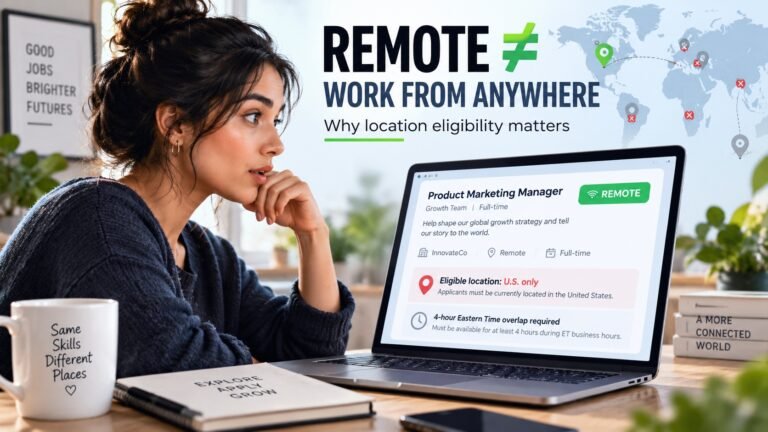
Remote is a work arrangement, not a hiring geography
A remote job can be limited to one country, selected provinces, a customer territory or locations within reach of an office. A company may also recruit only where it has the operational capability to engage someone. None of those boundaries becomes obvious simply because a vacancy says “remote.”
Employers often compress five separate decisions into that label: workplace, hiring location, working hours, engagement type and travel. Candidates should not have to reconstruct those decisions from scattered clues or discover them during an interview.
The October market shows why geography needs its own answer
On October 15, 2026, the Remote Jobs Center Hiring Index tracked 3,261 open remote roles across more than 275 companies. It classified 1,406 roles as U.S. openings, or 43%, and 1,076 as worldwide, or 33%.
Those figures describe that dataset alone. The index combines employer applicant-tracking systems and selected remote-job boards, removes duplicates and uses keyword analysis to classify listings. Its regional labels are useful signals, not independent confirmation of every vacancy’s eligibility or a census of the remote-job market.
The employer implication is practical: remote vacancies serve different hiring geographies. Companies may limit them for employment operations, payroll arrangements, regulatory requirements, security or customer coverage. Whatever the reason, candidates need the actual boundary before applying.
The Remote Job Clarity Check
Before publishing, answer these five questions where candidates can see them without opening an application form.
Replace broad labels with usable facts. Name the states. Specify the overlap window. Describe attendance frequency and destinations. Distinguish an employee role from an independent-contractor engagement where relevant. If a requirement is undecided, resolve it before applicants spend time meeting an expectation that may change.
Five phrases that are not interchangeable
These are editorial examples, not universal legal definitions. Employers should describe their actual arrangement rather than expect a label to carry the entire policy.
| Posting language | The clarification candidates need |
|---|---|
| Remote — United States | Hiring is within the U.S. State any further state restrictions and schedule requirements. |
| Remote — selected states | List every eligible state; “selected” leaves applicants guessing. |
| Remote — North America | Name the countries included in this vacancy’s hiring scope. |
| Remote — worldwide | Explain any country exclusions, engagement conditions or travel limits. |
| Remote — four hours of U.S. Eastern overlap | State eligible locations separately and identify the required overlap window. |
Location and working hours are separate hiring signals
A company can accept worldwide applications while requiring four hours of overlap with New York. Another can hire only within the United States while allowing asynchronous schedules. Location eligibility answers where someone may work; schedule compatibility answers when they must be available.
“U.S. hours” is therefore incomplete. Say whether the role requires a fixed shift or flexible overlap, which days it applies to, and the reference time zone. If the schedule follows New York local time, explain that expectation so applicants can assess seasonal clock changes.
A hypothetical posting could say: “Fully remote; eligible locations: Canada and the United Kingdom. Employee role. Required overlap: 9 a.m.–1 p.m. New York local time, Monday–Friday. No office attendance or business travel. No relocation required.” Each sentence resolves a different compatibility question.
Hidden requirements inflate the wrong number
When restrictions emerge late, recruiters spend screening time establishing basic eligibility. Interviews can reach people who could never accept the arrangement. Candidates may lose confidence in a listing whose practical terms appear only after they commit time.
Application volume also becomes harder to interpret. A busy inbox may reflect ambiguous wording rather than strong demand from suitable candidates. Missing location and schedule information gives search and matching systems less useful evidence, too.
An application count is a weak success measure when it includes people the employer could never consider.
The aim is a relevant, eligible pool. Clear requirements can help candidates decide earlier and let recruiters spend more attention on capability.
Clarity can expand the search, too
Before writing “U.S. candidates only,” establish what the business actually needs. Is the requirement residence in the United States, or customer coverage during particular hours? Is proximity necessary for site visits, or has geography become shorthand for availability?
If the real requirement is working-hour overlap, a broader search may be possible once employment, security and contractual constraints are assessed. Language, licensing, authorization and payroll capability can create different boundaries. Identify the genuine constraint before translating it into a location rule.
The same precision applies to physical attendance. A monthly office day, quarterly gathering or mandatory onboarding visit changes what a candidate must arrange. Describe frequency, destination, expected notice and who pays travel costs. If regular office attendance is required, make the hybrid arrangement explicit before applications begin.
Better information is part of better remote hiring
WorkinVirtual’s approach starts with earlier compatibility. Its employer posting information describes separate fields for location eligibility, time zone and work requirements. A live curated listing reviewed for this article displays eligible location, employment type, compensation, travel and authorization separately, marking several items “Not disclosed.”
That distinction matters: missing information should remain visible rather than become an assumed permission. Structured fields help organize the facts; employers still need to supply accurate requirements, and candidates need to check the current employer application page.
Remote recruitment is partly an information-design problem. The platform’s purpose should be to help a suitable candidate recognize a suitable opportunity before either side invests in the application. Better hiring signals make that decision more informed.
Questions employers commonly face
Can a remote job be limited to one country?
Yes. Working away from an office does not establish worldwide hiring eligibility. Name the eligible country and any narrower restrictions in the posting.
Does “worldwide” mean employees can move countries freely?
No. A broad hiring scope does not automatically authorize later relocation or temporary work abroad. State any approval requirements separately.
Where should location and schedule requirements appear?
Place them near the top of the vacancy, alongside the work arrangement, and keep them consistent on the application page. Candidates should see them before submitting information.
Make the next vacancy easier to assess
Could a candidate read your remote posting and determine where they may work, when they must be available and whether they will need to attend in person—without asking your recruiter?
Before your next remote job posting, run the clarity check. Candidates exploring current remote opportunities can use the same questions before applying.
The strongest hiring process removes preventable uncertainty before the application begins. Employers can define a limited hiring geography and still offer valuable remote work. Explain accurately where, when and how that work happens.
Sources and product pages checked October 15, 2026. Market figures come from the Remote Jobs Center Hiring Index and apply only to its dated dataset; the live index changes daily.
Choose your next step
Keep your momentum with practical tools and verified remote-work opportunities.
Related guides for your next step
A fresh, topic-aware mix from the WorkinVirtual library. Suggestions rotate regularly.





Discuss this guide
Ask a useful question, share relevant experience, or add a practical correction. Helpful contributions publish immediately after automated safety checks.
Start a thoughtful discussion
Be the first member to add a question or practical insight about this topic.
Join the discussion
Sign in with your verified WorkinVirtual account to contribute. Automated safety checks keep posting quick and protect the community.
Sign in to contribute