


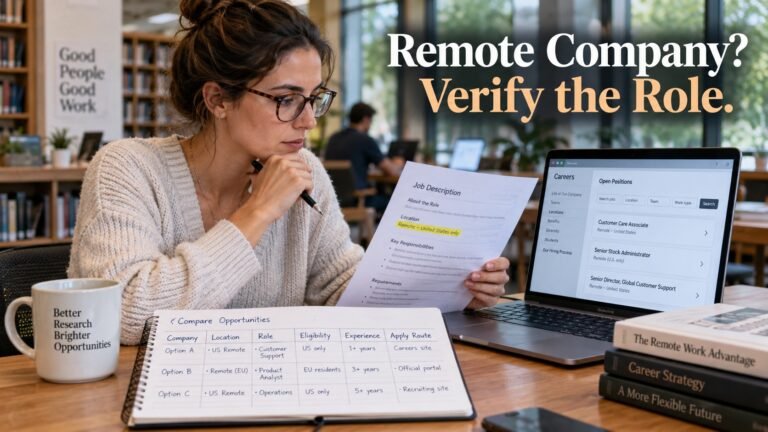
A useful remote job posting should tell candidates not only what the job involves, but whether they can actually be hired for it. Before asking someone to read a long list of responsibilities or prepare an application, clarify where they may work, whether the role is genuinely 100% remote, the required working-hour overlap, employment arrangement, compensation context, essential requirements and application route.
The most important distinction is simple: remote does not automatically mean work from anywhere.
An employer may have a fully remote role while still limiting applicants by country, state or region, requiring certain working hours, restricting the employment arrangement, expecting occasional travel or requiring specific training or equipment.
That information belongs near the beginning of the posting—not hidden after the candidate has already invested time deciding whether to apply.
Remote job posting checklist
Before publishing a remote role, make sure a candidate can answer these questions from the posting itself:
| Information | What the employer should clarify |
|---|---|
| Remote arrangement | Is the role 100% remote, hybrid, remote-first or occasionally work-from-home? |
| Eligible locations | Which countries, states, provinces or regions may the person work from? |
| Time-zone or schedule expectations | Are there fixed hours, core hours or a required overlap window? |
| Employment arrangement | Is the role full-time, part-time, temporary, employee-based or contractor-based? |
| Work authorization or hiring restrictions | Are there material authorization, payroll or employment limitations candidates need to know? |
| Compensation | What is the employer-provided salary or pay range, currency and pay period where available? |
| Responsibilities | What work will the person actually own or contribute to? |
| Essential requirements | Which capabilities are genuinely necessary to perform the work? |
| Preferred requirements | Which qualifications are useful but not mandatory? |
| Travel or in-person activity | Does the remote role include retreats, customer visits, training or other travel? |
| Equipment and security | What will the employer provide, and are there material device, connectivity or workspace requirements? |
| Application route | Where should candidates apply, what must they submit and what happens next? |
1. Define what “remote” actually means
Start with the work arrangement itself.
If the employee can perform the role entirely away from an employer workplace, say that clearly. If regular office attendance is required, describe the role as hybrid rather than presenting it as fully remote.
Google Search Central makes a similar distinction for job structured data: jobs represented as telecommute opportunities must actually be fully remote. Its guidance also distinguishes remote status from the geographic locations in which applicants are eligible to work.
That distinction matters to candidates as much as it matters to search systems.
Compare these descriptions:
Vague:
Remote Customer Success Manager
Clearer:
100% remote Customer Success Manager. Open to candidates residing in the United States in states where the company currently employs staff. The position requires four hours of overlap with the U.S. Eastern Time business day.
The second version answers three different questions: where the work happens, where the worker may live, and when collaboration is required.
2. State eligible locations separately from the time zone
Location and time zone are related, but they are not interchangeable.
An employer might accept candidates anywhere in Canada while requiring working-hour overlap with colleagues in Eastern Time. Another company might hire throughout several countries with no fixed time-zone requirement. A U.S. employer may also support remote employment in some states but not others.
Therefore, avoid using language such as “EST candidates only” if the real restriction is geographic, and avoid saying “U.S. remote” when the real requirement is simply working-hour overlap.
Specify each constraint for what it actually represents.
A practical order
- Remote status: 100% remote.
- Eligible location: countries, states or regions in which the employer can hire.
- Time expectation: fixed schedule or required collaboration overlap.
This is particularly important because genuinely worldwide opportunities are not the same thing as ordinary remote roles.
In WorkinVirtual’s August 2026 Remote Job Eligibility Index, only 13 of 112 active listings in the snapshot were classified as worldwide, while 69 were either U.S.-nationwide or limited to selected U.S. states. The research is a WorkinVirtual platform snapshot rather than a census of the entire remote-job market, but it illustrates why employers should not use “remote” as a substitute for eligibility details.
3. Explain the working schedule candidates are actually accepting
“Flexible hours” can mean very different things.
If a distributed team needs employees online simultaneously, state the relevant working or overlap window. If employees largely control their schedules but attend several recurring meetings, explain that instead.
For example:
- Work may be completed asynchronously, with attendance required at a Tuesday 10:00 a.m. ET team meeting.
- Employees choose their own schedule but must maintain at least four hours of overlap with 9:00 a.m.–5:00 p.m. ET.
- This is a fixed Monday–Friday, 8:00 a.m.–4:00 p.m. Pacific Time position.
A time-zone label alone can be ambiguous. Stating the actual working expectation gives candidates something they can evaluate.
4. Separate essential requirements from preferences
One of the simplest improvements an employer can make is to distinguish what a person must be able to do from what would merely be useful.
An essential requirement should normally connect to the work itself or a material condition of performing it.
For example, if a customer-support employee must communicate with Spanish-speaking customers every day, a language requirement may be material to the role. If a particular project-management platform can be learned during onboarding, prior experience using that exact product may be better presented as preferred rather than mandatory.
Consider dividing requirements into two sections:
Essential
- Capabilities required to perform core responsibilities.
- Necessary professional credentials where genuinely required.
- Material schedule or location requirements.
- Required job-related experience where necessary.
Preferred
- Experience with tools that can reasonably be learned.
- Industry familiarity that would shorten onboarding.
- Additional skills that could expand the person’s contribution.
This also creates a cleaner foundation for later screening because recruiters can compare applicants against criteria defined before applications arrive rather than inventing new standards during review.
Employers should also ensure that job advertisements and hiring criteria comply with the laws that apply to them. In the United States, for example, the Equal Employment Opportunity Commission states that job advertisements and recruitment practices may not discriminate on protected grounds covered by federal law. Other countries, states and municipalities may impose additional requirements.
5. Describe the work before describing the ideal person
A candidate should understand what they are being hired to accomplish.
Instead of filling the posting with personality adjectives such as “rockstar,” “high-energy,” “self-starter” or “perfect culture fit,” describe observable responsibilities and expectations.
For example:
Less useful:
We are looking for a highly motivated team player with excellent communication skills.
More useful:
You will manage approximately 20 active customer accounts, document customer issues in the CRM, coordinate escalations with product and support teams, and provide customers with written progress updates.
The second version gives candidates evidence they can compare against their actual experience.
It also gives the hiring team something concrete to evaluate later.
6. Make compensation understandable
If compensation is disclosed, give candidates enough context to interpret it.
Useful information can include:
- the employer-provided pay range;
- currency;
- hourly, monthly or annual basis;
- whether the range changes according to location or level;
- important bonus, commission or equity context where relevant.
Do not publish an estimated salary as though the employer supplied it.
Pay-transparency obligations differ substantially by jurisdiction, so employers should verify the rules applying to the places from which they recruit and employ people.
7. Disclose travel, training and equipment requirements
A job can still be genuinely remote while requiring occasional travel or a particular onboarding arrangement. The important issue is whether candidates know that before applying.
If the employee must attend an annual company retreat, complete several days of in-person training, travel to customer locations or visit headquarters periodically, state the expectation and approximate frequency where possible.
Equipment deserves similar clarity.
Tell candidates whether the company provides a computer and other necessary hardware, whether employees may use approved personal equipment, and whether there are material connectivity, privacy or security requirements.
These details can change whether an otherwise qualified candidate is practically able to accept the role.
8. Tell candidates how the hiring process works
The application route should not be a mystery.
State what applicants are expected to provide and where they should submit it. If the process involves a structured assessment or interview, explaining the major stages can help candidates prepare appropriately.
For example:
- Submit application and work-history evidence.
- Hiring team reviews essential eligibility and job-related requirements.
- Selected candidates complete a structured interview.
- Employer reviews the evidence and interview results.
- The employer makes the final hiring decision and communicates the outcome.
Technology can assist with organization, matching, structured questions, summaries and workflow management, but employers should preserve accountable human review of employment decisions.
WorkinVirtual follows the same principle in its remote hiring workflow: automation may assist the process, while the employer remains responsible for shortlisting and the final hiring decision.
9. Put important restrictions before the long description
Do not make candidates read 1,000 words before discovering that they live in an ineligible country.
A practical remote posting can place the most important decision information near the beginning:
- Work arrangement: 100% remote
- Eligible locations: United States — selected states
- Employment type: Full-time employee
- Schedule: Monday–Friday with four hours of ET overlap
- Compensation: employer-provided range and currency
- Travel: up to two company meetings per year
Then explain the role, responsibilities and requirements.
This allows candidates to make the eligibility decision before making the fit decision.
10. Run a final employer self-audit before publishing
Before the job goes live, read it from the applicant’s perspective and answer these questions:
- Can someone tell immediately whether the position is genuinely remote?
- Can they tell where they are allowed to work from?
- Can they understand the required schedule or time-zone overlap?
- Is the employment arrangement clear?
- Are material authorization or hiring restrictions disclosed appropriately?
- Can candidates distinguish essential qualifications from preferences?
- Does the posting explain the actual work rather than relying on personality labels?
- Is compensation understandable where it is supplied?
- Are travel, training and equipment expectations disclosed?
- Is the application route obvious?
- Does the hiring process preserve human responsibility for employment decisions?
If several answers are “no,” the posting probably needs another revision before distribution.
A clear remote job post is the first stage of the hiring process
A remote posting is not just promotional copy. It establishes the criteria candidates will use to decide whether to apply and the criteria the employer can later use to evaluate applications consistently.
The sequence should be straightforward:
eligibility → clear requirements → candidate evidence → evaluation → interview → human hiring decision.
The better the information at the beginning of that sequence, the less ambiguity both sides carry into the rest of the process.
Once the role, eligibility and requirements are clear, the logical next step is to publish them in a format candidates can evaluate properly. WorkinVirtual’s Post a Remote Job workflow is built specifically for remote-only opportunities and includes structured fields for location eligibility, time zone, employment arrangement and other material work requirements.
Frequently asked questions
What should be included in a remote job posting?
Include the role and responsibilities, remote arrangement, eligible work locations, time-zone or schedule requirements, employment type, essential and preferred qualifications, compensation context, travel, equipment requirements and application process. Any material restriction that could make an otherwise interested candidate ineligible should be communicated early.
Does remote mean candidates can work from anywhere?
No. A job may be 100% remote while still limiting where employees can live or work because of the employer’s hiring arrangements, operational requirements or other constraints. Employers should state the actual eligible locations rather than assuming the word “remote” communicates them.
Should a remote job posting include a time zone?
Include time-zone information when working hours or collaboration depend on it. Where possible, state the actual schedule or required overlap rather than listing a time zone without explaining what candidates are expected to do.
Should required and preferred qualifications be separated?
Yes. Separating essential criteria from preferred experience helps candidates evaluate their fit and gives recruiters a clearer basis for consistent screening. Essential requirements should be tied to the work or a material condition of performing it.
Choose your next step
Keep your momentum with practical tools and verified remote-work opportunities.
Related guides for your next step
A fresh, topic-aware mix from the WorkinVirtual library. Suggestions rotate regularly.





Discuss this guide
Ask a useful question, share relevant experience, or add a practical correction. Helpful contributions publish immediately after automated safety checks.
Start a thoughtful discussion
Be the first member to add a question or practical insight about this topic.
Join the discussion
Sign in with your verified WorkinVirtual account to contribute. Automated safety checks keep posting quick and protect the community.
Sign in to contribute