

WORKINVIRTUAL • REMOTE HIRING
A persuasive résumé can earn a candidate an interview. It cannot tell you, on its own, whether they can do the work.
A candidate can now use AI to tailor a résumé, strengthen a cover letter and prepare confident interview answers. For employers, that raises a practical question: how much does an impressive application reveal about the person behind it?
Western Governors University’s September 30, 2026 Workforce Decoded report offers one indication. In its survey of 3,128 U.S. hiring professionals, 60% said AI was making candidates’ real skills harder to evaluate. This is a broad U.S. hiring survey, rather than a measure of remote recruitment specifically.
For remote hiring teams, the implication is useful: keep the application, but improve the evidence you collect after reading it.
Why polished applications reveal less
AI can help a qualified professional explain genuine achievements more clearly. That is a legitimate use of technology, particularly for people who struggle with résumé writing or apply in a second language.
The difficulty is that candidates with very different abilities can now submit similarly polished applications. Strong wording still communicates a claim. It does not establish that the claim is accurate.
When presentation becomes easier to improve, demonstrated ability becomes more valuable.
Consider a remote project manager who writes: “I coordinated a team across four time zones and introduced a planning process that reduced missed deadlines.”
That is more informative than “excellent leadership skills.” But it still needs a conversation. What did the candidate personally own? What changed? How was the outcome measured? Which problems remained?
Specificity creates something useful to investigate. It is not proof by itself.
Five signals worth examining
What remote employers should verify
Can the candidate do the essential work?
Start with the capabilities that matter most to the role. A support candidate could respond to a realistic customer problem. A video editor could explain pacing and storytelling decisions in an existing portfolio. A developer could discuss a relevant code sample.
Keep assessments short and connected to actual responsibilities. Avoid turning screening into unpaid production work. If the job involves AI tools, explain permitted use and assess how the candidate checks, improves and takes responsibility for the output.
What did they personally contribute?
Company names and job titles provide context, but they do not explain ownership. Ask about a specific project: the problem, the candidate’s responsibility, the decisions they made and the result.
Give candidates room to credit collaborators while explaining their own work. “Our team delivered” may describe a meaningful achievement; the next question is which part they owned.
Is there credible work to examine?
A portfolio, relevant reference or work sample can strengthen an application. Pair the artifact with questions about how it was produced, which constraints shaped it and what the candidate would change.
For confidential work, invite a redacted example or a process walkthrough. Candidates should not need to disclose a former employer’s sensitive information to demonstrate competence.
A sample may involve collaboration, templates or AI assistance. Understanding those contributions is more useful than assuming the artifact represents entirely independent work.
Can the arrangement actually work?
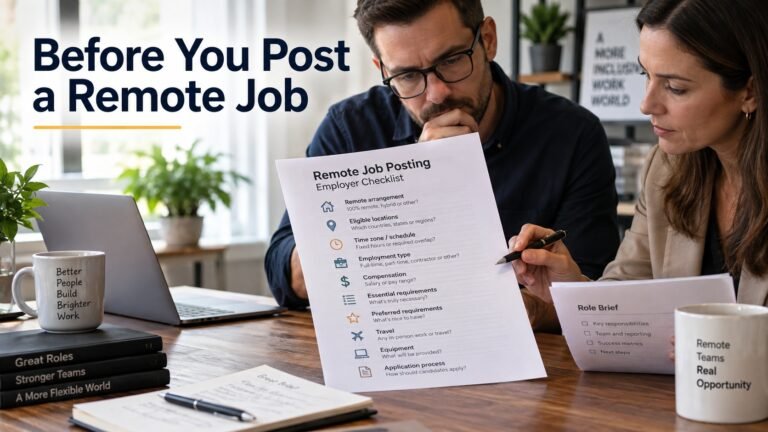
Confirm hiring-location requirements, relevant employment or contracting eligibility, schedule expectations, start-date availability and required time-zone overlap.
A skilled applicant who cannot provide four hours of required overlap may be unsuitable for that particular arrangement. That is a compatibility issue, not a judgment about their ability.
Put these requirements in the job posting and clarify them early. Clear expectations save time for both sides.
Do important details hold together?
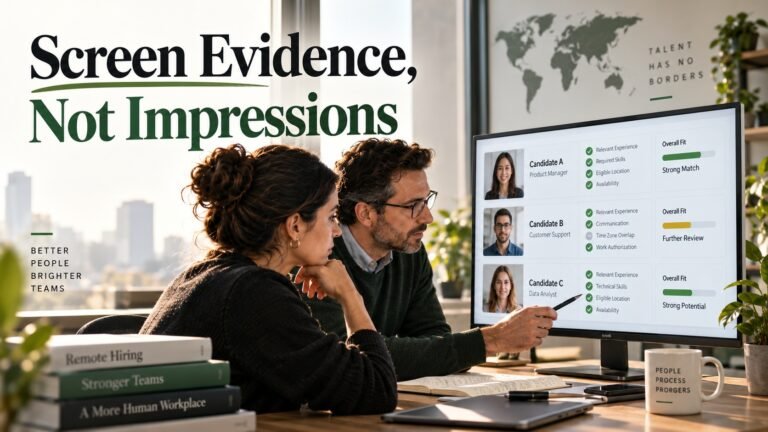
Where appropriate to the role, confirm material employment information, credentials or identity through a proportionate process. Focus on details that affect the hiring decision.
Conflicting employment dates may warrant clarification. Different wording between a résumé and an interview does not automatically indicate deception. Give candidates a fair opportunity to explain discrepancies.
A practical remote hiring evidence check
Before advancing a candidate, ask:
A discussion checklist, not an automatic hiring score. Ticking a box does not guarantee future performance.
Ask questions that reveal decisions
A useful interview invites candidates to explain the work, including its complications. Four questions can help:
- What part of the project did you personally own?
- What went wrong, and how did you respond?
- What changed because of your work?
- What would you do differently today?
Use comparable core questions and job-related criteria across candidates. Allow time to think and clarify. Confidence, fluency and charisma should not outweigh the evidence of relevant ability.
Build trust in both directions
Applicant authenticity deserves attention, but candidates face uncertainty too. In its 2026 State of Online Recruiting announcement, iHire reported that 41.2% of surveyed job seekers had encountered a fake or scam job in the previous year.
Employers can support trust by explaining the role, identifying who is hiring and making the evaluation process clear. Verification should respect privacy and accessibility, and remain relevant to the work.
Using AI to improve a genuine application, applying internationally or appearing nervous in an interview does not establish dishonesty or incompetence.
The purpose of stronger screening is to recognize qualified people more accurately.
Better remote hiring starts with clearer information
For employers using WorkinVirtual, the practical starting point is a better-defined remote opportunity: explain the work, state essential skills, specify location and time-zone requirements, and tell applicants what evidence will help you evaluate them.
These steps do not require an elaborate verification system. They make the hiring conversation more useful before either side commits to multiple interviews.
Keep the résumé. Improve what happens after reading it. An impressive application can open the conversation; relevant evidence should guide the decision.
Choose your next step
Keep your momentum with practical tools and verified remote-work opportunities.
Related guides for your next step
A fresh, topic-aware mix from the WorkinVirtual library. Suggestions rotate regularly.

Discuss this guide
Ask a useful question, share relevant experience, or add a practical correction. Helpful contributions publish immediately after automated safety checks.
Start a thoughtful discussion
Be the first member to add a question or practical insight about this topic.
Join the discussion
Sign in with your verified WorkinVirtual account to contribute. Automated safety checks keep posting quick and protect the community.
Sign in to contribute