

Use up and down arrow keys to resize the meta box pane.
Use up and down arrow keys to resize the meta box pane.
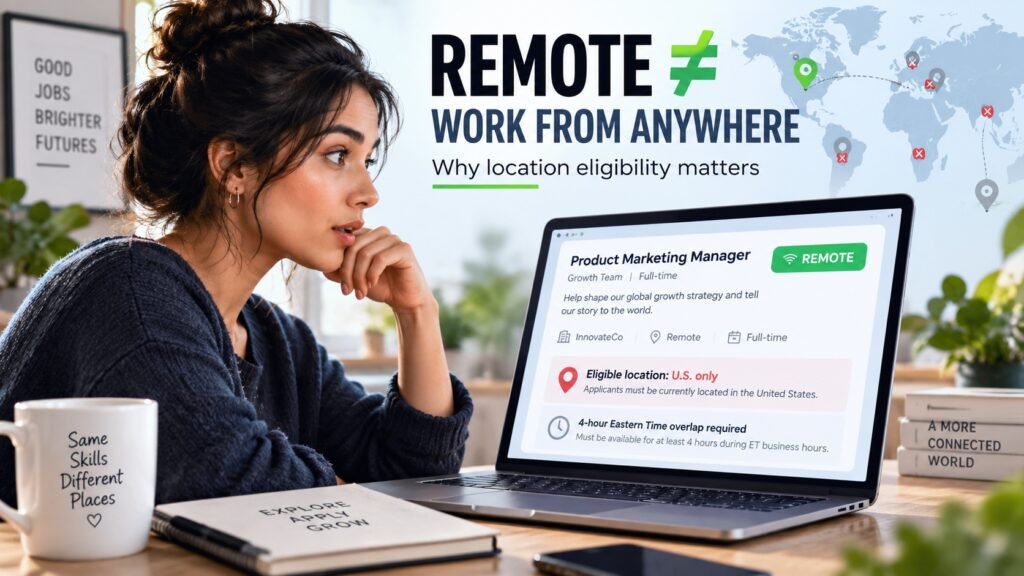
You find a promising job marked Remote. The responsibilities match your experience. The salary looks reasonable. You’re ready to apply.
Then comes the detail you almost missed: “Applicants must reside in the United States.”
For a candidate in Pakistan, Kenya, India or the Philippines, that single sentence changes everything. Even someone living in an eligible country might discover that the job requires working Pacific Time hours.
The employer hasn’t necessarily advertised the position incorrectly. The problem is that one label answered only half the question.
Remote tells you where the work happens.
Eligibility tells you whether you can actually do it.
Does Remote Mean You Can Work From Anywhere?
No. A remote job can still have geographic, legal, payroll, tax, licensing, security, travel or working-hours restrictions. Remote work generally means performing work away from an employer’s regular office. It does not automatically mean an employer can hire someone in every country.
Why do these restrictions exist? An employer might only have payroll arrangements in certain locations, need particular work authorization, serve clients within specific jurisdictions, or require employees to collaborate during shared business hours.
Some restrictions are operational choices; others reflect legal or contractual conditions. The important question for candidates is not whether a restriction exists, but whether it is clearly disclosed.
Remote, Location-Restricted and Work From Anywhere Are Not the Same
These expressions describe different levels of geographic flexibility. They are useful hiring descriptions, not universally standardized legal categories.
Remote
Work takes place outside a traditional office. Additional location conditions may still apply.
Location-restricted
Work is remote, but applicants must be based in specified countries, states or regions.
Work from anywhere
Broader geographic flexibility, sometimes worldwide, subject to any stated contractual or legal conditions.
A job advertised as worldwide remote may accept applications internationally while still requiring specific working hours or an approved contracting arrangement. Worldwide should never be interpreted as a guarantee of unrestricted eligibility.
Six Details Every Remote Job Should Make Clear
A useful remote-job description should help candidates assess practical eligibility before they invest time in an application.
What matters beyond the Remote label
Can remote jobs require a specific time zone? Yes. Employers may need common collaboration hours even when every team member works remotely.
A time-zone requirement describes scheduling compatibility; it does not, by itself, establish where someone can legally be hired.
Why One Remote Badge Isn’t Enough
Many job descriptions can be reduced to a simple field: Remote: Yes.
That is a useful starting point, but not a complete representation of a modern distributed role.
Remote: Yes
Important conditions remain unanswered.
Arrangement: Remote
Eligible: United States only
Schedule: Four-hour Eastern Time overlap
Type: Full-time employee
Travel: Not required
Illustrative job information, not an active vacancy.
The second representation communicates more than the first without requiring a lengthy job description.
Remote should be the beginning of a job’s location information, not the end of it.
How WorkinVirtual Approaches Remote Eligibility
At WorkinVirtual, the platform direction is to treat remote status as one attribute of a job, rather than a complete description of candidate eligibility.
Its structured job model is designed to surface relevant conditions wherever reliable information is available: eligible hiring locations, employment type, experience requirements, compensation, time-zone expectations, travel requirements and the application route.
This information is not equally complete across every vacancy. Some employers disclose more than others, and listing details can change. Candidates should still confirm material requirements on the current application page.
WorkinVirtual also explains its separate remote-job review approach, including how stated eligibility and application information are assessed for publication.
The larger platform principle is simple: better job information gives candidates a better starting point for deciding whether to apply.
Where the Reusable Remote-Work Profile Fits
Structured job requirements become more valuable when candidate information is organized with the same clarity.
WorkinVirtual’s reusable remote-work profile approach explores how professional qualifications, location, working-hour availability and candidate preferences can remain distinct.
One qualified candidate. Two different opportunities.
Location: Philippines
Skills: Customer support
Availability: Asian business hours
Remote; U.S. residents only; Eastern Time overlap required.
Worldwide applications accepted; no fixed time-zone requirement.
Illustrative compatibility example. Final eligibility depends on the employer’s actual requirements.
The same professional skills can be relevant to both positions, but the candidate’s location creates an immediate mismatch with Opportunity A. Opportunity B may be worth investigating further.
This is the longer-term value of structured remote hiring: comparing job-side requirements with candidate-side information without confusing professional ability with legal or operational eligibility.
Your 30-Second Remote Job Eligibility Check
Before submitting your next remote application, answer these five questions:
Check before you apply
- Can this employer hire someone in my location?
- Do I meet its work-authorization requirements?
- Can I work the required hours or time-zone overlap?
- Does the employment or contract arrangement fit?
- Can I meet any travel or onsite requirements?
If an answer is unclear, check the original job description or ask the employer before investing substantial time in the application.
Better Remote Hiring Starts With Better Definitions
The remote-work industry does not need to abandon the word remote. It needs to give that word enough context to be useful.
When job platforms distinguish work arrangement from candidate eligibility, job seekers can avoid more unsuitable applications and employers can communicate their hiring conditions more clearly.
That is the direction WorkinVirtual is working toward: remote opportunities described through meaningful information, not merely a label.
Find remote work that fits your circumstances.
Browse current opportunities and check the available location, work-arrangement and eligibility information before deciding where to apply.
Explore Remote Jobs →Always confirm final eligibility and employment terms with the hiring employer.
Choose your next step
Keep your momentum with practical tools and verified remote-work opportunities.
Related guides for your next step
A fresh, topic-aware mix from the WorkinVirtual library. Suggestions rotate regularly.



Discuss this guide
Ask a useful question, share relevant experience, or add a practical correction. Helpful contributions publish immediately after automated safety checks.
Start a thoughtful discussion
Be the first member to add a question or practical insight about this topic.
Join the discussion
Sign in with your verified WorkinVirtual account to contribute. Automated safety checks keep posting quick and protect the community.
Sign in to contribute