

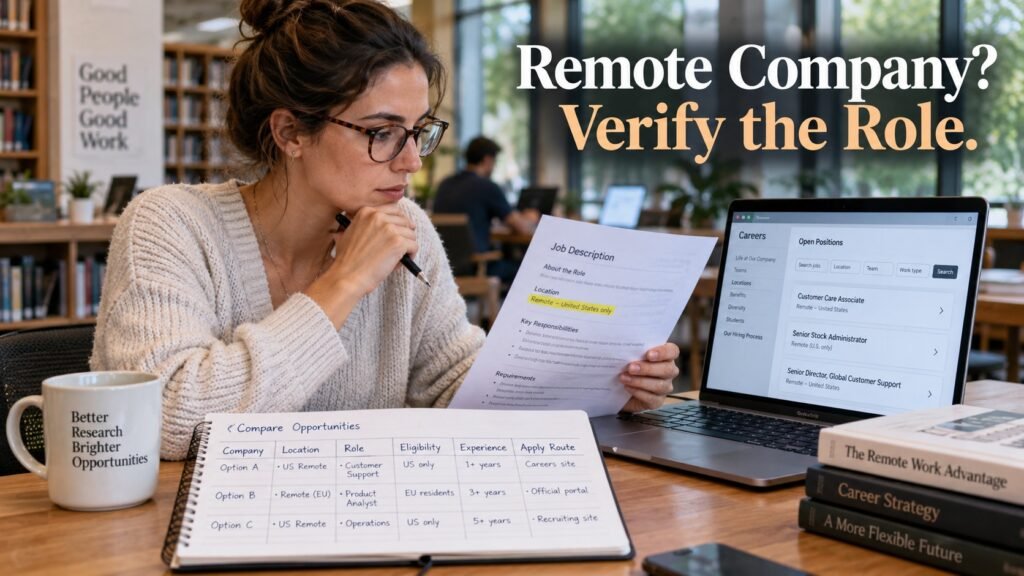
Yes, companies are hiring remote workers right now, but “remote company” and “company currently hiring for a remote role you can apply for” are not the same thing. The safest approach is to start with a current vacancy, confirm it on the employer’s official application system, and then check the location, experience, schedule and employment requirements before applying.
Last checked: September 9, 2026. Vacancies can close, change location or be replaced without notice. The employers below are current examples rather than a permanent ranking or promise of future hiring.
WorkinVirtual now connects company research with live remote-job information, including eligible locations, work arrangement, compensation when supplied, application routes and freshness signals. You can also browse current remote jobs instead of relying on a static employer list.
Companies with remote openings verified today
The following employers had current remote opportunities that could be verified through employer-controlled career or application systems when this guide was checked.
| Company | Verified remote example | Who can apply | Important qualification signal |
|---|---|---|---|
| Headway | Customer Care Associate | United States | Customer support, judgment, problem-solving and a suitable private remote workspace |
| Discord | Senior Stock Administrator | United States | Experienced stock-plan administration professional; the role requires substantial relevant experience |
| Prove | Senior Director, Global Customer Support | United States | Senior technical-support leadership experience in SaaS, cloud, fintech or related environments |
These three openings also demonstrate why a company name alone is not enough. One is a customer-care opportunity, another is a specialist finance and equity-administration role, and another is an executive-level technical-support position. All are remote, but they serve very different candidates.
1. Headway: current remote customer-care hiring
Headway currently lists a Customer Care Associate position through its official recruiting system. The opening is full time and remote, and the employer states that candidates can work across U.S. geographic locations.
The position involves assisting healthcare providers and patients, solving operational and technical questions, communicating through customer-service channels and handling challenging situations with good judgment.
Headway also makes an important application-security point on its careers page: applicants should use the company’s official careers route and be cautious of recruiters or websites impersonating the company.
Who should consider Headway?
- Customer-service and customer-experience professionals
- Candidates comfortable handling email, chat and phone support
- People who can demonstrate problem-solving rather than simply saying they have “good communication skills”
- U.S.-based applicants who meet the specific vacancy requirements
Verify before applying: Do not assume every Headway position is remote simply because this one is. Check the individual requisition, location and work arrangement.
2. Discord: remote does not mean worldwide
Discord currently has a Senior Stock Administrator opening that its official application page describes as available in the San Francisco Bay Area or remotely within the United States.
The employer discloses a U.S. base salary range of $132,000 to $148,500, plus equity and benefits. It also asks for at least five years of stock-plan administration experience, including experience with global equity plans and equity-administration systems.
This is a useful example of a common remote-job mistake: a candidate outside the United States may see “remote” and assume the opportunity is worldwide. The actual requisition makes the geographic boundary clear.
Who should consider the Discord role?
- Experienced equity or stock-plan administrators
- Professionals with public- and private-company equity experience
- Candidates familiar with equity grants, exercises, RSU releases and compliance processes
- Applicants legally able to work within the location rules stated by the employer
Verify before applying: Location requirements matter more than the remote label. Read the current employer posting immediately before submitting your application.
3. Prove: remote hiring also exists at senior leadership level
Prove currently lists a Senior Director, Global Customer Support role through its official recruiting system. The employer identifies the position as U.S. Remote.
This is not a general customer-service job. Prove is looking for an experienced leader who can oversee technical support teams, offshore operations, external partners, support performance and customer-experience systems.
The employer asks for extensive progressive experience in enterprise technical support, customer operations or customer success, together with significant leadership experience.
Who should consider Prove?
- Senior customer-support and support-operations leaders
- Professionals with SaaS, fintech, cloud API or comparable technical environments
- Leaders who have managed distributed or offshore support organizations
- Experienced candidates comfortable working across Product, Engineering, Revenue and Customer Success
Verify before applying: “Customer support” spans everything from frontline assistance to executive leadership. Match your actual level of responsibility to the vacancy rather than applying because the general function sounds familiar.
What these current openings tell remote job seekers
The most important lesson is not that Headway, Discord and Prove should be added to a permanent list of “best remote companies.” It is that current requisitions are more useful than historical employer reputations.
A company can be remote-friendly and still have:
- no suitable vacancy for you today;
- remote roles limited to one country;
- state-specific hiring restrictions;
- seniority requirements you do not meet;
- time-zone or schedule requirements;
- some remote teams and other office-based teams.
That is why WorkinVirtual separates employer discovery from individual-job eligibility.
How to tell whether a company is really hiring remotely
Use the following process whenever you encounter a company in a remote-work article, social-media post or job board.
- Find the current requisition. A company careers homepage is useful, but a live individual vacancy is stronger evidence.
- Confirm that the vacancy is still open. An old search result or copied job-board page may remain visible after recruitment closes.
- Read the location literally. “Remote – U.S.” is not worldwide remote. “Remote – Brazil” is not available throughout Latin America unless the employer says so.
- Check work authorization. Remote work does not automatically remove payroll, immigration or employment restrictions.
- Check time-zone and schedule requirements. Some employers permit geographic flexibility while requiring particular working hours.
- Check employment type. Employee, contractor, temporary and freelance arrangements can have very different terms.
- Confirm compensation at the source. Do not rely on salary estimates copied from another website.
- Apply through the verified route. Compare the application domain with the employer’s official careers information before sharing personal information.
Remote-friendly is not the same as currently hiring
This distinction matters enough to make explicit.
| Claim | What it actually tells you |
|---|---|
| Remote-friendly company | The employer has supported remote work in at least part of its organization. |
| Remote-first company | Distributed work may be central to the company’s operating model, but individual hiring restrictions can still apply. |
| Currently hiring remotely | A current employer-controlled vacancy explicitly permits remote work. |
| Currently hiring you | The live vacancy permits your location and you meet the relevant work-authorization and candidate requirements. |
The last category is the one that matters when deciding whether to spend time on an application.
Why old “companies hiring” lists become unreliable
A traditional remote-company article may contain dozens of legitimate employers while still giving poor application guidance.
The problem is freshness. Companies open and close requisitions continuously. Teams change hiring plans. A company that advertised five remote positions several months ago may have none today, while another employer may have opened a suitable position yesterday.
Rather than treating this page as a permanent promise that every company listed here will always be hiring, use it as a decision process:
company → current vacancy → location eligibility → requirements → verified application route.
Use live jobs instead of waiting for the next company roundup
WorkinVirtual’s current job system is designed to make those checks easier. Listings can surface information such as:
- eligible country or region;
- remote work arrangement;
- salary or compensation when disclosed;
- employment type;
- application method;
- employer or source information;
- freshness and information-quality signals.
Inventory changes as vacancies are published, reviewed or closed, so a live search is more useful than waiting for another monthly “companies hiring” article.
Browse current remote jobs on WorkinVirtual →
Before you apply to any remote company
Spend two minutes answering these questions:
- Is the vacancy still visible through the employer or its authorized application system?
- Does the employer explicitly allow my country or state?
- Do I meet the actual experience level?
- Can I work the required schedule or time zone?
- Is the compensation employer-disclosed or merely estimated elsewhere?
- Does the application route belong to the employer or its legitimate recruiting provider?
If any essential answer is unclear, investigate it before investing time in a long application.
The better company-search strategy
Do not build a watchlist simply because an employer appeared on a “top 50 remote companies” article.
Build it because the company recruits for work related to your skills, has location arrangements that can include you, and provides an official careers route you can monitor.
Then combine that watchlist with current vacancy searches. This gives you something much more useful than a giant collection of company names: a repeatable way to find remote opportunities you can actually pursue.
Hiring information checked September 9, 2026. Vacancies, compensation and eligibility conditions can change. Always review the current employer requisition immediately before applying.
Choose your next step
Keep your momentum with practical tools and verified remote-work opportunities.
Related guides for your next step
A fresh, topic-aware mix from the WorkinVirtual library. Suggestions rotate regularly.






Discuss this guide
Ask a useful question, share relevant experience, or add a practical correction. Helpful contributions publish immediately after automated safety checks.
Start a thoughtful discussion
Be the first member to add a question or practical insight about this topic.
Join the discussion
Sign in with your verified WorkinVirtual account to contribute. Automated safety checks keep posting quick and protect the community.
Sign in to contribute