


Imagine a candidate whose skills and experience appear almost perfectly aligned with a remote vacancy. There is one problem: the employer hires only within a particular country, and the candidate lives elsewhere. Should that really count as a strong match?
It might be a strong skills match. It is not yet a viable opportunity. That distinction is central to WorkinVirtual’s direction for structured remote hiring: establish whether an opportunity can work before deciding how relevant it looks.
Relevance and eligibility are not the same thing. A résumé can resemble a job description while location, work authorization, working hours or employment arrangements make the opportunity impractical.
What Does Job Matching Actually Mean?
Job matching means comparing a candidate’s circumstances, qualifications, skills and preferences with an employer’s job requirements to determine whether an opportunity is viable and relevant.
Effective remote job matching should evaluate compatibility in layers:
Each layer answers a different question. A high relevance score should not conceal a clear eligibility conflict. Equally, an unanswered question should remain unresolved, rather than silently becoming either approval or rejection.
Eligibility Opens the Door. Fit Explains the Opportunity.
Job eligibility concerns the conditions that make accepting a role possible. Job fit concerns how well an eligible opportunity aligns with someone’s abilities, background and goals.
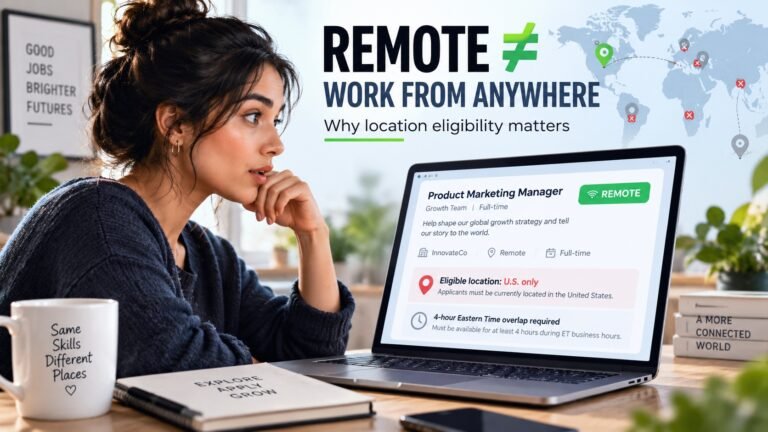
Remote-job eligibility can involve permitted locations, work authorization, required schedules, time-zone overlap, employment arrangements and travel obligations. Living in a particular country does not, by itself, establish work authorization.
As WorkinVirtual explains in why “remote” does not automatically mean work from anywhere, the label describes only part of the arrangement. It cannot establish who can accept the role.
A candidate profile and a job listing both need enough structured information for meaningful candidate-job fit assessment. Otherwise, the system is comparing incomplete pictures.
Hard Constraints and Soft Signals Need Different Treatment
A hard constraint is a genuine, non-negotiable requirement. An explicitly mandatory hiring location or a professional license required for the work may determine whether the opportunity is viable.
A soft signal helps assess relative suitability. Preferred industry experience, familiarity with a particular tool or a desirable specialization may improve ranking without making everyone else unsuitable.
Consider an experienced support specialist who meets the location and schedule requirements but has used a different help-desk system. If the advertised software is preferred, that difference deserves context. It should not automatically end consideration.
Employer wording matters. “Required,” “preferred” and “willing to train” should not become interchangeable inputs. Unclear requirements call for clarification; missing candidate information is not proof of incompatibility.
Why Job Recommendations Can Look Right and Still Be Wrong
Job recommendations can be irrelevant when a system overweights textual similarity, lacks eligibility information or confuses preferences with requirements.
Matching titles can hide different responsibilities. “Account manager” might describe customer retention in one company and sales acquisition in another. Different titles can also conceal closely transferable work.
Résumé keywords offer clues, but repeated terminology does not establish capability. Nor does it confirm that someone can work the required hours, accept the employment arrangement or undertake mandatory travel.
Modern job platforms use varied methods; this is not a claim that they rely only on keywords. The weakness arises whenever titles, skills matching or AI-generated relevance scores outweigh practical compatibility.
A Better Remote-Job Match Asks These Questions in Order
- Can I actually take this job? Check location, authorization, schedule and employment arrangement, including any mandatory travel.
- Do I meet the essential requirements? Look for genuine must-have skills, experience, certifications or other prerequisites.
- How relevant is the role to my background? Consider occupation, industry, seniority and transferable skills, beyond title similarity.
- Does it fit what I want? Compare compensation, schedule, employment type and career direction with your preferences.
- Only then: how highly should it rank? Give greater prominence to viable opportunities with meaningful professional and practical alignment.
WorkinVirtual’s Direction: Structure on Both Sides
WorkinVirtual’s platform architecture is designed around more structured candidate and job information, rather than treating every résumé and vacancy as undifferentiated blocks of text.
Relevant signals can include candidate location, job location eligibility, experience, skills, work arrangement, time-zone availability, employment type, compensation, travel requirements and candidate preferences.
The platform model connects structured hiring data with candidate/job compatibility. These are architectural principles, not a claim that every matching stage is already automated or live.
This also builds on What Should a Reusable Remote-Work Profile Actually Contain? WorkinVirtual’s Remote Work Passport direction centers on reusable candidate information. That information becomes more useful when job requirements are structured too: both sides can describe the conditions under which an opportunity could work.
Where AI Helps—and Where Human Judgment Remains
AI can help organize information, identify potential compatibility, detect apparent mismatches, summarize qualifications and rank large sets of opportunities. AI job matching is most useful when its suggestions can be checked against clear requirements and supporting information.
Matching is decision support, not the hiring decision itself. AI should assist the process; final hiring decisions should remain human-led. Candidates also retain the judgment about whether an opportunity deserves their time.
Better Matching Means Fewer Wasted Applications
The goal should not simply be the largest possible set of vacancies. Good candidate matching should reduce noise for job seekers and obviously incompatible applications for employers.
A good match is not simply a job that looks similar to someone’s résumé. It is an opportunity they can realistically take, are sufficiently qualified for and have a meaningful reason to consider.
Better information does not replace human hiring decisions. It helps candidates and employers reach those decisions with less unnecessary friction.
Explore current opportunities on WorkinVirtual Remote Jobs. Review the available eligibility, work-arrangement and role information before investing time in an application.
Choose your next step
Keep your momentum with practical tools and verified remote-work opportunities.
Related guides for your next step
A fresh, topic-aware mix from the WorkinVirtual library. Suggestions rotate regularly.





Discuss this guide
Ask a useful question, share relevant experience, or add a practical correction. Helpful contributions publish immediately after automated safety checks.
Start a thoughtful discussion
Be the first member to add a question or practical insight about this topic.
Join the discussion
Sign in with your verified WorkinVirtual account to contribute. Automated safety checks keep posting quick and protect the community.
Sign in to contribute