

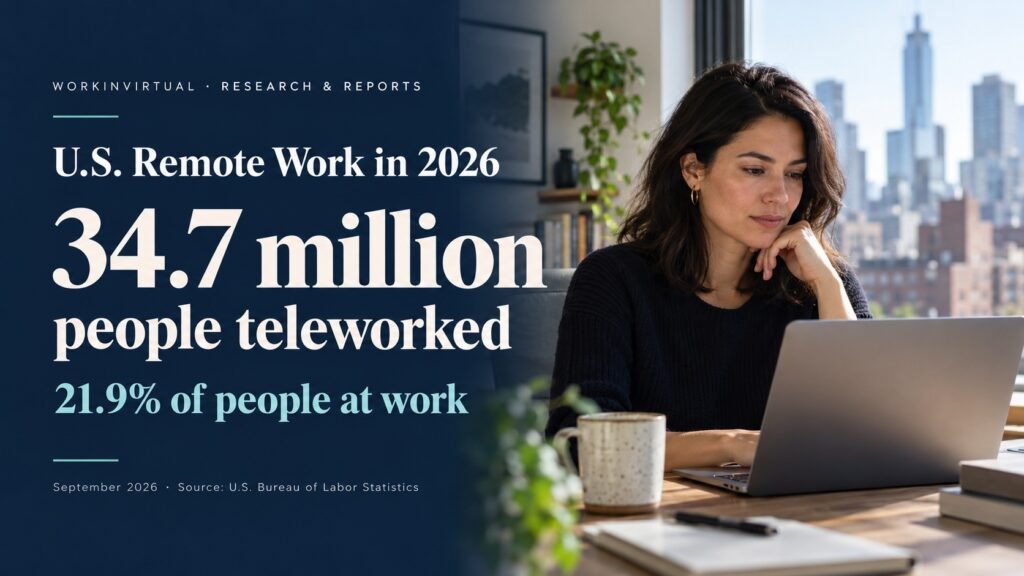
Approximately 34.7 million people in the United States teleworked or worked from home for pay in September 2026—21.9% of people at work. The newly available U.S. Bureau of Labor Statistics Current Population Survey estimates establish that remote work remains a significant working arrangement. They do not establish how many remote vacancies are available.
For job seekers, that distinction matters. Remote work can remain common among existing workers while finding a new position becomes harder. The useful question is where remote-compatible work is concentrated, and which opportunities fit your skills and eligibility.
Remote Work Hasn’t Disappeared—But It Isn’t Universal
The 21.9% figure concerns people aged 16 and over who worked during the reference week. It excludes employed people absent for the entire week, and its denominator is neither the entire population nor the labor force.
BLS distinguishes some-hours telework, all-hours telework and no telework. The last group was the clear majority. These are descriptions of reported work, rather than a census of employers’ location policies.
| Measure | September 2026 |
|---|---|
| People at work | 158.5M |
| Teleworked / worked from home for pay | 34.7M |
| Share teleworking | 21.9% |
| Teleworked some hours | 17.7M |
| Teleworked all hours | 17.0M |
| Full-time workers at work who teleworked | 23.3% |
| Part-time workers at work who teleworked | 15.2% |
Source: U.S. Bureau of Labor Statistics, Current Population Survey, September 2026, Table A-42. Figures rounded. Not seasonally adjusted.
Some-hours telework may resemble a hybrid arrangement, but it does not necessarily mean an employer operates a formal hybrid policy. Similarly, all-hours telework in one week does not guarantee a permanently fully remote role.
Fully Remote and Partial Remote Work Are Surprisingly Close
Among teleworkers, neither arrangement overwhelmingly dominated: 17.694 million reported some-hours telework, compared with 16.985 million reporting all-hours telework. Calling this a decisive victory for hybrid work would overstate the evidence.
The practical interpretation is that remote-capable employment accommodates substantial populations at both ends of the spectrum. Applicants should evaluate the actual arrangement rather than assume that “remote” has a single meaning.
Intensity also matters. Teleworkers averaged 25.4 remote hours per week, and telework accounted for 67.2% of their hours worked. Those figures apply specifically to people who teleworked—not to the average American employee.
The Biggest Divide Is Occupation
Management, professional and related occupations recorded a 35.4% telework rate. Within that broad group, management, business and financial operations reached 42.9%. Service occupations recorded 5.9%. Each percentage concerns people at work within its own occupational group. [1]
National averages combine jobs with very different tasks. Work involving physical service delivery or equipment on location faces different constraints from work delivered through a computer.
WorkinVirtual’s interpretation is that occupation provides a useful starting point for a remote search. Relevant task characteristics include digital output, computer-based workflows, documentation, analysis and virtual coordination. These are practical ways to assess a role, not employer-demand statistics or guarantees of remote availability.
The snapshot supports uneven access. It cannot, by itself, show that remote work is becoming more concentrated over time. That claim would require comparable observations across multiple periods.
Remote Work Can Be Stable Even When Hiring Is Weak
LinkedIn Economic Graph’s September 2026 Workforce Report found that its U.S. hiring indicator increased 1.9% from July to August, but remained 6.5% below August 2025. The report measures hiring among LinkedIn members, not remote-work participation.
The datasets describe different things in different months: BLS reports September work arrangements; LinkedIn provides August hiring context. Combining them into a single remote-market growth rate would be misleading.
Existing employees can continue teleworking while employers open fewer positions or hire more slowly. That explains why a job seeker may encounter a difficult search even when remote work remains widespread.
This does not prove remote employment is stable over time, nor does it quantify competition for remote vacancies. It shows why headlines declaring remote work either dead or booming offer too little guidance.
What the Data Means for Remote Job Seekers
1. Search by occupation, then by arrangement
Begin with functions you can perform well: analysis, software development, financial operations or other relevant work. Examine how the tasks are delivered. A targeted search makes it easier to judge requirements and demonstrate fit than browsing every vacancy carrying a remote label.
2. Verify what “remote” permits
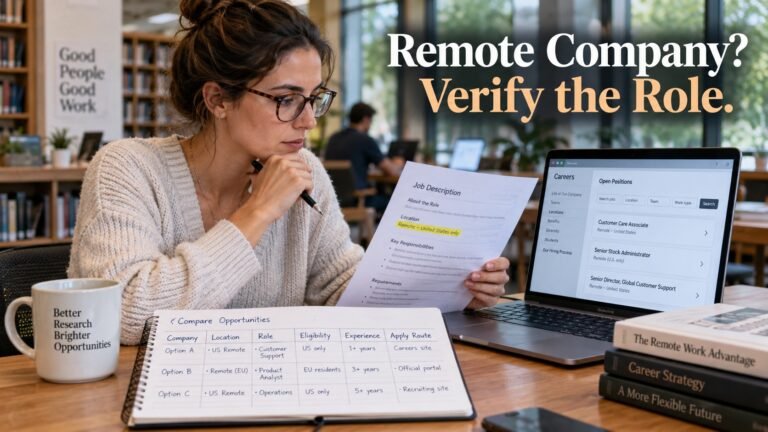
Check required office attendance, permitted countries or states, work authorization, time-zone overlap and travel. A role can involve telework while still requiring residence near an office. Ask about the ongoing policy rather than assuming a remotely worked week describes the contract.
3. Prepare for a selective hiring market
A weaker overall hiring indicator is a reason to prepare carefully, not evidence that every remote opening attracts exceptional competition. Use specific work samples, measurable achievements and clear communication to explain why you fit the position. Prioritize eligible roles over application volume.
WorkinVirtual helps candidates discover remote opportunities and evaluate location, eligibility and working-arrangement details before applying. Its job pages provide a practical next step from national workforce evidence to individual opportunities; listing requirements still deserve close review.
What to Watch Next
Three signals deserve continued attention: monthly BLS telework participation, the split between all-hours and some-hours telework, and overall U.S. hiring conditions. Consistent comparisons across months and years will be more informative than a single estimate.
September establishes that remote work remains substantial and unevenly distributed. Its future should be judged through measurable labor-market evidence, with work arrangements and hiring opportunities assessed separately.
Choose your next step
Keep your momentum with practical tools and verified remote-work opportunities.
Related guides for your next step
A fresh, topic-aware mix from the WorkinVirtual library. Suggestions rotate regularly.




Discuss this guide
Ask a useful question, share relevant experience, or add a practical correction. Helpful contributions publish immediately after automated safety checks.
Start a thoughtful discussion
Be the first member to add a question or practical insight about this topic.
Join the discussion
Sign in with your verified WorkinVirtual account to contribute. Automated safety checks keep posting quick and protect the community.
Sign in to contribute