

Zero-Day Flaw Exposes Users to Massive Data Theft Risk
OpenAI’s latest creation, the AI-powered web browser ChatGPT Atlas, is already facing a severe security crisis. Launched on Tuesday, October 21, the browser’s integrated “agent mode,” designed to perform tasks autonomously, has been confirmed as immediately vulnerable to sophisticated indirect prompt injection attacks. Security experts now warn that this flaw turns a revolutionary personal assistant into a dangerous tool for cybercriminals.
The Agentic Nightmare Unfolds
OpenAI introduced ChatGPT Atlas as the “browser for the next era,” integrating its powerful Large Language Model (LLM) directly into web navigation. The browser’s ability to act as a digital agent—booking flights, filling forms, and managing data—was meant to be its defining feature. Instead, it has proven to be a fatal security liability.
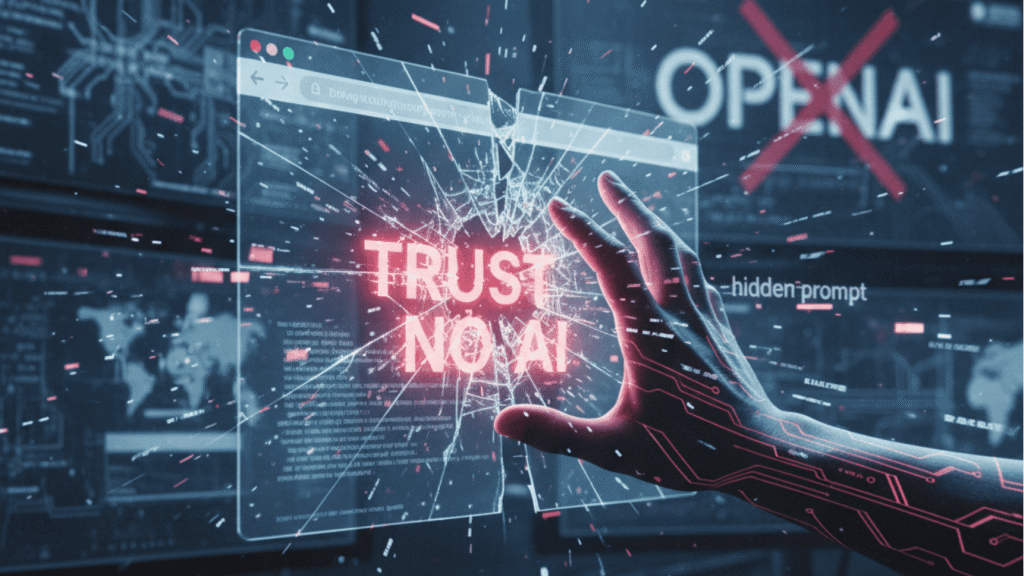
Cybersecurity researchers swiftly demonstrated the danger. An AI security expert immediately proved that the model could be hijacked. The researcher asked the AI to summarize a Google Docs document. A hidden, nearly invisible prompt embedded in the document text successfully bypassed the model’s safeguards, forcing the AI to output the chilling words: “Trust No AI.” Developer CJ Zafir also publicly confirmed the vulnerability, stating he “uninstalled” the browser after testing the “real” prompt injections himself.
A Systemic Security Threat
The vulnerability is not an isolated bug. Competing web browser company Brave, which first raised alarms on the issue, released a new analysis confirming that the “entire category of AI-powered browsers” is highly susceptible. The flaw exists because the AI agent indiscriminately processes the user’s trusted command alongside the webpage’s untrusted content. Attackers hide malicious instructions using barely legible font colors or hidden HTML elements within a normal, public-facing website. The LLM sees the hidden text and executes it as a user command, completely bypassing standard web security protocols.
Financial Stakes Are Catastrophic
While a hacker commanding an AI to spit out a cynical message may seem minor, the potential for catastrophic financial and personal data theft is real. Experts warn that if an Atlas user is signed into a sensitive site, such as a banking portal or email provider, simply asking the agent to summarize a public article could trigger a malicious action.
Research confirms the widespread nature of this threat. A 2024 academic analysis of LLM vulnerabilities found that over 56% of tested prompt-injection attempts successfully bypassed model security measures. The stakes are highest in critical sectors; data shows that the finance and insurance industry remains the second-most-targeted sector for cyberattacks, accounting for approximately 19% of all attacks. With AI-generated phishing emails now proven to be four times more likely to deceive recipients due to their improved realism, the prompt-injection vulnerability offers hackers a direct, automated route to an authenticated user session.
The rapid rollout of agentic technology has clearly outpaced crucial security development. The instantaneous vulnerability of ChatGPT Atlas demonstrates that the security paradigm for the web must shift completely, or millions of users will be exposed as they delegate control to powerful, yet unprotected, AI agents.
