

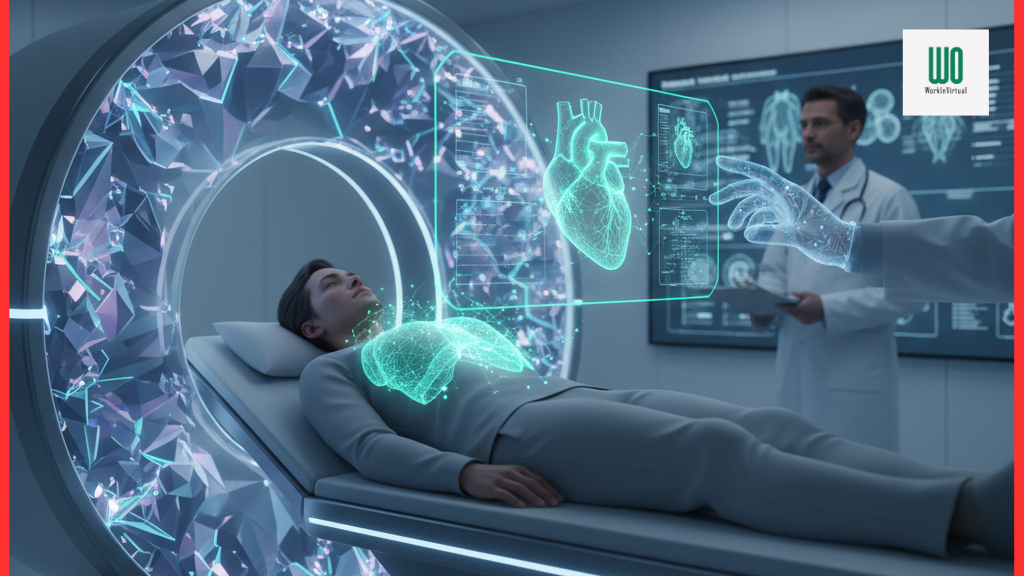
A silent revolution is underway in medical diagnostics. Imagine doctors can see inside the human body with unparalleled clarity, revealing hidden diseases with stunning detail. This isn’t science fiction, but a new reality powered by a groundbreaking crystal technology that promises to transform nuclear medicine. Researchers have developed a novel gamma-ray detector by using a unique family of crystals called perovskites. The implications for patient care are immense.
The Blurry Truth: Why Today’s Scans Fall Short
For decades, physicians have relied on nuclear medicine to peer into our most vital organs. By introducing a minuscule, harmless radiotracer into the body, they can track its journey as it emits gamma rays. These rays, like tiny bursts of light, are captured by external scanners to create 3D images of a patient’s heart, brain, or other organs. It’s a powerful tool, but the current technology is far from perfect.
The detectors currently in use, made from materials like cadmium zinc telluride (CZT) or sodium iodide (NaI), have significant drawbacks. CZT detectors deliver high-quality images but are astonishingly expensive, often costing millions of dollars for a single camera. They are also incredibly fragile, making them difficult and costly to manufacture. On the other hand, NaI detectors are more affordable but produce images that are hazy and imprecise. It’s like trying to diagnose a complex issue by looking through a foggy window. This dilemma has meant that advanced diagnostic capabilities are often limited to large medical centers that can afford the hefty price tag.
The Crystal Breakthrough: A New Way to See
Enter the perovskite crystals. These remarkable compounds, first heralded for their potential in solar energy, are now poised to reshape the world of medical imaging. A collaborative team of scientists, led by experts from Northwestern University and Soochow University, has successfully created the first perovskite-based detector capable of capturing individual gamma rays with unprecedented precision.
The key to this breakthrough lies in the unique properties of perovskites. Unlike their brittle counterparts, these crystals can be grown and shaped into highly stable, pixelated sensors. This allows for a detector that is not only robust but also provides record-breaking clarity. In trials, the new detector could distinguish between faint medical signals and separate minuscule radioactive sources just a few millimeters apart, producing sharp images. This level of detail has never been seen before with such a stable and cost-effective material.
A Brighter Future for Patients Everywhere
This technological leap holds the promise of significant benefits for patients and healthcare providers. For patients, the potential is game-changing. The increased sensitivity of the new perovskite detectors means that scan times could be dramatically shortened, reducing the time patients need to spend in a scanner. Furthermore, the enhanced efficiency of the detectors may allow for lower radiation doses, making the procedure even safer.
The real power of this innovation lies in its potential to democratize access to advanced medical imaging. Because perovskites are easier to produce and less expensive than traditional materials, the new detectors could significantly reduce the cost of high-quality nuclear medicine cameras. This means that top-tier diagnostic tools could become available to smaller hospitals and clinics, bringing state-of-the-art care to a wider range of communities. Ultimately, this technology could mean better, faster, and more accessible scans for people worldwide, leading to earlier diagnoses and improved health outcomes.