

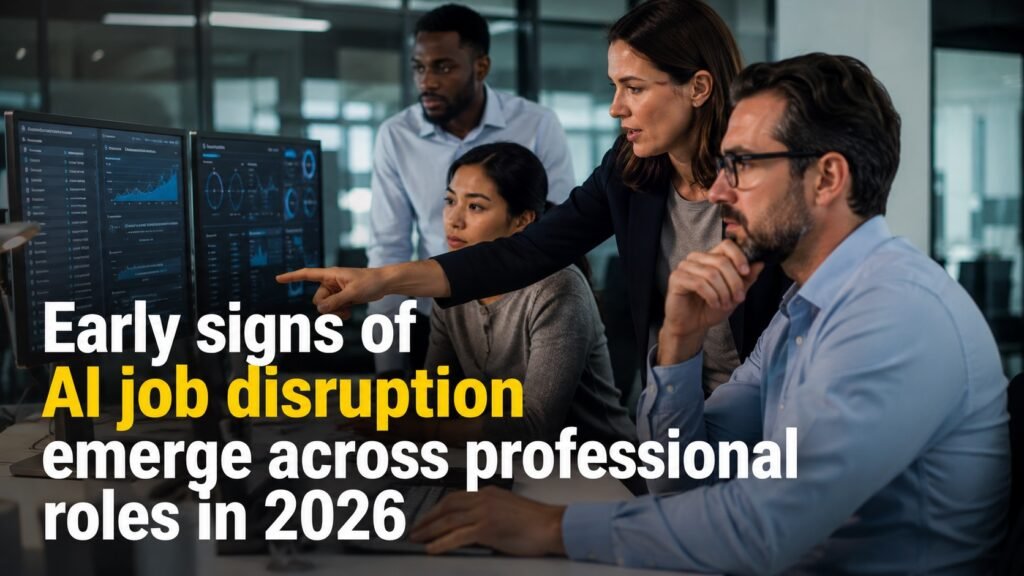
AI exposure statistics do not equal job-loss forecasts. The strongest evidence separates tasks a system may perform from employers’ adoption, changes in hours or postings, worker transitions and net employment. Current research indicates substantial potential transformation—especially in clerical and digital tasks—but outcomes depend on deployment, demand, skills, policy and job redesign.
Use an evidence-quality ladder
At the first level are capability demonstrations: a model performs a task in a controlled setting. Next are task-exposure models that estimate how much work could be affected. Adoption evidence asks whether organizations actually use the technology. Labor-demand evidence tracks vacancies, hours, wages or task requirements. Employment evidence measures entry, exits, unemployment and transitions. Net impact also includes jobs and tasks created elsewhere.
Each level answers a different question. The ILO’s 2025 update measures potential occupational exposure and emphasizes transformation rather than treating exposure as an automatic redundancy count. The ILO–NASK summary explicitly warns that potential exposure is not actual job loss. OECD and national statistical evidence provide broader labor context, but estimates, periods and geographies must not be mixed casually.
Which work is more exposed?
Generative systems are strongest at some language, information-processing and digital-content tasks. Clerical occupations often contain a high share of such tasks. Professional roles may contain exposed components while still requiring judgment, accountability, relationship work, physical context or regulated decisions. An occupation is a bundle of tasks, not one prompt.
Risk also depends on whether work is standardized, data is available, error is tolerable, deployment is affordable, and law or customers permit automation. A technically feasible task can remain human-led because verification costs or consequences are high. Conversely, a low-visibility administrative task may change quickly when it is easy to integrate into an existing workflow.
How workers should assess change
List the ten tasks that occupy most of your time. Mark each as routine or variable, low- or high-consequence, independent or relationship-dependent, and easy or hard to verify. Then ask whether AI is likely to automate the task, accelerate it, create more review work or leave it largely unchanged.
Choose one response for each high-priority task: deepen domain judgment, learn responsible tool use, improve quality assurance, move closer to customers or decisions, or build an adjacent skill. Do not chase every AI course. Produce a work sample that shows problem framing, source checking, privacy awareness, error detection and a useful outcome.
What employers should measure
Track adoption and labor effects separately. Record which workflow changed, human review time, error and rework, service outcomes, workload distribution and training. Audit for discrimination, privacy, security and accessibility. Give workers a meaningful route to challenge automated outputs. A productivity claim without quality and harm measures is incomplete.
When changing a role, describe tasks and decision rights honestly. Do not advertise an entry-level position while expecting one person to supervise an automated workload formerly handled by a team. Report layoffs or hiring changes with dates and company context instead of presenting them as proof of a national causal effect.
How to apply and assess changing roles
Read current postings for changing task language rather than only titles. Show evidence of domain knowledge, verification and responsible technology use. Tailor the resume to requirements you actually meet and prepare interview examples about catching an error, improving a process and learning a tool safely. Ask how AI changes the role, who reviews outputs, what data may be used and how success is measured.
Verify vacancies on official employer sites. AI-themed fake jobs and “training-to-hire” schemes can exploit urgency. Never pay for a job or equipment release, and never provide gift cards, cryptocurrency, bank credentials or remote-control access.
Stale-claim cleanup
Delete any unsupported “early signs” causal claim, fixed 2026 forecast and sensational “jobs apocalypse” language. Do not convert percentages of exposed work into workers displaced. Label geography, occupation coverage, method and date beside every statistic. Replace anecdotal CEO quotations with measured evidence or clearly label them as company-specific statements.
Frequently asked questions
What percentage of jobs will AI eliminate?
No single defensible percentage applies across countries, time periods and deployment choices. Exposure estimates measure potential task change, not guaranteed elimination.
Are office jobs at greater risk?
Many clerical and information-processing tasks are highly exposed, but occupation outcomes depend on task mix, adoption, review and demand.
Should I learn AI tools?
Learn tools relevant to verified work needs, along with domain judgment, source validation, privacy and error checking. A generic certificate is not proof of value.
How often should this article be updated?
Review it when major primary datasets or methods change, and display the evidence period rather than manufacturing freshness.
Choose your next step
Keep your momentum with practical tools and verified remote-work opportunities.
Related guides for your next step
A fresh, topic-aware mix from the WorkinVirtual library. Suggestions rotate regularly.




Discuss this guide
Ask a useful question, share relevant experience, or add a practical correction. Helpful contributions publish immediately after automated safety checks.
Start a thoughtful discussion
Be the first member to add a question or practical insight about this topic.
Join the discussion
Sign in with your verified WorkinVirtual account to contribute. Automated safety checks keep posting quick and protect the community.
Sign in to contribute