


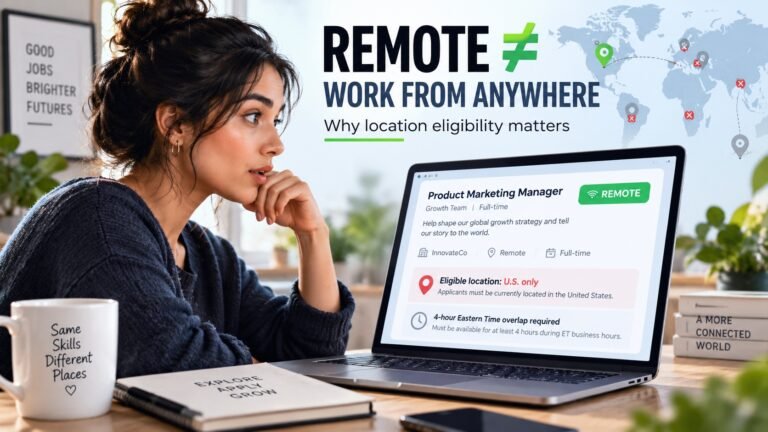
A remote job is not automatically a work-from-anywhere job. Employers may restrict location because the place where work is performed can affect payroll and tax, social security, employment rights, immigration, insurance, data access, security, time-zone coverage and customer contracts. Get written approval before moving or working across a state or national border, and use qualified tax, immigration and employment advice for the jurisdictions involved.
This article must display a visible last verified date. Durable guidance must be separated from volatile facts such as a vacancy, deadline, location, work model, contract, eligibility, compensation, benefits or application method. Every volatile field must be checked against its exact official source on publication day. WorkinVirtual is independent and does not receive applications, represent the named employer or guarantee an outcome.
Decision and retained evidence
Before any release decision, export at least 16 months of GSC page/query data and page-level GA4 landing-page, engagement, official-source-click, tool-start, conversion and assisted-journey data. Audit backlinks, referring domains, internal links, citations and saves. Content gap: The 436-word legacy page frames location controls as a global lockdown. It lacks worker-status, payroll, permanent-establishment, social-security, immigration, insurance, security, data and policy distinctions, and could encourage unauthorized work.
The Phase 1 disposition is rebuild. It remains an editorial proposal. Analytics, backlink evidence, current official sources, legal or specialist review, destination completeness and owner approval may change it.
What readers need to know
The IRS explains that remote location does not by itself turn an employee into an independent contractor and points to additional rules for U.S. citizens or resident aliens employed abroad. OECD material explains that cross-border remote work can raise a business taxable-presence or permanent-establishment question under applicable treaties. EU and European Labour Authority guidance shows that social-security coverage can depend on where work is performed, residence and the proportion of activity, with special cross-border telework frameworks in some cases. These examples demonstrate complexity, not a universal rule. A safe request names the proposed location, dates, employee or contractor status, citizenship and work authorization, tax residence, job duties, customer/data restrictions, equipment, time zone, insurance and emergency contact; only the employer and qualified advisers should decide.
Relevant roles or stakeholders include remote employee, contractor, manager, HR partner, payroll specialist, tax adviser, immigration counsel, employment counsel, security team and data-protection officer. These are navigation and planning examples, not evidence of current openings or legal requirements. The exact official notice, policy or regulator controls. Avoid “latest,” “best,” “high-paying,” “lucrative,” “guaranteed” and “now hiring” unless the wording is narrowly sourced and time-bounded.
Application steps
- Read the employer’s remote-work, travel, security, equipment and data policies before booking or moving.
- Write the exact proposed country or state, address type, start/end dates, work pattern, duties, customer access and time zone.
- Confirm employment or contractor status; do not change labels to avoid obligations.
- Ask HR/payroll, tax, immigration, legal, security and insurance owners to review the relevant jurisdictions and duration.
- Document approved equipment, networks, data restrictions, working hours, emergency contacts and return conditions.
- Obtain written approval before performing work, and carry any required authorization or certificates.
- Recheck when dates, location, duties, clients or immigration status change; do not rely on a colleague’s approval in another case.
For applications, always use the verified official route and exact requisition. For operational guidance, document owners, definitions, denominators, review cadence and escalation. Never substitute a scraped form, paid access, opaque scoring or surveillance for a legitimate decision process.
Skills and evidence
Priority evidence includes policy reading, jurisdiction mapping, worker-status verification, payroll coordination, immigration and tax escalation, data classification, time-zone planning and written approval. Present evidence as requirement → context → action → measurable result → proof, clearly separating personal contribution from team outcomes. Use synthetic, public or explicitly permitted portfolio examples. Do not invent credentials, employment, salary, license, clearance, language fluency, results or selection probability. Never expose customer, patient, employee, source-code, security or commercially confidential data.
Engagement design
Provide a work-location request template with jurisdiction, dates, duties, data, time zone and approval owners. It should not calculate tax, immigration eligibility or permanent-establishment risk and should store entries locally.
Useful next actions may include opening an official source, completing a checklist, saving a role, tailoring a resume, practicing an interview, comparing a metric definition or recording a review action. Instrument only after consent and analytics governance. Do not use fake countdowns, auto-refreshing vacancy counts, forced registration, dark patterns or a quiz that predicts hiring or business success.
Verification, privacy and safety
This is general information, not tax, immigration, employment or legal advice. Never advise visa misuse, false residence, worker misclassification or hiding location from an employer. Minimize address and travel data and do not upload documents to WorkinVirtual.
For employment content, match the recruiter domain, requisition, legal entity and final application destination. Reject fees, cryptocurrency, fake checks and messaging-only recruitment. The FTC job-scam guide at https://consumer.ftc.gov/articles/job-scams supplies general warning signs, but the current employer route controls. For business guidance, minimize personal data, restrict access, document retention and use aggregate reporting where possible.
WorkinVirtual must show author and reviewer ownership, an independent-site disclosure, a correction path and a dated maintenance record. When a current official source conflicts with this draft or a third-party page, the current official source controls. High-risk legal, employment, privacy, security or health claims need a qualified reviewer.
FAQ
Does remote mean I can work from any country?
No. The employer’s approved geography and applicable law control.
Why does my employer care where I work?
Location may affect payroll, tax, social security, employment rights, immigration, insurance, data, security and customer obligations.
Can I work abroad on a tourist visa?
Do not assume so. Obtain qualified immigration advice and written employer approval for the exact jurisdiction and activity.
Does becoming a contractor solve the issue?
No. Worker status depends on facts and law, not a label, and contractors also have tax, immigration and client obligations.
What should an approval request include?
Exact location and dates, status, duties, data, equipment, time zone, customer restrictions and the required reviewers.
Official and primary sources
- IRS — Independent contractor or employee — https://www.irs.gov/businesses/small-businesses-self-employed/independent-contractor-self-employed-or-employee
- OECD — Cross-border remote work and taxable presence — https://www.oecd.org/en/blogs/2026/06/home-and-away-when-does-working-remotely-across-borders-create-a-taxable-presence.html
- EU — Social security cover abroad — https://europa.eu/youreurope/citizens/work/social-security-and-benefits/country-coverage/index_en.htm
- European Commission — Which social security rules apply — https://employment-social-affairs.ec.europa.eu/policies-and-activities/moving-working-europe/eu-social-security-coordination/which-rules-apply-you_en
- European Labour Authority — Cross-border telework — https://eures.europa.eu/whats-latest-cross-border-telework-and-social-security-2023-11-13_en
These sources establish the entity, current verification route, measurement model or regulatory context. They do not by themselves prove a legacy vacancy remains open or a tactic guarantees results. Reopen and date-stamp evidence on release day; remove any claim a source no longer supports.
Choose your next step
Keep your momentum with practical tools and verified remote-work opportunities.
Related guides for your next step
A fresh, topic-aware mix from the WorkinVirtual library. Suggestions rotate regularly.



Discuss this guide
Ask a useful question, share relevant experience, or add a practical correction. Helpful contributions publish immediately after automated safety checks.
Start a thoughtful discussion
Be the first member to add a question or practical insight about this topic.
Join the discussion
Sign in with your verified WorkinVirtual account to contribute. Automated safety checks keep posting quick and protect the community.
Sign in to contribute