

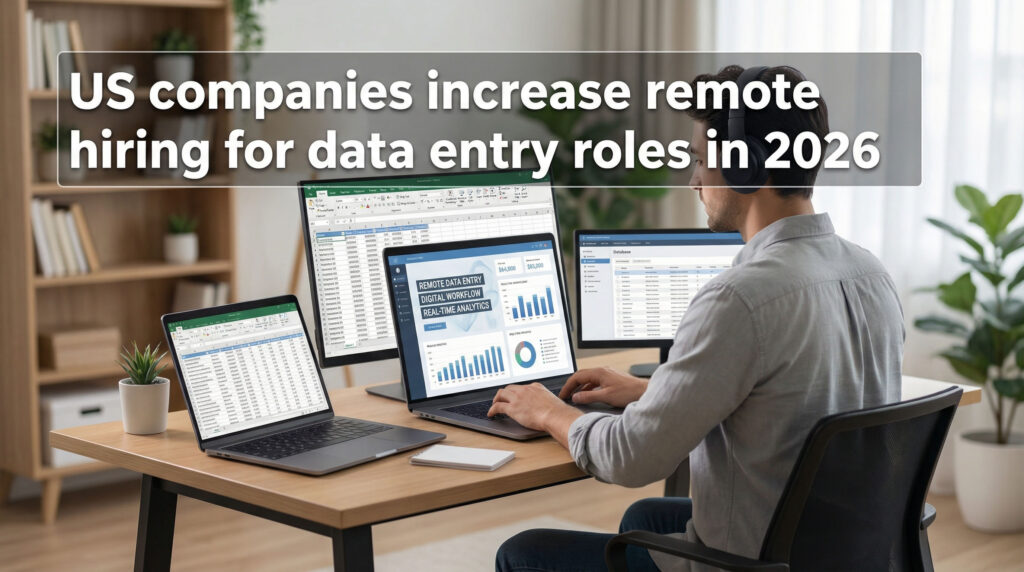
Legitimate remote data-entry work usually appears inside a broader records, order-processing, claims, billing, catalog, research or operations role. It requires accuracy, validation, confidentiality and documented workflows—not effortless money for typing. Search specific duty-based titles, verify the employer and job ID, ask how quality and productivity are measured, and never pay a fee or deposit an equipment check. Treat vague messages offering unusually high pay for simple tasks as a serious warning.
Show a visible last verified date. Separate durable guidance from volatile vacancy status, employer, job ID, location, work mode, schedule, pay, benefits and deadline. Reopen each volatile field on its exact official source on publication day. WorkinVirtual is an independent information service; it does not receive applications, represent an employer or guarantee employment, pay, legal status, ranking or career results.
Decision and retained evidence
Before release, obtain at least 16 months of GSC page/query data and page-level GA4 reporting. Audit backlinks, referring domains, internal links, citations and saves. Content gap: The legacy page presents growing data-entry hiring without evidence and does not distinguish legitimate records work from task scams, explain quality metrics, privacy, equipment, pay basis or realistic progression.
The evidence-backed proposal is rebuild, preserving owner 102626. Analytics, current official evidence, specialist review and owner approval may still change it.
What readers need to know
BLS describes general office and information clerks as collecting information, entering data, preparing documents and maintaining records; duties often extend beyond keystrokes.
Information clerks may handle confidential records and need integrity, organization and computer skills.
FTC guidance warns that scammers advertise remote data-entry or simple-task work, demand money, use fake checks or seek personal and financial information.
Quality measures must define error types, sample size, denominator, review process and correction rights; speed without accuracy can damage records and people.
Relevant roles or stakeholders include records clerk, order-processing clerk, claims or billing support specialist, catalog or content operations associate, data quality assistant, administrative operations clerk. These examples support navigation; they do not prove a vacancy, credential or legal authority. The exact employer notice, government source, licensing authority and jurisdiction control. Avoid latest, best, guaranteed, high-paying and now hiring unless narrowly sourced and date-bounded.
Application and decision steps
- Search for duty-based titles on verified employer sites rather than responding to unsolicited generic data-entry messages.
- Match the employer, legal entity, job ID, location, schedule, pay basis and application URL independently.
- Ask what records are handled, how access is controlled, how accuracy and productivity are measured and how errors are corrected.
- Build a synthetic work sample that includes source data, validation rules, exception log, quality summary and secure disposal note.
- Calculate pay carefully for hourly, per-item or contract terms and include unpaid setup, review and equipment costs.
- Protect identity and financial information until a legitimate interview, written offer and secure onboarding stage.
- Reject fees, reshipping, ratings tasks, crypto, gift cards and any check sent to buy equipment; report suspected fraud.
Start each application from the verified official domain. Record the legal entity, job ID, final destination, work location, schedule and evidence date. Do not rely on a copied form, paid-access page, recruiter message or stale aggregator when the official source differs. Recheck the posting before every interview.
Skills and evidence
Priority evidence includes accurate keyboard and spreadsheet work, validation and duplicate detection, document naming and version control, privacy and secure handling, productivity and quality documentation, clear escalation of ambiguous records. Present claims as requirement → context → action → measurable result → proof, defining the metric, denominator, time period and personal versus team contribution. Use public, synthetic or explicitly permitted material. Never invent employment, credentials, licenses, clearance, pay, results or selection probability, and never expose customer, patient, employee, source-code, legal, security or commercial secrets.
A strong portfolio states the problem, inputs, constraints, alternatives, decision, test, outcome, limitations and what changed. A weak portfolio is a tool list, unexplained percentage, employer screenshot or artifact the reviewer cannot safely inspect.
Engagement design
Add a job-verification card, data-quality checklist and pay-unit calculator with explicit assumptions. The calculator must not recommend sending sensitive records or promise earnings.
Useful next actions include opening an official source, completing a checklist, saving a role, tailoring a resume, practicing an interview or recording a verification date. Instrument only after consent and analytics governance. Avoid fake countdowns, live-looking vacancy counts, forced registration, dark patterns and tools that predict hiring, income, compliance, legal status or health outcomes.
Verification, privacy and safety
Remove stale availability, urgency, compensation, benefits and trend claims unless a current exact source supports them. Match recruiter domain, job ID, legal entity and application destination. Reject fees, cryptocurrency, gift cards, fake checks, equipment purchases and messaging-only recruitment. FTC job-scam guidance provides general warning signs, but the verified employer route controls.
Minimize personal data, use least privilege, document retention and protect confidential evidence. Current official sources override this draft. Employment, licensing, tax, privacy, security, accessibility or compensation claims need qualified review when they cross into regulated advice.
FAQ
Are remote data-entry jobs real?
Yes, but they are often embedded in records or operations work. Verify the exact duties and employer because the label is heavily used in scams.
What productivity target is normal?
There is no universal target. Ask for the unit, quality threshold, training period, review method and whether correction time is paid.
Should an employer send a check for equipment?
No. The FTC warns that fake-check equipment schemes leave victims owing the bank after the check fails.
How can I progress beyond entry work?
Build skills in data quality, spreadsheets, records governance, billing, claims, systems or domain operations and document measurable accuracy improvements.
Official and primary sources
- BLS: General Office Clerks — https://www.bls.gov/ooh/office-and-administrative-support/general-office-clerks.htm
- BLS: Information Clerks — https://www.bls.gov/ooh/office-and-administrative-support/information-clerks.htm
- O*NET: Data Entry Keyers — https://www.onetonline.org/link/summary/43-9021.00
- NIST Privacy Framework — https://www.nist.gov/privacy-framework
- FTC: Job scams — https://consumer.ftc.gov/articles/job-scams
- FTC: Fake check scams — https://consumer.ftc.gov/articles/how-spot-avoid-and-report-fake-check-scams
These official and primary sources establish occupational patterns, public guidance, technical standards or regulatory context. They do not prove a legacy vacancy is open or a tactic guarantees results. Reopen and date-stamp each source on release day; remove claims it no longer supports.
Choose your next step
Keep your momentum with practical tools and verified remote-work opportunities.
Related guides for your next step
A fresh, topic-aware mix from the WorkinVirtual library. Suggestions rotate regularly.






Discuss this guide
Ask a useful question, share relevant experience, or add a practical correction. Helpful contributions publish immediately after automated safety checks.
Start a thoughtful discussion
Be the first member to add a question or practical insight about this topic.
Join the discussion
Sign in with your verified WorkinVirtual account to contribute. Automated safety checks keep posting quick and protect the community.
Sign in to contribute