

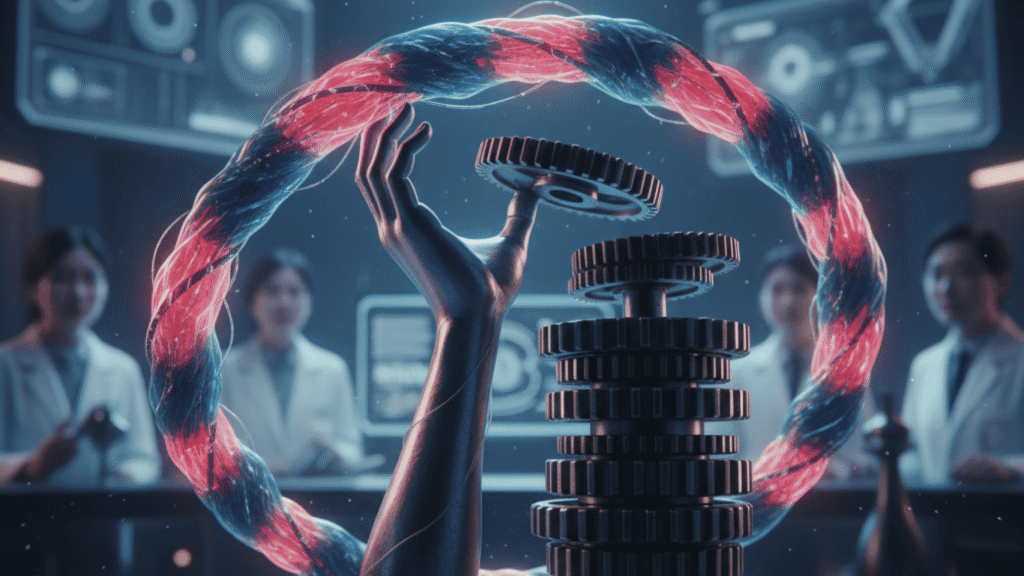
Tiny Polymer Material Smashes Limits on Strength and Flexibility, Promising Real-Life Terminator Technology.
A team of South Korean researchers has made a significant breakthrough in artificial muscle technology. They created a composite material capable of lifting thousands of times its own weight. This breakthrough eliminates the long-standing trade-off between power and pliability in robotics, paving the way for truly versatile and powerful humanoid machines and medical devices.
Read More: Revolutionizing Construction: ORNL’s Robotics and Automation Breakthroughs
A Material That Changes State
The innovation comes from the Ulsan National Institute of Science and Technology, or UNIST. Professor Hoon Eui Jeong’s team engineered an innovative polymer that can dynamically adjust its stiffness. Consider it the crucial element. The material can become as rigid as a structural component when bearing a heavy load, then immediately turn soft and flexible for movement or contraction.
This “high-performance magnetic composite actuator” is deceptively simple. It features a dual cross-linking structure. The clever design combines strong chemical bonds for structural integrity with weaker physical bonding networks that can form and break on demand. Moreover, the addition of magnetic microparticles enables precise control through the use of an external magnetic field, allowing engineers to switch directly and on demand between ‘steel’ and ‘rubber’ functionality.
Outperforming Human Tissue
The performance metrics of the new muscle are nothing short of astonishing. A sample of the material, weighing just 1.25 grams, or approximately 0.04 ounces, can sustain a load of up to 5 kilograms, or 11 pounds. It translates to an incredible ability to lift approximately 4,000 times its own weight. To put this into perspective, it is equivalent to a single human muscle fiber lifting an entire car.
The muscle also demonstrates extraordinary work density, a measure of the mechanical energy delivered per unit volume, and the artificial muscle achieved a work density of 1,150 kilojoules per cubic meter. This value is approximately 30 times greater than that of natural human tissue. Furthermore, the material exhibits an exceptional actuation strain of 86.4 percent when contracting from its original length, a rate more than double the 40 percent strain capability typical of human muscles.
The Dawn of Soft Power
For years, roboticists faced a dilemma. They could build strong, rigid robots, or weak, soft ones, but now, that compromise is over. Professor Jeong calls this a solution to the “fundamental limitation” of older designs, considering this innovation propels the soft robotics and wearable technology sectors into a new era of capability.
The potential applications are immense. For instance, advanced, lightweight exoskeletons could give people superhuman strength and endurance, while the rehabilitation robotics could utilize these gentle yet powerful actuators to assist patients with movements more naturally. More generally, it will accelerate the development of next-generation humanoid robots. These robots will not only possess incredible strength but also an unprecedented level of dexterity and compliance when interacting with human workers or fragile environments.
Keep in mind that the global soft robotics market was valued at approximately $1.51 billion in 2023. Well, projections anticipate a significant surge, with the market expected to grow at a Compound Annual Growth Rate (CAGR) of 34.7%, reaching a value of $12.15 billion by 2030. This new Korean technology places itself right at the epicenter of this explosive growth, promising to redefine industries from medical surgery to space exploration. The age of the super-powered, yet flexible, machine has officially begun.
