

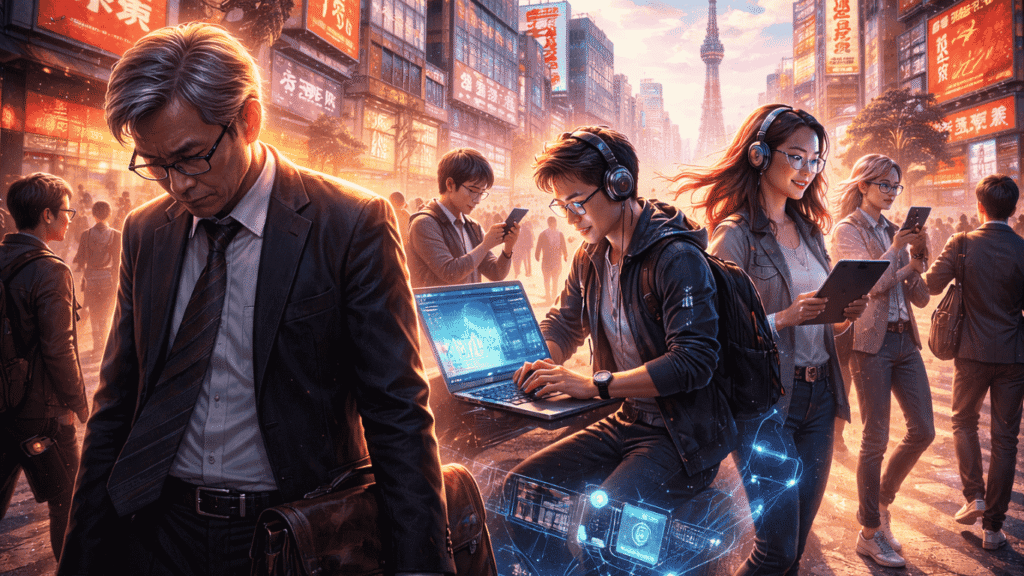
A digital revolution is quietly reshaping the Japanese job market, as nearly half of all applicants are turning to generative intelligence.
How much of a modern cover letter actually comes from the human heart? In Japan, the answer is increasingly not much, as a seismic shift in recruitment culture takes hold.
Recent data reveal a startling trend in which the relentless pressure of the Japanese “shukatsu” (job-hunting) season now meets the efficiency of Silicon Valley code. Applicants are no longer staring at blank pages in frustration. Instead, they are feeding prompts into machines to secure their futures.
The Death of the Handwritten Resume
For decades, the Japanese recruitment process prioritized the “Rirekisho,” a handwritten resume intended to reveal a candidate’s character through their penmanship. Today, that tradition is crumbling under the weight of automation. Statistics from a specialized study by Aidem, a Tokyo-based recruitment firm, indicate that 41.8% of job seekers have integrated generative AI into their professional pursuits.
The data suggests that 22.6% of these candidates specifically rely on AI to construct or polish their resumes. By outsourcing the technicality of self-presentation to an algorithm, applicants are bypassing the traditional soul-searching phase of the job search.
Furthermore, 19.1% of participants admitted to using AI to ghostwrite their motivational statements. These personal essays, once the cornerstone of Japanese corporate vetting, are becoming polished products of large language models rather than authentic reflections of the individual.
A Generational Great Divide
While the digital tide rises, it does not lift all boats equally. A profound demographic rift has emerged, splitting the workforce into AI Natives and Analog Traditionalists. Among professionals in their 30s or younger, the adoption rate is staggering. Over 54% of this younger cohort engages with AI regularly, with nearly 18% using it as a daily companion in their professional lives.
| Age Demographic | AI Adoption Rate | Primary Usage |
| 30s and Younger | 54.7% | Daily Integration |
| 40s and Older | <50% | Rare or Zero Usage |
In stark contrast, the older generation remains anchored in the past. More than half of respondents aged 40 and above reported that they rarely touch the technology, or in many cases, do not even understand how to access it. This disparity creates a shadow job market in which younger applicants have a massive speed and optimization advantage over their veteran counterparts.
The Risks of a Polished Mirror
While efficiency is at an all-time high, experts warn of a homogenization of the workforce. If every applicant uses the same neural network to describe their unique strengths, every cover letter begins to sound identical. An official from Aidem noted that while AI excels at organizing chaotic thoughts, it lacks the human nuance required for a final, authentic review.
If the AI suggests only certain roles, the candidate’s career path is no longer their own choice but a suggestion from a server farm. Japan stands at a crossroads where the efficiency of the future threatens to erase workers’ personalities.
