

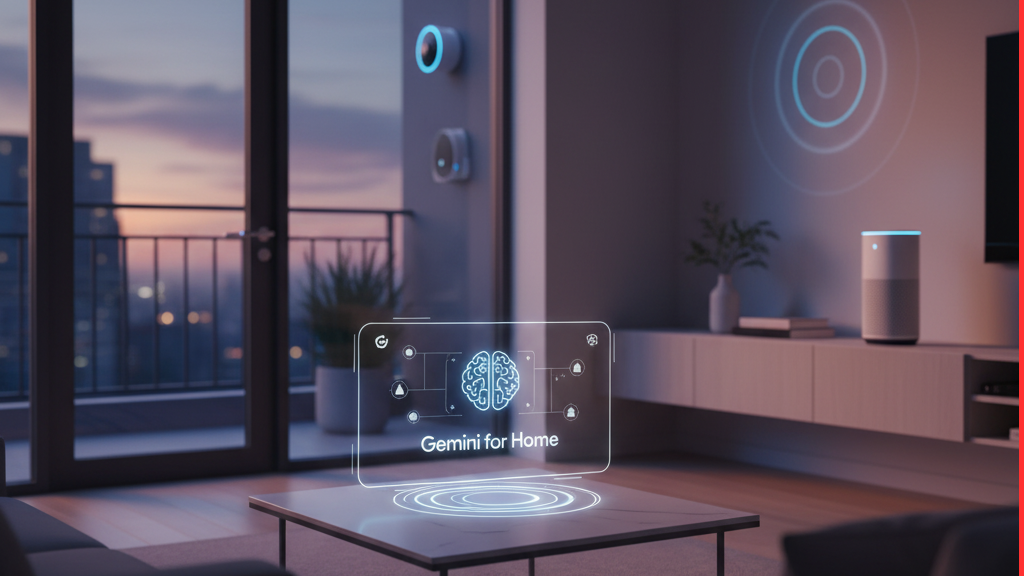
Google today unveiled a monumental leap forward in its smart home ecosystem with the launch of “Gemini for Home,” a sophisticated AI upgrade designed to infuse Nest devices with deeply conversational and intuitive interactions. This announcement, made at a highly anticipated press event, signals Google’s commitment to transforming passive smart homes into proactive, understanding environments. Alongside the software overhaul, the tech giant also introduced a suite of revamped Nest hardware, including a next-generation Nest Cam, an advanced Doorbell, and a line of premium Audio Speakers, all engineered to leverage Gemini’s power.
The core of this revolution lies in “Gemini for Home,” an AI model explicitly tailored for the nuances of domestic life. Unlike previous iterations of Google Assistant, which often relied on precise command phrasing, Gemini for Home is built for natural language understanding. Imagine telling your home, “It’s a bit stuffy in here, and I’m craving some upbeat music for cleaning,” and having your thermostat adjust, the windows open slightly (if integrated), and a personalized playlist start without further prompts. This level of contextual awareness and predictive intelligence is what Google aims to deliver.
“Our vision for the smart home has always been about making technology blend seamlessly into your life, anticipating your needs rather than waiting for explicit instructions,” stated Sundar Pichai, CEO of Google and Alphabet, during the keynote address. “With Gemini for Home, we’re moving beyond simple commands to genuine conversations. Your home will understand.”
The impact of conversational AI on the smart home market is projected to be substantial. Recent industry analysis indicates that smart home device adoption continues its upward trajectory, with an estimated 89.8 billion smart homes in the U.S. by 2025, representing a significant market. However, a persistent challenge has been the user experience, with many consumers reporting frustration over rigid voice commands and complex integrations. Gemini for Home directly addresses this pain point, promising to unlock the full potential of smart devices for a broader audience. Early data from internal Google trials suggests an increase in user engagement with smart home features when powered by conversational AI, indicating a strong positive reception.
Introducing the Next-Gen Nest Hardware
To complement the Gemini for Home AI, Google also unveiled three critical hardware updates:
- Nest Cam (3rd Generation): The new Nest Cam features enhanced on-device AI processing, allowing for more accurate person, pet, and package detection with reduced false alerts. It boasts 4K HDR video recording, improved low-light performance, and a longer-lasting battery for wireless models. Crucially, Gemini for Home integrates with the Nest Cam to provide more descriptive event notifications, such as “A package just arrived at your front door, and it looks like the one you’ve been expecting from Amazon,” rather than just a generic “Motion detected.”
- Nest Doorbell (2nd Generation): This updated doorbell features a broader field of view, enhanced two-way audio clarity, and advanced facial recognition that distinguishes between known visitors and strangers. With Gemini for Home, the doorbell can proactively announce visitors by name if they are recognized and even engage in basic conversational exchanges with delivery personnel on your behalf if you’re unavailable.
- Nest Audio Speakers (Pro Line): Google is expanding its audio offerings with a “Pro” line of Nest Audio Speakers. These new speakers feature spatial audio capabilities, enhanced bass response, and a more powerful array of microphones designed to pick up conversational nuances even in noisy environments. The Gemini integration enables more personalized audio experiences, including automatic volume adjustments based on ambient noise and mood-tailored music suggestions derived from conversational cues.
Reshaping the Smart Home Ecosystem
The integration of conversational AI like Gemini for Home is poised to reshape the smart home ecosystem profoundly. Currently, a substantial portion of smart home users, around 20%, report underutilizing their devices due to complexity. By simplifying interactions, Google aims to reduce this figure significantly, making smart home technology more accessible and valuable.
Furthermore, the advancements in on-device AI processing, particularly in the new Nest Cam, represent a strategic move towards greater privacy and faster response times. By performing more tasks locally, sensitive data can remain on the device, addressing growing consumer concerns about cloud-based data processing. This local processing capability enables instantaneous reactions to environmental changes or commands, thereby minimizing the latency often associated with cloud-dependent AI.
The competitive landscape in the smart home market is intense, with players like Amazon’s Alexa and Apple’s HomeKit constantly innovating. Google’s Gemini for Home, with its focus on truly natural and contextual conversations, positions the company as a leader in the next frontier of smart home interaction. The AI’s ability to learn user preferences over time and proactively suggest actions will be a key differentiator. For example, if Gemini learns you typically dim the lights and play jazz music around 8 PM, it might eventually ask, “Shall I set the evening ambiance now?” “The future of the smart home is about a connected intelligence that understands and adapts to you,” added a Google spokesperson. “Gemini for Home is the embodiment of that intelligence.”
This launch marks a significant milestone, promising to move smart homes from a collection of devices to a cohesive, intelligent, and truly conversational living environment. The era of talking to your home is here.
Also Read: Google’s New Preferred Sources Feature Will Completely Change How You Read the News