

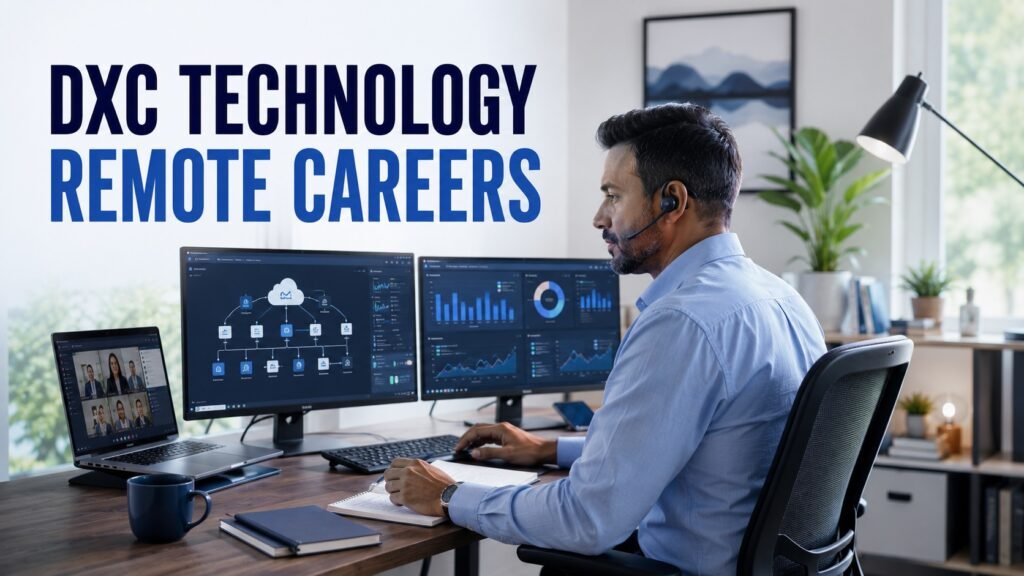
Searching for DXC Technology work-from-home jobs? This employer career guide explains the remote and flexible career paths available at DXC Technology, the departments that commonly recruit, the skills hiring teams may value, and how to find legitimate openings through the company’s official careers website.
The original vacancy associated with this page advertised a remote cloud sales-management opportunity in Florida with an estimated salary range of $91,400–$169,700. That individual role may no longer be accepting applications. The page has therefore been rebuilt as an evergreen resource for professionals researching DXC Technology work-from-home jobs, DXC remote careers, cloud sales roles, technology consulting positions and flexible enterprise-technology careers.
Remote availability, compensation, work location and client-travel requirements can change between vacancies. Always verify the current conditions in the official job description before applying.
DXC Technology Company Snapshot
DXC Technology provides software, services and enterprise-technology solutions to large commercial and public-sector organizations. Its work includes managed infrastructure, application modernization, cloud, cybersecurity, data, consulting and industry-specific software.
Because DXC supports customers across countries, industries and technology environments, its workforce includes technical specialists, consultants, project professionals, sales teams, customer-support employees and corporate functions.
Does DXC Technology Offer Work-From-Home Jobs?
DXC Technology may advertise fully remote, hybrid, client-based and office-based positions. The appropriate arrangement depends on the customer account, department, country, security requirements and responsibilities of the position.
A vacancy described as remote may still limit applicants to a specific country, state, region or commuting area. Certain positions also require employees to visit client sites, attend planning meetings or work from a DXC location on designated days.
Common DXC Work Arrangements
- Fully remote: Work is primarily completed from an approved home-office location.
- Remote within an approved region: Applicants must reside in a named country, state or group of locations.
- Remote with client travel: Employees work from home but periodically visit customer sites.
- Hybrid: Work is divided between home, a DXC office and possibly client locations.
- Client-site based: Regular presence at a customer location is required.
- Office-based: The position is assigned primarily to a DXC workplace.
What to Check Before Applying
- The exact country, state or regional eligibility
- Whether the role requires proximity to a DXC or client office
- Expected travel frequency
- Required working hours and time-zone coverage
- Security-clearance or citizenship requirements
- Home-office and internet expectations
- Whether occasional evening, weekend or on-call work applies
Do not assume that “remote” means the position can be performed from anywhere in the world. Most DXC work-from-home roles remain tied to the employer’s legal hiring locations and the needs of a particular customer account.
Popular DXC Technology Remote Career Areas
DXC Technology recruits across a much wider range of functions than the cloud sales vacancy that originally appeared on this page. Its official careers site organizes opportunities across technology, consulting, operations, support and corporate departments.
1. Cloud and Infrastructure Careers
Cloud and infrastructure professionals help clients modernize, operate and secure complex technology environments.
Possible job titles include:
- Cloud Engineer
- Cloud Architect
- Infrastructure Engineer
- Systems Administrator
- Platform Engineer
- DevOps Engineer
- Site Reliability Engineer
- Infrastructure Operations Lead
- Cloud Migration Consultant
- Technical Account Manager
Remote availability can be influenced by the customer environment, security controls, service hours and need for access to physical infrastructure.
2. Software Engineering and Application Careers
Software and application teams design, modernize, test and maintain systems used by enterprise and public-sector customers.
Potential roles include:
- Software Engineer
- Application Developer
- Full-Stack Developer
- Java Developer
- .NET Developer
- Mobile Application Developer
- Quality Assurance Analyst
- Test Automation Engineer
- Application Support Analyst
- Software Engineering Lead
3. Cybersecurity Careers
Cybersecurity employees may support identity, risk, infrastructure protection, incident response, governance and client security programs.
Relevant job titles may include:
- Cybersecurity Analyst
- Security Engineer
- Security Architect
- Identity and Access Management Specialist
- Governance, Risk and Compliance Analyst
- Security Operations Center Analyst
- Cybersecurity Consultant
- Security Sales Executive
Some security roles may require background screening, professional certifications, citizenship conditions or access to controlled customer environments.
4. Data Science and Analytics
Data professionals help customers organize information, improve reporting, develop analytical solutions and use artificial intelligence responsibly.
Possible roles include:
- Data Analyst
- Business Intelligence Analyst
- Data Engineer
- Data Scientist
- Machine Learning Engineer
- Analytics Consultant
- Data Architect
- AI Solutions Specialist
5. Consulting and Advisory
Consultants help organizations evaluate technology needs, improve operations, plan transformation programs and deliver new solutions.
Career paths may include:
- Business Analyst
- Technology Consultant
- Transformation Consultant
- Enterprise Architect
- ServiceNow Consultant
- SAP Consultant
- Change Management Consultant
- Industry Solutions Consultant
Consulting positions may be remote-friendly while still requiring customer workshops, travel or periodic on-site collaboration.
6. Sales and Sales Enablement
Sales professionals develop client relationships, identify business needs and connect customers with appropriate technology and consulting solutions.
Possible titles include:
- Sales Development Representative
- Account Executive
- Sales Manager
- Senior Sales Manager
- Cloud Sales Specialist
- Cybersecurity Sales Executive
- Client Partner
- Business Development Manager
- Sales Operations Analyst
- Sales Enablement Specialist
Many enterprise-sales roles combine home-based work with customer meetings, industry events, internal planning sessions and regional travel.
7. IT Support and Service Management
Support teams help operate customer systems, resolve incidents and maintain dependable technology services.
Relevant roles may include:
- Service Desk Analyst
- Technical Support Specialist
- Desktop Support Engineer
- Incident Manager
- Problem Manager
- Service Delivery Manager
- IT Operations Analyst
- Infrastructure Support Specialist
8. Business Process Services and Customer Support
Business-process and customer-support employees may help clients manage transactions, records, service requests and operational workflows.
Possible positions include:
- Customer Support Representative
- Business Process Associate
- Operations Analyst
- Claims Support Specialist
- Service Coordinator
- Back-Office Processing Specialist
- Team Lead
- Operations Manager
9. Project and Program Management
Project professionals coordinate technology implementations, migrations, customer programs and operational improvements.
- Project Coordinator
- Project Manager
- Senior Project Manager
- Technical Program Manager
- Implementation Manager
- Transition Manager
- Program Director
- Portfolio Manager
10. Corporate and Business Functions
DXC also recruits professionals who support the wider organization.
- Finance and accounting
- Human resources and recruiting
- Legal and contract management
- Marketing and communications
- Procurement and vendor management
- Administration and operations
- Pricing and commercial management
- Corporate development
Remote and hybrid eligibility differs by team, business need and country.
DXC Technology Cloud Sales Careers
The page was originally published for a cloud-focused sales-management position. Cloud sales therefore remains an important supporting topic, but the rebuilt page now serves the broader search intent behind DXC Technology work-from-home careers.
Enterprise cloud sales involves more than promoting a standard product. Professionals must understand customer challenges, coordinate with technical specialists and develop solutions that connect technology investments with business outcomes.
Typical Cloud Sales Responsibilities
- Develop and manage a qualified sales pipeline
- Research target industries, accounts and business needs
- Build relationships with client decision-makers
- Coordinate with cloud architects, consultants and delivery teams
- Explain service capabilities, pricing and commercial value
- Prepare proposals, presentations and account plans
- Manage lengthy enterprise-sales cycles
- Participate in contract and pricing negotiations
- Track opportunities and activity through a CRM platform
- Monitor competitors and market developments
- Support forecasting and revenue planning
- Maintain relationships after the initial sale
Skills Relevant to Cloud Sales Roles
- Consultative and solution-based selling
- Enterprise account management
- Cloud-service and infrastructure knowledge
- Pipeline management
- CRM proficiency
- Proposal and presentation development
- Commercial negotiation
- Stakeholder management
- Cross-functional collaboration
- Sales forecasting
- Clear written and verbal communication
Applicants do not need to describe themselves as technical architects unless that is accurate. Strong technology sales professionals show that they can understand the customer’s problem, involve the right specialists and communicate a credible business case.
Remote-Work Expectations at DXC Technology
Remote enterprise-technology careers can involve structured schedules, customer commitments, security rules and extensive virtual collaboration.
Remote Employees May Be Expected To:
- Work during hours that support assigned clients or project teams
- Attend video meetings, planning sessions and customer calls
- Use approved devices, networks and security procedures
- Protect confidential customer and company information
- Provide regular written updates and documentation
- Collaborate across countries and time zones
- Travel to client or company locations when required
- Participate in on-call or service-coverage arrangements for some technical roles
- Maintain reliable internet and an appropriate workspace
- Deliver results without continuous in-person supervision
Ask the recruiter whether the position is permanently remote, temporarily remote, hybrid or linked to a specific client contract. This distinction can materially affect long-term flexibility.
Explore Current DXC Technology Jobs
DXC vacancies, locations and work arrangements change regularly. Search the official careers website and verify that any third-party listing leads back to an authorized DXC application page.
WorkinVirtual Editorial Note: WorkinVirtual is an independent career-resource website and is not affiliated with DXC Technology. The original cloud sales position may have expired. Job availability, salary, benefits, remote-work eligibility and hiring procedures may change. Always verify current details through the employer’s official careers website.
Who Should Consider DXC Technology Careers?
DXC Technology recruits professionals from many different backgrounds, making it a suitable employer for both experienced specialists and career changers who possess transferable business or technical skills.
You May Be a Good Fit If You Are:
- An enterprise technology sales professional
- A cloud consultant looking to move into solution sales
- An IT project coordinator or project manager
- A customer success or account management specialist
- A software engineer interested in enterprise consulting
- A cybersecurity professional seeking client-facing work
- A business analyst with technology implementation experience
- An infrastructure engineer interested in cloud transformation
- A graduate with technology, business or engineering qualifications
- A military veteran transitioning into enterprise technology
- A technology recruiter or HR professional supporting global teams
- A finance or operations professional with experience supporting IT organizations
Rather than applying to dozens of unrelated vacancies, identify one or two career paths that closely match your experience and tailor your application accordingly.
Technical Skills DXC Technology Often Values
Different departments require different technical expertise, but the following capabilities frequently appear across enterprise technology organizations.
Cloud & Infrastructure
- Microsoft Azure
- Amazon Web Services (AWS)
- Google Cloud Platform
- VMware
- Hybrid cloud environments
- Infrastructure modernization
- Cloud migration planning
- Networking fundamentals
Software Development
- Java
- C#/.NET
- Python
- JavaScript
- React
- Node.js
- REST APIs
- Git
- CI/CD pipelines
Enterprise Platforms
- ServiceNow
- SAP
- Salesforce
- Oracle
- Microsoft Dynamics
- Workday
Data & Analytics
- SQL
- Power BI
- Tableau
- Python analytics
- Business Intelligence
- Data visualization
- Reporting automation
Sales & Commercial Skills
- CRM platforms
- Pipeline management
- Account planning
- Commercial negotiations
- Enterprise presentations
- Solution selling
- Proposal development
Employers typically value evidence of successful project delivery more than a long list of technologies without measurable achievements.
Professional Skills That Strengthen Applications
- Business communication
- Consultative thinking
- Customer relationship management
- Problem solving
- Presentation skills
- Executive communication
- Leadership
- Negotiation
- Strategic planning
- Time management
- Remote collaboration
- Cross-functional teamwork
- Adaptability
- Commercial awareness
- Continuous learning
Enterprise employers increasingly expect professionals to combine technical capability with strong communication, customer focus and business understanding.
DXC Technology Salary Expectations
Salary varies significantly depending on country, business unit, technical specialization, certifications, client responsibilities and management level.
The original vacancy that inspired this page advertised an estimated salary range of $91,400–$169,700 annually for one cloud sales management role. That figure should not be treated as the standard salary for every DXC position.
Typical U.S. Market Salary Ranges
- Technical Support & Operations: $45,000–$80,000
- Business Analysts: $65,000–$105,000
- Cloud Engineers: $95,000–$155,000
- Software Engineers: $90,000–$165,000
- Cybersecurity Specialists: $95,000–$170,000
- Project Managers: $90,000–$150,000
- Enterprise Sales: Base salary plus commission or incentive plans
- Sales Managers: Frequently include variable compensation tied to business performance
- Directors: Compensation varies considerably according to region and business responsibility
Technology employers often combine base salary with bonus opportunities, commissions, equity programs or performance incentives depending on the position.
Questions to Ask During the Hiring Process
- Is the advertised salary location-adjusted?
- Is commission included?
- Are annual bonuses available?
- What travel expenses are reimbursed?
- Does the company provide home-office equipment?
- How frequently are salaries reviewed?
- Are certification costs reimbursed?
Benefits That May Be Available
Benefit programs differ between countries and employment types. Eligible employees may receive a combination of:
- Medical, dental and vision insurance
- Retirement savings plans
- Life insurance
- Paid holidays
- Paid annual leave
- Parental leave
- Employee assistance programs
- Professional certification support
- Learning and development programs
- Internal career mobility
- Flexible or hybrid work arrangements where applicable
- Employee wellbeing initiatives
Always review the benefits summary attached to the active vacancy because packages vary by country and legal entity.
How Often Does DXC Technology Hire?
DXC Technology supports long-term customer contracts around the world, so recruitment may occur throughout the year across multiple business functions.
Typical Hiring Patterns
- Year-round recruitment for technology specialists
- Project-driven hiring during major customer implementations
- Graduate and early-career recruitment cycles
- Leadership hiring as business needs evolve
- Sales hiring aligned with regional growth objectives
- Operational hiring following new customer contracts
Some positions remain available for several weeks while others close quickly once hiring targets have been reached.
Typical DXC Technology Hiring Process
Step 1 — Online Application
Create a resume record and apply through DXC Technology’s official careers website.
Step 2 — Recruiter Review
Your qualifications, work authorization and location eligibility are reviewed.
Step 3 — Recruiter Conversation
You may discuss your experience, salary expectations, preferred work arrangement and career interests.
Step 4 — Hiring Manager Interview
The hiring manager evaluates your technical knowledge, commercial understanding and relevant experience.
Step 5 — Technical or Functional Interviews
Depending on the role, additional interviews may include technical assessments, sales scenarios, presentations or case studies.
Step 6 — Final Evaluation
Leadership reviews interview feedback before a hiring decision is made.
Step 7 — Background Screening
Employment history, education and other checks may be completed where permitted.
Step 8 — Offer and Onboarding
Successful candidates receive an employment offer followed by onboarding and technology setup.
Typical Application Timeline
- Days 1–7: Application review
- Week 1–3: Recruiter contact
- Week 2–5: Hiring manager interviews
- Week 3–6: Technical interviews or assessments
- Week 5–8: Final decision
- Following acceptance: Background checks and onboarding
Highly specialized consulting, cloud and security positions may require additional interview stages.
Editorial Note: Hiring timelines vary according to location, business unit and customer requirements. Always use the timeline provided by the recruiter for your specific vacancy.
How to Tailor Your Resume for DXC Technology
A strong DXC Technology application should connect your experience to the specific customer, technology, consulting, sales or operational problem described in the vacancy.
Avoid submitting one generic resume to unrelated roles. A cloud sales position, cybersecurity analyst opening and project-management vacancy require different evidence, terminology and achievements.
Write a Focused Professional Summary
Your opening summary should identify your career area, level of experience, strongest relevant skills and the type of results you have delivered.
Example for a cloud sales professional:
Enterprise technology sales professional with eight years of experience developing cloud, infrastructure and managed-services opportunities across complex client accounts. Skilled in consultative selling, pipeline management, executive presentations and coordinating technical teams throughout long sales cycles.
Example for a cloud engineer:
Cloud engineer with six years of experience designing, migrating and supporting secure AWS and Azure environments. Experienced in infrastructure automation, performance monitoring, incident resolution and collaborating with distributed enterprise teams.
Example for a project manager:
Technology project manager with seven years of experience leading application, infrastructure and service-transition programs. Skilled in stakeholder communication, risk management, budget tracking and coordinating global delivery teams.
Show Outcomes Instead of Duties
Weak example: Managed cloud sales opportunities.
Stronger example: Built and managed a $4.2 million cloud-services pipeline across 18 enterprise accounts, improving qualified-opportunity conversion by 24% within one year.
Weak example: Supported infrastructure projects.
Stronger example: Coordinated a 14-month infrastructure-modernization program across three countries, completing migration milestones on schedule and reducing critical service incidents by 31%.
Weak example: Helped customers resolve technical issues.
Stronger example: Resolved an average of 35 enterprise support requests per week while maintaining a 96% service-level compliance rate.
Useful Evidence to Include
- Revenue generated
- Pipeline value created
- Sales conversion improved
- Projects delivered on schedule
- Budgets managed
- Downtime reduced
- Systems migrated
- Security incidents prevented
- Customer-satisfaction results
- Service-level performance
- Processes automated
- Costs reduced
- Teams or regions supported
- Certifications completed
Potential ATS Keywords for DXC Technology Applications
Use keywords only when they genuinely match your background and appear naturally in the active job description. Unsupported keyword repetition may weaken your credibility during an interview.
Cloud and Infrastructure Keywords
- Cloud transformation
- Cloud migration
- Hybrid cloud
- AWS
- Microsoft Azure
- Google Cloud Platform
- Infrastructure modernization
- Virtualization
- DevOps
- Site reliability engineering
- Platform engineering
- Managed infrastructure
Software and Application Keywords
- Application modernization
- Software development
- Java
- .NET
- Python
- JavaScript
- API integration
- Test automation
- CI/CD
- Agile development
Cybersecurity Keywords
- Security operations
- Incident response
- Identity and access management
- Governance, risk and compliance
- Threat monitoring
- Security architecture
- Vulnerability management
- Zero Trust
- Cyber risk
Sales and Commercial Keywords
- Enterprise sales
- Solution selling
- Consultative selling
- Pipeline management
- Account planning
- Business development
- Client relationship management
- Sales forecasting
- CRM
- Commercial negotiation
- Proposal development
- Revenue growth
Project and Consulting Keywords
- Project management
- Program management
- Technology consulting
- Digital transformation
- Stakeholder management
- Risk management
- Change management
- Service transition
- Implementation
- Business analysis
Remote-Work Keywords
- Remote collaboration
- Distributed teams
- Virtual communication
- Cross-functional teamwork
- Time-zone coordination
- Independent work
- Client communication
- Documentation
Common DXC Technology Resume Mistakes
- Using one generic resume for every DXC vacancy
- Listing technologies without showing how they were applied
- Describing responsibilities without measurable outcomes
- Failing to explain client-facing experience
- Ignoring location, travel or security-clearance requirements
- Overstating cloud or cybersecurity expertise
- Using technical language that does not match the target position
- Omitting commercial results from a sales resume
- Failing to mention service-level or customer-performance results
- Using a visually complicated resume that is difficult to scan
- Including outdated or irrelevant certifications
- Applying to many unrelated roles without a clear career direction
Strengthen Your Resume Before Applying
Use the WorkinVirtual Resume Improvement Advisor to identify weak achievement statements, unclear summaries and missing role-specific evidence.
How to Prepare for a DXC Technology Interview
DXC Technology interview questions may focus on technical knowledge, client communication, project delivery, commercial judgment and your ability to work across distributed teams.
Prepare examples that show how your work improved customer outcomes, revenue, service quality, security, efficiency or project delivery.
Research Before the Interview
- Review the current vacancy and identify its most important requirements.
- Understand the customer, industry or technology area connected with the role.
- Research the relevant DXC service, platform or business function.
- Prepare examples involving enterprise customers or complex stakeholders.
- Review the technical tools and certifications named in the posting.
- Confirm whether the position is remote, hybrid, office-based or client-site based.
- Prepare questions about customer expectations, team structure and travel.
Common DXC Technology Interview Questions
- Why are you interested in working at DXC Technology?
- What interests you about enterprise technology services?
- Tell us about a complex customer problem you helped solve.
- Describe a project that did not go according to plan.
- How do you manage competing priorities across several stakeholders?
- Tell us about a time you influenced a decision without direct authority.
- How do you explain technical information to a nontechnical client?
- Describe a process you improved.
- How do you work effectively across remote and international teams?
- Tell us about a difficult customer relationship and how you handled it.
- How do you maintain accurate documentation?
- What would you aim to accomplish during your first 90 days?
Cloud Sales Interview Questions
- How do you build an enterprise cloud sales pipeline?
- Describe a long or complex sales cycle you managed.
- How do you identify the business value behind a technical solution?
- How do you work with architects and delivery teams during the sales process?
- Tell us about a deal you lost and what you learned.
- How do you forecast revenue accurately?
- How do you respond when a customer focuses only on price?
- Describe your experience negotiating enterprise contracts.
Technical Interview Questions
- Describe a cloud migration you supported.
- How do you approach a major service incident?
- What steps do you take to secure a hybrid-cloud environment?
- How do you improve the reliability of a production system?
- How do you document technical decisions for future support teams?
- Tell us about a time you reduced downtime or improved performance.
- How do you balance technical quality with delivery deadlines?
Project and Consulting Interview Questions
- How do you define project scope with a client?
- Describe a transformation program involving several teams.
- How do you manage delivery risks?
- Tell us about a stakeholder who resisted change.
- How do you communicate delays or problems to senior leaders?
- How do you ensure that a solution delivers business value?
Use the STAR Method for Stronger Interview Answers
Structure behavioral interview responses using:
- Situation: Briefly explain the context.
- Task: Describe your responsibility.
- Action: Explain the steps you personally took.
- Result: Share the measurable or meaningful outcome.
Sample STAR Answer for Enterprise Sales
Question: Tell us about a time you recovered a difficult sales opportunity.
Situation: A long-term enterprise customer delayed a cloud-modernization decision because executives were concerned about cost, security and disruption.
Task: I was responsible for rebuilding confidence and clarifying the business case.
Action: I organized discovery sessions with the customer’s finance, security and operations leaders. I worked with our architects to develop a phased migration plan, created a risk-and-cost comparison and presented three implementation options.
Result: The customer approved a two-year services agreement worth $2.8 million, and the phased approach reduced the projected transition risk.
Sample STAR Answer for Remote Project Delivery
Question: Tell us about a time you managed a distributed team.
Situation: A systems-transition project involved teams in the United States, the United Kingdom and India.
Task: I needed to improve coordination and recover a four-week schedule delay.
Action: I introduced one shared project tracker, clarified ownership for each workstream and created overlapping handover windows between time zones. I also replaced several status meetings with concise written updates.
Result: The team recovered three weeks of the delay, completed the highest-risk migration on schedule and reduced unresolved handover issues by 40%.
Practise Before Your Interview
Use the WorkinVirtual Interview Prep Generator to create role-specific questions and improve your STAR examples.
Questions to Ask a DXC Technology Interviewer
- Which customer account, service line or business unit would this role support?
- What are the most important priorities during the first 90 days?
- How is success measured?
- Is the role permanently remote or connected with a client contract?
- How often is travel or office attendance required?
- Which technologies, platforms or methodologies are used most often?
- How is the team distributed across locations and time zones?
- What are the biggest challenges currently facing the team?
- What training and certification support is available?
- How does the team collaborate with sales, consulting and delivery functions?
- What career-development opportunities are available?
- What are the remaining stages of the hiring process?
Career Progression at DXC Technology
Career progression may occur through deeper specialization, consulting responsibility, customer leadership, people management or movement between related departments.
Cloud and Infrastructure Career Path
Technical Support Analyst or Junior Cloud Engineer
↓
Cloud Engineer or Infrastructure Engineer
↓
Senior Cloud Engineer
↓
Cloud Architect or Technical Lead
↓
Engineering Manager
↓
Cloud Practice Director
Enterprise Sales Career Path
Sales Development Representative
↓
Account Executive or Sales Specialist
↓
Senior Account Executive or Sales Manager
↓
Client Partner or Regional Sales Manager
↓
Sales Director
↓
Vice President of Sales
Project and Program Career Path
Project Coordinator
↓
Project Manager
↓
Senior Project Manager
↓
Program Manager
↓
Portfolio Manager
↓
Program Director or PMO Director
Consulting Career Path
Business Analyst or Associate Consultant
↓
Technology Consultant
↓
Senior Consultant
↓
Principal Consultant or Enterprise Architect
↓
Consulting Manager
↓
Consulting Director
Cybersecurity Career Path
Security Analyst
↓
Security Engineer
↓
Senior Security Engineer
↓
Security Architect or Technical Lead
↓
Cybersecurity Manager
↓
Security Practice Director
Helpful Certifications for DXC Technology Careers
Certifications are most valuable when they support real experience and match the requirements of your target role.
Cloud and Infrastructure
- AWS Certified Solutions Architect
- AWS Certified Cloud Practitioner
- Microsoft Azure Administrator
- Microsoft Azure Solutions Architect
- Google Professional Cloud Architect
- VMware certification
- Red Hat certification
- Cisco CCNA or CCNP
Cybersecurity
- CompTIA Security+
- Certified Information Systems Security Professional
- Certified Ethical Hacker
- Certified Cloud Security Professional
- Certified Information Security Manager
- GIAC certifications for relevant specialist roles
Project and Service Management
- Project Management Professional
- Certified Associate in Project Management
- PRINCE2
- Certified ScrumMaster
- PMI Agile Certified Practitioner
- ITIL Foundation
- Lean Six Sigma
Enterprise Platforms
- ServiceNow certification
- SAP certification
- Salesforce certification
- Oracle certification
- Microsoft Dynamics certification
Sales and Commercial Careers
- Relevant cloud-fundamentals certification
- Salesforce certification
- Solution-selling or consultative-selling training
- Commercial negotiation training
- Industry-specific technology credentials
Before paying for training, review several current DXC vacancies in your target department and identify which certifications appear repeatedly.
How to Succeed in a Remote DXC Technology Role
- Clarify priorities and deadlines early.
- Document decisions and technical changes.
- Share concise progress updates.
- Raise risks before they become delivery problems.
- Respect client confidentiality and security controls.
- Prepare thoroughly for virtual customer meetings.
- Build working relationships across time zones.
- Keep technical and professional skills current.
- Understand the business impact of your work.
- Maintain a reliable and professional home workspace.
- Ask for feedback during the first months.
- Track achievements for future performance discussions.
Important: Certifications, career paths and interview examples in this guide are general career-planning resources. Requirements differ by country, client account and active vacancy. Always prioritize the qualifications stated in the current official job posting.
Enterprise Technology Industry Outlook
DXC Technology operates in an industry that continues to evolve through cloud adoption, cybersecurity investment, artificial intelligence, digital transformation and modernization of legacy systems. Organizations across both the public and private sectors continue to invest in technology that improves efficiency, security and customer experience.
Technology Trends Driving Future Hiring
- Cloud migration and hybrid infrastructure
- Artificial intelligence and automation
- Cybersecurity and Zero Trust security models
- Data engineering and business intelligence
- Digital workplace transformation
- Application modernization
- Managed infrastructure services
- Enterprise consulting
- Customer experience modernization
- Industry-specific technology solutions
Professionals who combine technical expertise with communication, consulting and commercial awareness are likely to remain valuable as enterprise technology continues to evolve.
Compare DXC Technology With Similar Employers
Job seekers researching DXC Technology should compare several global technology employers before making a career decision.
DXC Technology vs Accenture
Both organizations deliver consulting and enterprise technology services. Accenture has broader consulting operations, while DXC has a strong heritage in enterprise infrastructure, managed services and large-scale technology operations.
DXC Technology vs IBM
IBM combines software, consulting, AI and hybrid cloud services. DXC focuses heavily on enterprise IT operations, customer transformation and managed technology environments.
DXC Technology vs Cognizant
Cognizant and DXC both recruit technology consultants, engineers, analysts and customer-facing professionals supporting global enterprise clients.
DXC Technology vs Capgemini
Capgemini has a significant consulting and engineering practice, while DXC is well known for infrastructure, modernization and managed technology services.
DXC Technology vs Kyndryl
Both employers specialize in enterprise infrastructure and technology operations. Applicants should compare certifications, work arrangements, customer industries and long-term career development.
Other Employers Worth Researching
- Atos
- TCS
- Infosys
- Wipro
- HCLTech
- Deloitte
- EY
- PwC
- NTT DATA
- CGI
Continue Your Remote Technology Career
If DXC Technology does not currently have a suitable opening, continue building your application pipeline by exploring other employers and career resources.
Search Current DXC Technology Jobs
Technology hiring changes regularly as customer projects, consulting engagements and enterprise priorities evolve. Always verify the latest opportunities directly through DXC Technology’s official careers website.
Editorial Note: WorkinVirtual is an independent career resource and is not affiliated with DXC Technology. This guide replaces an expired job posting with an evergreen employer career resource designed to help professionals understand DXC Technology careers, remote work opportunities and the hiring process. Job availability, salaries, benefits and remote eligibility may change over time.
Choose your next step
Keep your momentum with practical tools and verified remote-work opportunities.
Related guides for your next step
A fresh, topic-aware mix from the WorkinVirtual library. Suggestions rotate regularly.




Discuss this guide
Ask a useful question, share relevant experience, or add a practical correction. Helpful contributions publish immediately after automated safety checks.
Start a thoughtful discussion
Be the first member to add a question or practical insight about this topic.
Join the discussion
Sign in with your verified WorkinVirtual account to contribute. Automated safety checks keep posting quick and protect the community.
Sign in to contribute