

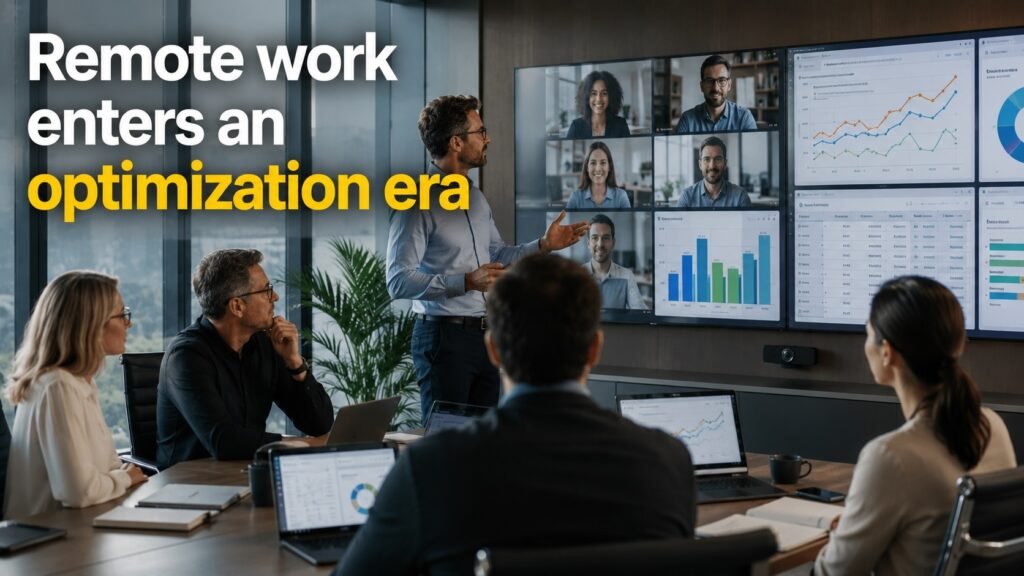
The defining remote-work trend in 2026 is not a simple return to the office or a new remote boom; it is sharper segmentation by occupation, employer and location. Fully remote openings remain valuable and competitive, hybrid rules are more explicit, and mature distributed employers are refining schedules, documentation and performance systems. Candidates should verify each live role instead of applying a headline statistic to every career.
Read remote-work statistics carefully
A job-posting dataset measures advertised opportunities, not the share of people currently working remotely. A worker survey measures respondents and may include anyone who worked at home for part of a day. An employer policy survey measures formal rules, which may differ from team practice. Geography, occupation and fieldwork also change the result.
Robert Half’s 2026 analysis, for example, categorizes postings across professional fields and shows that remote and hybrid shares differ substantially by field. The BLS American Time Use Survey provides a government measure of work performed at home, but it answers a different question. Report the source, period, population and definition whenever quoting a number.
Six trends that matter
1. Work models are becoming role-specific
Companies increasingly label vacancies onsite, hybrid, remote or field-based. A company known for flexibility may still require one team near an office. The advert controls.
2. “Remote” often has a legal geography
Payroll registration, licensing, tax, data access and time-zone coverage limit where an employer can hire. “Remote—United States” is not “work from anywhere.”
3. Hybrid expectations are more operational
Candidates need the office location, required days, anchor events and whether travel is reimbursed. “Flexible” without those details is incomplete.
4. Distributed work is an operating model
Mature employers invest in documentation, predictable collaboration windows, intentional in-person events and outcome-based management. Dropbox’s public Virtual First material is one example of an employer explaining the model beyond a location label.
5. Remote access is unequal by occupation
Knowledge work is more portable than hands-on care, manufacturing or field service. Career advice should identify remote-capable tasks rather than declaring an industry remote.
6. Verification and scam resistance matter more
Competition and brand impersonation make official career domains, recruiter identity and interview process essential checks.
Candidate verification card
Before applying, record:
- exact work-model sentence from the live advert;
- eligible country, state or distance from office;
- recurring office or travel requirement;
- employment type and legal entity;
- core working hours and time-zone overlap;
- equipment and expense policy;
- official application domain and requisition ID; and
- posting or closing date.
If two items are unclear, ask before investing in a long assessment. Never assume an old employer profile overrides the vacancy.
Skills that strengthen remote candidacy
Remote-friendly evidence includes written decision records, independent prioritization, asynchronous updates, reliable handoffs, facilitation across time zones and secure tool use. Translate those into outcomes. “Worked remotely” is weaker than “Coordinated a five-time-zone launch with written handoffs and delivered two weeks early.”
Managers need workload design, inclusive meetings, explicit decision rights and fair performance review. Employers should audit whether remote employees receive equal access to information, stretch work and promotion.
Employer operating-model scorecard
Score one point for every documented practice: role-level eligibility, predictable collaboration hours, written decision records, accessible meeting norms, results-based goals, location-compliant hiring, secure access, fair career review and an intentional in-person purpose. A high score indicates a designed system; a low score suggests flexibility depends on individual managers.
How to apply safely
- Start with WorkinVirtual job discovery, then open the employer’s official vacancy.
- Verify location and work-model terms immediately.
- Tailor resume examples to distributed outcomes and the target occupation.
- Confirm recruiter email domains and interview platform.
- Never pay for a job, deposit a check for equipment or send banking details before verified onboarding.
- Save the advert because the wording may change or disappear.
FAQ
Are remote jobs disappearing in 2026?
Remote work persists, but availability varies by occupation and dataset. Avoid a universal yes/no claim.
Is hybrid easier to get than fully remote work?
Often there are more hybrid opportunities in some professional fields, but local competition and commute requirements matter.
Does remote mean global?
Rarely. Most roles specify an eligible geography for legal and operational reasons.
What internal links should WorkinVirtual add?
Link to the live remote-jobs board, remote resume guide, scam checker, skills tool and employer remote-policy resources. Role-specific remote career guides should link back to this trends owner.
Choose your next step
Keep your momentum with practical tools and verified remote-work opportunities.
Related guides for your next step
A fresh, topic-aware mix from the WorkinVirtual library. Suggestions rotate regularly.

Discuss this guide
Ask a useful question, share relevant experience, or add a practical correction. Helpful contributions publish immediately after automated safety checks.
Start a thoughtful discussion
Be the first member to add a question or practical insight about this topic.
Join the discussion
Sign in with your verified WorkinVirtual account to contribute. Automated safety checks keep posting quick and protect the community.
Sign in to contribute