

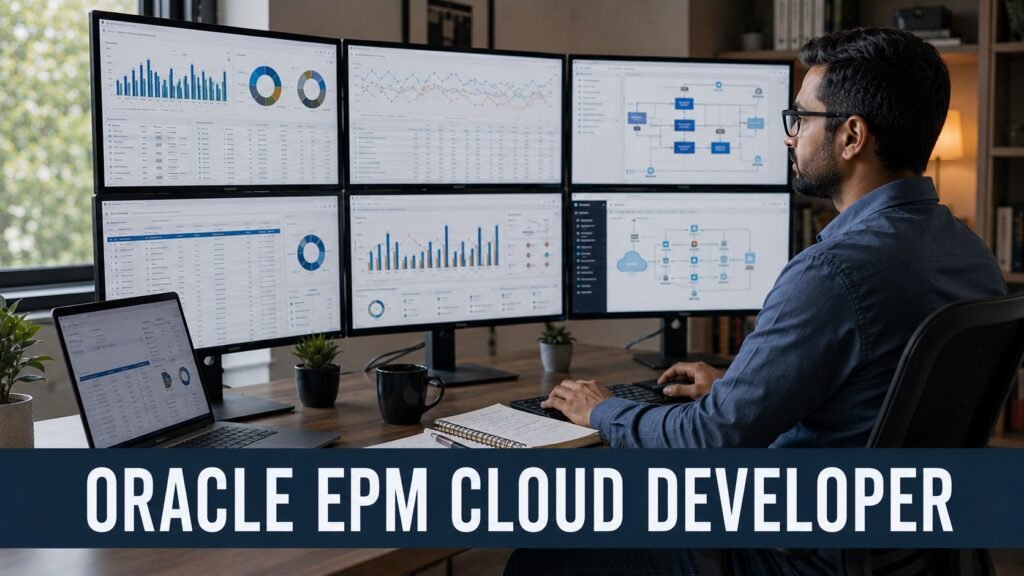
GDIT Oracle EPM developer careers can involve configuring and supporting enterprise planning, forecasting, reporting, metadata, business rules, integrations, security, testing, and production stability. A current official role may state no clearance, a Public Trust condition, or another suitability requirement, but that must never be generalized. Search GDIT’s official career site, verify the requisition, location and hybrid or onsite expectation, and show sanitized EPM evidence: business process, model design, data flow, controls, release method, support, and measurable result.
Understand the platform and delivery context
Oracle Enterprise Performance Management supports processes such as planning, budgeting, forecasting, consolidation, reconciliation, profitability, and reporting. A developer role may focus on one product or an integrated landscape. The current listing determines whether Oracle Cloud EPM, Planning, Essbase, scripting, data integration, SQL, reporting, or legacy migration is relevant.
GDIT works across government and enterprise missions. Some roles support internal business operations; others support a customer program. Eligibility, citizenship, background, clearance, contract, site, and remote conditions are vacancy-specific. Do not self-disqualify or claim eligibility without reading the current announcement.
Portfolio evidence
Prepare two sanitized cases. Explain the planning or reporting problem, users, dimensions and data, integration, calculations, security, workflow, testing, deployment, support, and outcome. Include one performance, data-quality, or reconciliation issue and how you diagnosed it. State assumptions and your exact contribution.
Never publish employer cubes, metadata extracts, scripts, financial data, credentials, customer names, network details, or screenshots. Use fictional or public data and reproduce only the architectural pattern.
How to apply and verify
- Search GDIT’s official careers page by Oracle, EPM, Essbase, Planning, financial systems, and cloud.
- Confirm requisition, employer, customer/internal context, location, onsite frequency, clearance/Public Trust language, and closing status.
- Map essential product and delivery requirements to two technical cases.
- Tailor the resume around outcomes such as forecast cycle, data quality, performance, reliability, or user adoption.
- Prepare a sanitized model/data-flow view and an incident or release example.
- Apply directly; follow any statement about third-party or corp-to-corp submissions in the live listing.
Engagement: EPM readiness matrix
Score 0, 1, or 2: planning process; dimensional modeling; business rules; Essbase; data integration; security; testing/reconciliation; deployment; performance/support; and stakeholder translation. A high product score with weak finance-process understanding is a gap. Use the matrix to target developer, administrator, analyst, or architect roles accurately.
Practical scenario
A forecast load completes but totals differ from the source and a deadline is near. A strong developer stops downstream use, reconciles scope and mappings, checks metadata and transformation changes, documents affected periods and entities, communicates status, corrects through approved change, reruns controls, and records prevention. They do not manually overwrite results to meet the deadline.
Suitability, security, and recruitment integrity
Background investigation, Public Trust, or clearance terms are legal and contract-specific; describe them exactly as the live vacancy does. Do not offer advice on evading disclosure or screening. Answer official forms truthfully.
Verify recruiter messages on gdit.com. Reject fees, equipment-check scams, or requests for credentials. Protect financial, customer, and government information throughout the application.
Stale-content cleanup
Remove outdated salary, “cloud developer” opening status, remote promise, deadline, and clearance generalization. Replace with a reviewed date, live-requisition CTA, role-specific suitability caveat, portfolio safeguards, and official sources.
FAQ
Is the former GDIT Oracle EPM role still open?
This guide does not promise that. Search GDIT’s current official careers portal.
Is a security clearance required?
It depends on the requisition. Some roles may state none, Public Trust, or another requirement; read the live listing.
Which Oracle EPM skills matter?
The specific product varies, but process understanding, data, calculations, security, testing, deployment, and support are recurring foundations.
Can I share screenshots in a portfolio?
Use only authorized public or fictional environments. Never expose customer or employer data and configurations.
Internal links
/jobs/— current cloud/finance systems roles/remote-resume-builder/— tailor EPM evidence/interview-preparation/— practice reconciliation scenarios/job-scam-checker/— verify recruiting contact
Sources
- GDIT careers: https://www.gdit.com/careers/
- Official GDIT Oracle EPM listing example: https://www.gdit.com/careers/job/ef46c2e83/oracle-epm-developer/
- Oracle Cloud EPM documentation: https://docs.oracle.com/en/cloud/saas/enterprise-performance-management-common/
- Oracle EPM product overview: https://www.oracle.com/performance-management/
- USAJOBS background-check overview: https://help.usajobs.gov/faq/job-announcement/security-clearance
Choose your next step
Keep your momentum with practical tools and verified remote-work opportunities.
Related guides for your next step
A fresh, topic-aware mix from the WorkinVirtual library. Suggestions rotate regularly.




Discuss this guide
Ask a useful question, share relevant experience, or add a practical correction. Helpful contributions publish immediately after automated safety checks.
Start a thoughtful discussion
Be the first member to add a question or practical insight about this topic.
Join the discussion
Sign in with your verified WorkinVirtual account to contribute. Automated safety checks keep posting quick and protect the community.
Sign in to contribute