

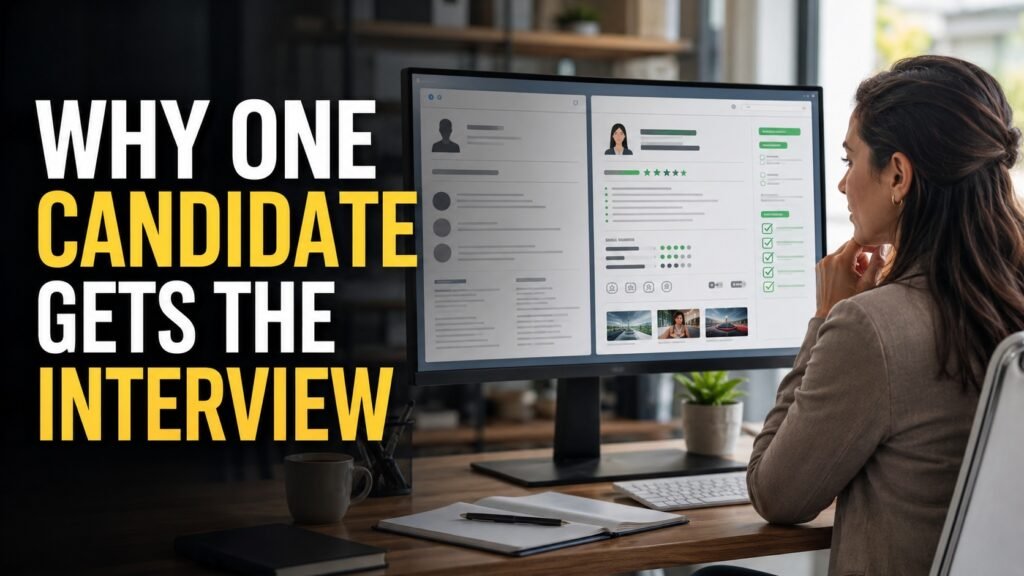
When two remote candidates appear similar, a sound hiring process should compare job-related evidence—not charisma, private circumstances or invented “culture fit.” Differentiators often include the specificity of past results, relevance of work samples, clarity under constraints, written communication, collaboration across distance and the candidate’s ability to explain tradeoffs and limitations. Structured interviews ask consistent questions and use common rating standards; work simulations can reveal how a person performs representative tasks. Candidates cannot control every decision, but they can make relevant evidence easier to find, verify and score.
What to verify
- Extract competencies and outputs from the actual job description rather than a generic role profile.
- Confirm that every résumé result has scope, your responsibility, method, outcome, limitation and verifier.
- Use a representative, permission-safe work sample and label synthetic assumptions.
- Prepare for consistent behavioral and situational questions without memorizing deceptive scripts.
- Request an accommodation through the employer’s process; do not disclose unnecessary medical detail.
Create a claim ledger with the claim, direct URL, source owner, publication/update date, access date, scope or jurisdiction, confidence and unresolved question. Recheck volatile facts on release day. When the evidence does not establish a condition, state “not established” rather than filling the gap.
Evidence or implementation framework
- Match strength: direct evidence for essential duties, adjacent evidence and true gaps.
- Outcome quality: baseline, action, observable change, attribution limit and evidence owner.
- Remote readiness: written decisions, asynchronous handoffs, escalation and access/security habits.
- Communication: answer first, reasoning, uncertainty, audience adaptation and next action.
- Learning: feedback received, correction made, later result and remaining constraint.
For every example use context, responsibility, method or control, observable result, limitation and verifier. Separate fact, scenario and inference. Remove confidential employer, client, candidate, health, security or financial data. A smaller defensible example is more useful than a large unverified claim.
Practical application or implementation steps
- Turn the job description into five scored competencies and three deliverables.
- Map each competency to one concise example and flag gaps instead of stretching claims.
- Build one synthetic work sample that represents a real task and explains assumptions.
- Practice structured answers with context, responsibility, action, result and limitation.
- Audit written communication for clarity, accessibility and decision usefulness.
- Prepare questions about success measures, collaboration, onboarding and evaluation.
- Afterward, record evidence gaps and improve them rather than inferring a hidden personal reason.
A useful first-hour output is one completed evidence matrix or decision table. Include a stop condition: an unverified source, unclear scope, inaccessible mandatory step, sensitive-data exposure or a conclusion that reverses under reasonable assumptions.
Safety, accessibility and trust
Employment decisions can be affected by bias and unlawful practices; this guide does not validate a particular employer’s process or provide legal advice. Never fabricate references, metrics or credentials. Use independently reached official domains. Never pay an individual for recruitment, equipment, training, identity checks or account recovery; never share passwords, one-time codes or unrestricted identity files. Provide keyboard-accessible controls, clear headings, descriptive links and text alternatives. Material medical, legal, tax, employment, privacy or security decisions require accountable qualified review.
Engagement checklist
The reader should leave able to state the current answer in one sentence, identify three relevant factors and two unknowns, save at least four direct sources with dates, complete one evidence or decision row, name a safety or methodology stop condition and choose one next step plus review date. Measure purposeful checklist completion rather than raw scrolling.
Primary and official sources
- OPM — Structured interviews: https://www.opm.gov/policy-data-oversight/assessment-and-selection/structured-interviews/
- OPM — Hiring assessments: https://www.opm.gov/agency-services/talent-management-services/assessment-and-evaluation/hiring-assessments/
- EEOC — Employment tests and selection procedures: https://www.eeoc.gov/laws/guidance/employment-tests-and-selection-procedures
- EEOC — Disability discrimination: https://www.eeoc.gov/disability-discrimination-and-employment-decisions
Access date: 2026-08-09. These sources establish only the scoped facts described in this package. They do not collectively prove a live vacancy, individual eligibility, guaranteed outcome, universal causal effect or current compensation.
FAQ
Why does one similar candidate advance?
Usually the hiring team finds stronger job-related evidence or a clearer match, but candidates rarely see the complete process and should not invent certainty.
Does personality decide?
A well-designed process uses job-related competencies and consistent standards, although real practices vary.
Should I copy a portfolio template?
Use a structure, but fill it with permission-safe evidence and explain your own decisions.
Can I ask for interview feedback?
Yes, respectfully, but employers may not provide it. Use your evidence audit regardless.
Choose your next step
Keep your momentum with practical tools and verified remote-work opportunities.
Related guides for your next step
A fresh, topic-aware mix from the WorkinVirtual library. Suggestions rotate regularly.





Discuss this guide
Ask a useful question, share relevant experience, or add a practical correction. Helpful contributions publish immediately after automated safety checks.
Start a thoughtful discussion
Be the first member to add a question or practical insight about this topic.
Join the discussion
Sign in with your verified WorkinVirtual account to contribute. Automated safety checks keep posting quick and protect the community.
Sign in to contribute