

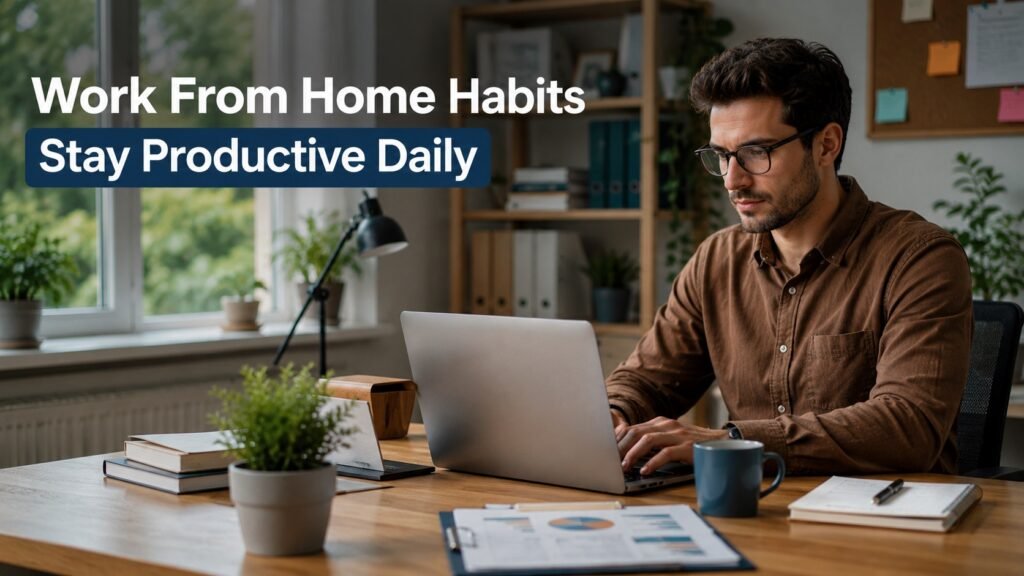
A better work-from-home routine does not copy an office minute by minute. It protects a high-value focus period, makes availability visible, includes movement and meals, and ends with a shutdown that separates work from home. Choose one habit, test it for five working days and measure output, energy and spillover; keep what helps and change what does not.
Define a successful day
Productivity is not keyboard activity. At the start of the day, identify one important outcome and up to two maintenance tasks. A support agent’s output may be safe, high-quality resolutions; a writer’s may be a reviewed draft; a manager’s may be a decision that unblocks a team.
Share constraints when others depend on you. “Offline 14:00–15:00; urgent incidents use the on-call route” is clearer than appearing always available.
A flexible daily structure
Opening: review commitments, choose the important outcome and remove obvious blockers.
Focus block: reserve 45–90 minutes for work that needs concentration. Silence nonessential alerts and keep a note for unrelated thoughts.
Communication window: process messages, make decisions and update colleagues. A window is not a promise to ignore genuine emergencies; the team needs a defined escalation path.
Recovery: take meals, change posture, move and rest eyes. Workstation guidance can reduce strain, but individual health needs require qualified advice.
Shutdown: record progress, capture loose tasks, choose tomorrow’s first action and set status. Close work systems when the role allows.
Caregivers and workers with health conditions may need shorter blocks or different hours. Consistency means a reliable pattern, not identical schedules.
Five-day habit experiment
Choose one change, such as:
- a 60-minute notification-free focus block;
- checking email at defined intervals;
- a written top outcome;
- a ten-minute midday walk;
- a fixed shutdown note.
Before starting, record a simple baseline. For five days, track whether the important outcome was completed, your end-of-day energy from one to five, unplanned overtime and major interruptions. At the end, keep, adjust or discard the habit. Do not add another habit until you understand the first.
Communication is part of the routine
Remote focus fails when colleagues cannot distinguish delay from disappearance. Agree on expected response times by channel. Put durable decisions in a searchable place. Use status for availability, not as surveillance.
Send updates with context, progress, risk and next action. When blocked, state what you tried and what decision is needed. This reduces meetings and demonstrates remote readiness.
Shape the environment
Use a workspace that is as safe and sustainable as circumstances allow. Place essential materials within reach, adjust screen and chair position, and change posture regularly. Noise control may mean headphones, a household signal or choosing a quieter focus window.
Separate work through cues: a lamp switched on, a short walk, packing the laptop away or changing accounts. The cue matters because it starts or closes a behaviour consistently.
How to use this when applying for remote jobs
Application steps: verify the vacancy’s geography and schedule, map requirements to evidence, and prepare a remote-work story showing planning, communication and recovery from disruption. A credible interview answer describes an actual system and its trade-offs, not “I am productive at home.”
Ask how priorities change, how urgent work is escalated and how the employer prevents after-hours overload. Avoid companies that equate remote work with unpaid permanent availability.
Safety and limits
Burnout, pain, sleep problems or persistent anxiety are not productivity failures. Use employer support and qualified medical help where appropriate. Do not turn health data or webcam monitoring into a personal optimisation project.
Job seekers should also verify remote offers. Never pay for equipment or deposit a cheque to purchase it. Confirm the employer domain and interview process.
Quick questions
Should I follow the same schedule daily? A repeatable skeleton helps, but adapt it to duties, time zones and health.
Are long focus blocks always better? No. Use a duration you can sustain and that fits the task.
How many priorities per day? One important outcome plus limited maintenance work is a practical starting point.
What if messages are constant? Agree on response expectations and a genuine urgent channel with the team.
Choose your next step
Keep your momentum with practical tools and verified remote-work opportunities.
Related guides for your next step
A fresh, topic-aware mix from the WorkinVirtual library. Suggestions rotate regularly.






Discuss this guide
Ask a useful question, share relevant experience, or add a practical correction. Helpful contributions publish immediately after automated safety checks.
Start a thoughtful discussion
Be the first member to add a question or practical insight about this topic.
Join the discussion
Sign in with your verified WorkinVirtual account to contribute. Automated safety checks keep posting quick and protect the community.
Sign in to contribute