

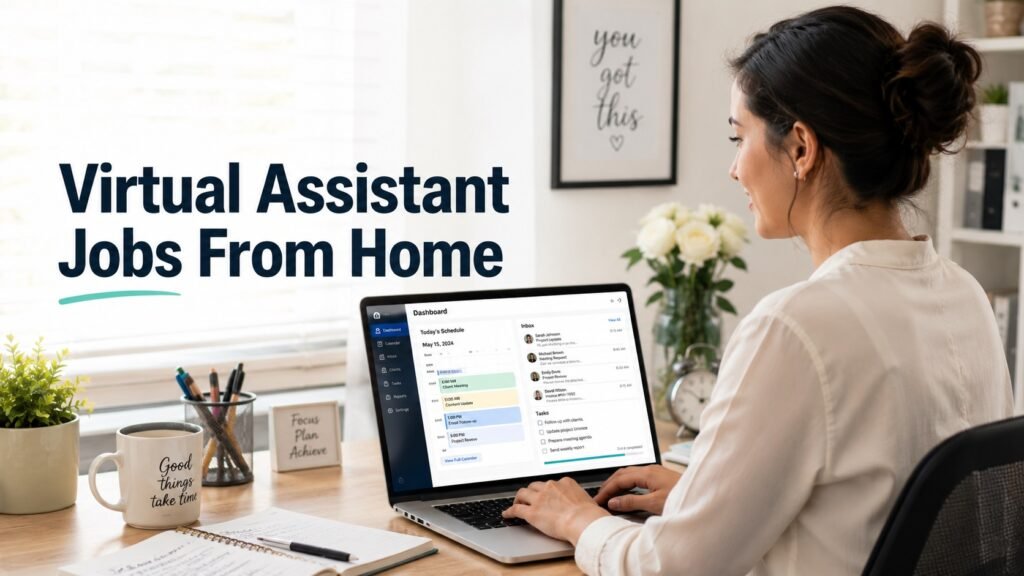
A beginner virtual assistant should start with one bounded service, one type of client and a clear delivery standard—not a promise to do every online task. Examples include calendar support, inbox triage, document formatting, research or customer operations, subject to appropriate access and privacy controls. Create a synthetic work sample, define scope, turnaround, revision, communication, payment and termination terms, then screen the client before receiving sensitive access. Many arrangements are self-employment, but classification depends on the real relationship and applicable law. Track time, income, expenses and taxes. Never pay to receive work, accept an excess check, move client money or reship goods.
Evidence that demonstrates fit or progress
Design a fictional service package with target client, included tasks, excluded tasks, inputs, output format, turnaround, revision limit, communication window, privacy rule and price assumption. Build a synthetic calendar, inbox taxonomy, spreadsheet or research brief without real client data. Add a checklist for access level, password manager use, account ownership, backup and offboarding. Track time across three trial deliveries and calculate an effective rate after preparation, revisions, fees and unpaid administration. Do not publish passwords, calendars, contact lists, contracts, invoices or client materials.
Build a requirement-to-evidence matrix with requirement, proof, result and gap columns. Copy a current requirement or operating need into the first column. Add one truthful example and a verifiable result. Label missing proof as a gap instead of hiding it with keywords. Legal status, health, safety, schedule, location, privacy, accessibility or security mismatches require a decision.
Write two short cases containing context, constraint, personal action, quality or safety check and result. Reduce each to one résumé, plan or portfolio bullet. Keep confidential clients, systems, employees, health information and security details out. A credible sanitized example is stronger than detail that should not be public.
How to apply or use the guidance
Choose a service that matches existing evidence and can be delivered safely. Screen clients by legal name, business domain, contact, scope, payment method and public footprint. Use a written agreement that states deliverables, access, confidentiality, fees, expenses, payment timing and termination. Start with least-privilege access and remove it at offboarding. Keep business and personal finances appropriately separated and consult official tax resources for your jurisdiction. Avoid unpaid custom work beyond a small bounded test, and reject checks, crypto deposits, reshipping and requests to use personal financial accounts.
Verification checklist
- Open the official employer, government or primary source.
- Confirm current status, document or requisition ID and the date checked.
- Record legal, location, eligibility, deadline, privacy and work-model constraints.
- Compare mandatory criteria with evidence that can be substantiated.
- Identify one decisive gap before spending more time or money.
- Save the source, decision, accountable owner and fallback.
- Stop when payment, secrets, unsafe access or unofficial transfer of sensitive information is demanded.
Practical exercise and decision aid
Create a next-48-hours card with one verification, one evidence improvement and one communication action. At the end, mark completed, learned and changed. This creates a return reason and keeps the page useful when a legacy vacancy, product claim or simplistic promise is removed.
Use a stop/continue table. Continue when the official source is current, core requirements fit and the next cost is reasonable. Pause when legal status, health, location, accessibility, safety, security, privacy or money is unclear. Stop when an accountable party is hidden, payment is demanded for a job, or normal verification is bypassed.
Safety and stale-content cleanup
Delete claims that beginners are broadly finding flexible work in 2026 or that virtual assistance provides quick guaranteed income. Remove platform rankings, current fees and rate tables unless checked and dated. Do not label every VA a contractor or imply a contract overrides worker-classification law. Avoid presenting privacy or tax steps as universal legal advice. Preserve the owner as an educational guide, remove active vacancy schema and refresh official scam and tax references.
- Replace urgency and guaranteed outcomes with dated verification.
- Do not infer remote work from a digital role or site brand.
- Keep employer, government, manager, worker and tool roles distinct.
- Put official or primary sources ahead of copied pages.
- Do not collect identity, bank, health, immigration or security data.
- Recheck canonical, robots, schema, outbound links and dates in QA.
- Keep unpublished if the intent cannot be served honestly.
Frequently asked questions
What service should a beginner offer first?
Choose one bounded service with a clear output, delivery standard and evidence you can show safely.
Do I need to be a contractor?
Not necessarily; classification depends on the real relationship and applicable law.
How should I share passwords?
Use approved least-privilege access and a password manager; avoid sending reusable credentials in chat.
Should I pay for client leads or onboarding?
Be cautious; legitimate work should not require paying an unknown recruiter to unlock earnings.
Official and primary sources
- IRS Independent Contractor Defined — official or primary evidence for scope, status, safeguards or application.
- IRS Worker Classification — official or primary evidence for scope, status, safeguards or application.
- IRS Small Business and Self-Employed Center — official or primary evidence for scope, status, safeguards or application.
- FTC Work-at-Home Enforcement — official or primary evidence for scope, status, safeguards or application.
- FTC Remote Job Scam Guidance — official or primary evidence for scope, status, safeguards or application.
Research checked 2026-08-09. Organization and guidance pages establish context; only an accountable live source establishes a current vacancy, rule, price or individual recommendation. Evidence is applied within its limits and does not guarantee outcomes.
Choose your next step
Keep your momentum with practical tools and verified remote-work opportunities.
Related guides for your next step
A fresh, topic-aware mix from the WorkinVirtual library. Suggestions rotate regularly.




Discuss this guide
Ask a useful question, share relevant experience, or add a practical correction. Helpful contributions publish immediately after automated safety checks.
Start a thoughtful discussion
Be the first member to add a question or practical insight about this topic.
Join the discussion
Sign in with your verified WorkinVirtual account to contribute. Automated safety checks keep posting quick and protect the community.
Sign in to contribute