

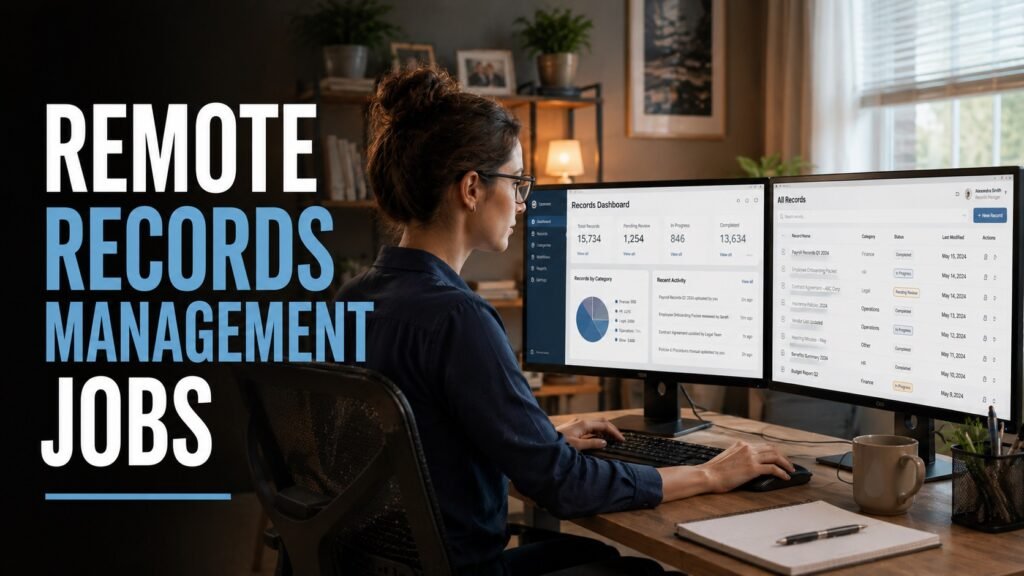
Online records-management work involves controlling information through its lifecycle, not merely typing data into a system. Entry roles may scan, index, classify, retrieve and quality-check documents, while advanced roles develop retention rules, permissions, audits and defensible disposition. Candidates should prove accuracy, confidentiality and process discipline, then verify that a remote employer has a legitimate role and secure way to handle records.
Data entry versus records management
Data entry focuses on capturing or correcting information. Records management asks what the record is, who owns it, how long it must be kept, who may access it and what happens at the end of its lifecycle. A job can include both, but the accountability is different.
Document control is another related path, common in engineering, construction, healthcare and regulated industries. Archives work can emphasise long-term preservation and historical value. Information governance connects records, privacy, legal requirements, risk and technology. Read the live duties rather than relying on the title alone.
Common duties and evidence
Entry or support duties can include scanning, indexing, metadata entry, file naming, quality review, retrieval, access requests and inventory. More experienced work can include retention schedules, legal holds, taxonomy, system migration, audits, training and disposal controls.
| Capability | Evidence to prepare |
|---|---|
| Accuracy | Error rate, audit result or corrected backlog |
| Classification | Consistent use of taxonomy or file plan |
| Retrieval | Faster response or improved findability |
| Privacy | Controlled access and safe data handling |
| Retention | Applied an approved schedule with review |
| Change support | Migrated or cleaned records with traceability |
Do not claim legal authority you did not have. If you followed an approved schedule, say that; do not present yourself as its author unless you were responsible for it.
Records-lifecycle scenario
Use this engagement exercise. A shared drive contains duplicate contracts, drafts, signed versions and personal data with unclear owners. Write what you would do before deleting anything. A safe answer identifies the record owner, pauses destruction, confirms legal hold and retention rules, inventories versions, protects access and documents decisions.
This scenario separates records judgement from fast data entry. The correct first move is rarely “clean everything up.” It is to establish authority and preserve evidence.
Tools and learning path
Employers may use Microsoft 365, SharePoint, enterprise content management systems, document-management platforms, spreadsheets, scanning tools and ticketing systems. Tool names change, so learn the underlying controls: metadata, versioning, permissions, audit logs, retention labels, search and export.
ARMA International provides professional resources and credentials, while the U.S. National Archives publishes official records-management guidance. A certification can help but is not a universal entry requirement. Start with a small, non-confidential portfolio: a sample file plan, metadata dictionary, quality checklist and documented retention-decision workflow.
How to apply
- Verify the vacancy on the employer’s official careers site.
- Identify whether it is data entry, records support, document control, archives or governance.
- Confirm industry-specific privacy, licence or clearance requirements.
- Build a requirement-to-evidence matrix.
- Tailor the resume around accuracy, retrieval, confidentiality and controlled decisions.
- Ask how remote records are accessed, secured and audited.
- Apply through the official route and retain the requisition.
Remote suitability depends on the information. An employer may require secure devices, approved networks, a private workspace or on-site handling of physical records. Never promise work-from-anywhere access to sensitive documents.
Application safety
Remote data-entry scams often use records-related titles. Do not pay for software, training, equipment or a background check. Be cautious about high pay for simple typing, interviews conducted only by chat, mailed cheques and demands to purchase equipment from a named vendor.
Never upload identity documents, health records, customer files or other sensitive data into an interview test. A legitimate skills exercise can use synthetic records and a clear privacy notice.
Quick questions
Is records management the same as data entry? No. Data entry captures information; records management controls classification, access, retention and disposition.
Can records jobs be remote? Some can, but security, physical documents and regulatory controls may require approved locations or on-site work.
Do I need a degree? Requirements vary. Entry roles may value accuracy and systems experience; advanced governance or archives roles may require specialised education.
Which skills should I learn first? Metadata, file plans, access control, quality assurance, retention basics, privacy and spreadsheet or document-system proficiency.
Choose your next step
Keep your momentum with practical tools and verified remote-work opportunities.
Related guides for your next step
A fresh, topic-aware mix from the WorkinVirtual library. Suggestions rotate regularly.





Discuss this guide
Ask a useful question, share relevant experience, or add a practical correction. Helpful contributions publish immediately after automated safety checks.
Start a thoughtful discussion
Be the first member to add a question or practical insight about this topic.
Join the discussion
Sign in with your verified WorkinVirtual account to contribute. Automated safety checks keep posting quick and protect the community.
Sign in to contribute