

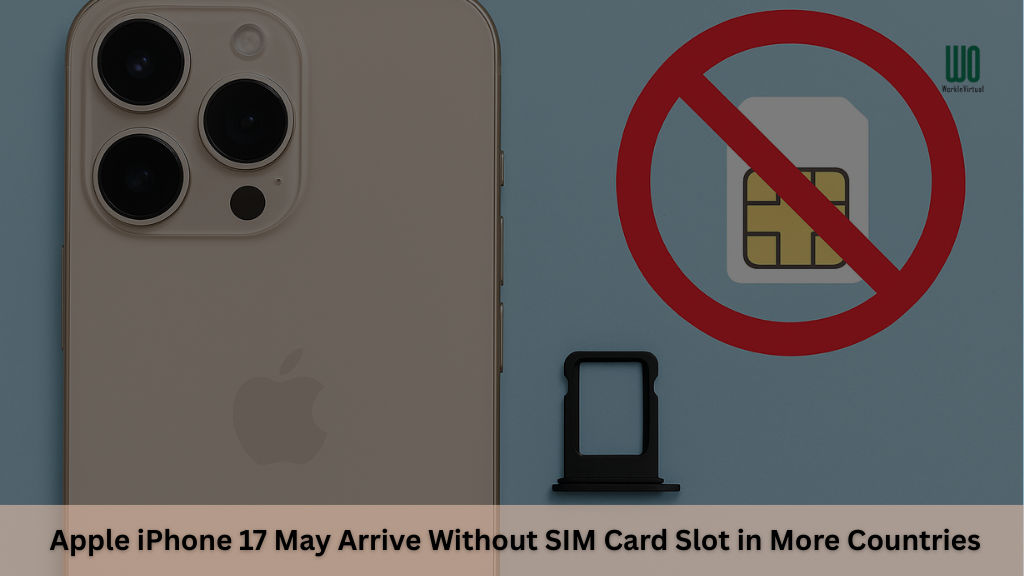
Apple seems ready to take another bold step toward a future without physical SIM cards. New details suggest that the upcoming iPhone 17 lineup could drop the traditional SIM tray in several more regions, extending the digital-only eSIM rollout far beyond the United States.
Training Signals a Major Shift in Europe
According to people familiar with Apple’s internal plans, staff members at Apple Authorized Resellers in the European Union have been instructed to complete a mandatory training program focused on eSIM technology. The deadline for this training is set for Friday, September 5. With Apple’s next major launch event expected on September 9, the timing strongly hints that eSIM-only iPhones are about to make their debut in Europe.
A Global Push Beyond the US
In the US, iPhones have already gone “all-in on” eSIM starting with the iPhone 14 series. Now, it looks like other parts of the world are next in line. The training materials are being shared through Apple’s SEED app, a platform used not only in Europe but across Apple Stores and reseller networks worldwide. This could indicate that the shift is much bigger than just Europe.
What to Expect From the iPhone 17
Apple is rumored to unveil several models this year, including the ultra-thin iPhone 17 Air. Analysts believe this model will certainly launch without a SIM card tray in most countries. Industry insiders suggest that the iPhone 17 Pro and iPhone 17 Pro Max could also be eSIM-only in international markets, though some regions, such as China, may remain exceptions for now.
Why Apple Wants a SIM-Free Future
Apple has long argued that eSIM technology can provide greater security because it cannot be physically removed if an iPhone is lost or stolen. It also simplifies international travel by allowing users to activate multiple eSIM profiles without juggling tiny cards. Up to eight eSIMs can be managed on a single device, making it far more convenient for frequent travelers.
The Broad Strategy of Apple
The move toward eSIM is part of Apple’s broader strategy to streamline hardware design and encourage digital-first adoption worldwide. While the transition may face some resistance in countries where carrier support is still limited, Apple’s momentum suggests it is only a matter of time before physical SIM cards become a thing of the past.