

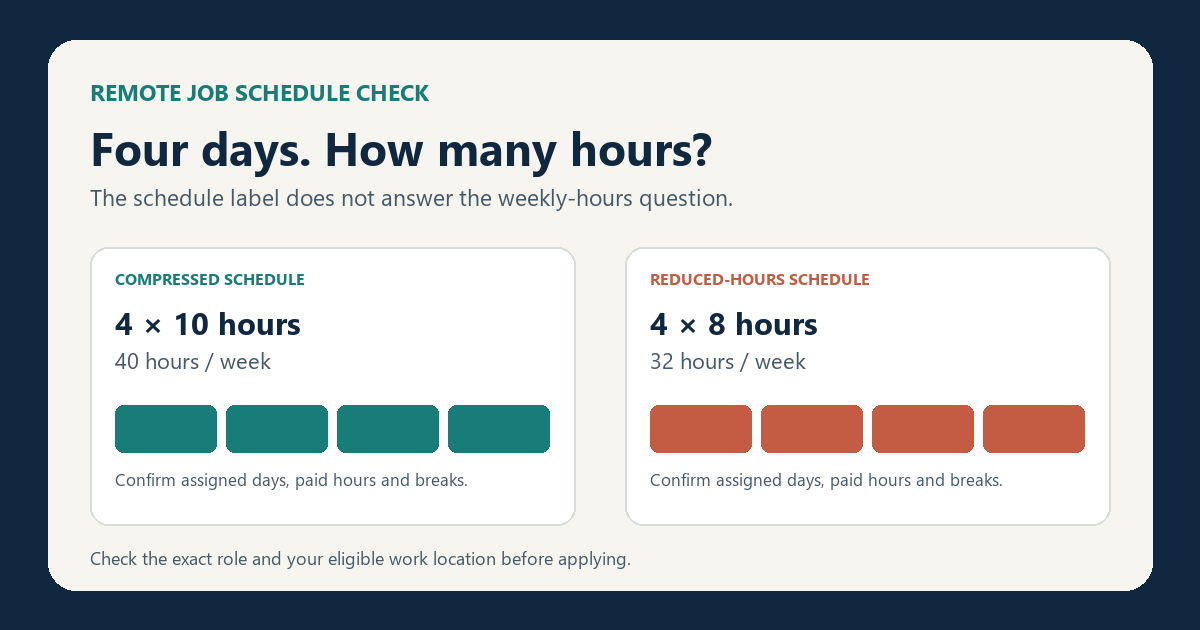
A remote job advertised as a “four-day week” may still schedule 40 hours. Before you apply, confirm whether the role compresses 40 hours into four longer days or schedules fewer hours, such as 32 across four days. Check the assigned days, paid hours, breaks, shift times and states where you may work.
The U.S. Department of Labor says the Fair Labor Standards Act does not define full-time employment hours; employers generally determine that label. “Full-time” and “four-day” alone do not tell you how many paid hours the offer includes. DOL: FLSA questions and answers.
Separate the number of days from the number of hours
These are different schedules:
- Compressed 40-hour schedule: four 10-hour workdays, totaling 40 hours in the week.
- Reduced-hours schedule: four 8-hour workdays, totaling 32 hours in the week, if the employer confirms those hours and pay terms.
- Unclear or rotating schedule: the posting says “four-day week” but does not specify weekly hours, fixed days or shift length. Treat those details as unanswered.
The Office of Personnel Management describes a four-day compressed schedule for full-time federal employees as 10 hours a day and 40 hours a week. That is a federal example; it does not establish the schedule or employment terms for a private employer. OPM: alternative work schedules.
Read a remote listing without assuming it is nationwide
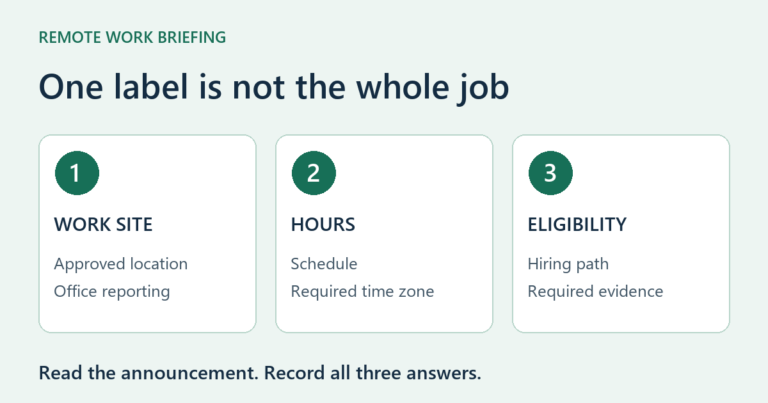
MCI’s careers page currently displays a bank call-center role labeled “4X10,” “4 Days A Week (10 Hour Days)” and “Full-Time.” Its location field says US-GA-Savannah, while its description calls the work remote. The page does not establish that applicants can work from anywhere in the United States. Ask whether your state and home address are approved, then confirm the actual days, start and end times, and any required training schedule on the employer’s page. MCI’s official role posting.
Check the daily span and the weekly total
Four longer days can change childcare, appointments, a second job or when you can disconnect. Put the stated start and end times into your local calendar, and check the workweek dates and time zone. If the listing gives a shift range, write down the earliest start and latest end rather than planning around the most convenient option.
- Are the four workdays fixed, chosen by you, rotating or assigned by coverage needs?
- How many hours are scheduled and paid each week? Is a meal break unpaid or included in the stated span?
- What time zone sets the shift, and does the schedule change seasonally?
- Can the employer change days or hours after training? How much notice is stated?
For covered, nonexempt employees, federal overtime rules generally apply after 40 hours in a workweek, and some state laws set additional standards. That general rule does not answer how a particular role is classified or paid. Check the written offer and the labor guidance for the state where you will work. DOL: overtime pay.
Ask for four details before you count the schedule as a fit
You can ask the recruiter: “Does this four-day schedule mean 40 hours compressed into four shifts, or a reduced number of weekly hours? Which days and local start and end times apply to this position? Are meal breaks paid, and are days fixed or rotating? Is my state and work address eligible, and will training follow the same schedule?”
Keep the answer beside the offer. Record weekly scheduled hours, paid hours, days, daily span, time zone, break treatment, location approval and any detail still pending. If an essential item is missing, ask when it will be confirmed before you make plans around a particular schedule.
For other remote-job schedule checks, see how to compare training hours with a regular shift and how to read a team overlap window. Confirm address eligibility separately with the remote job location guide.
Choose your next step
Keep your momentum with practical tools and verified remote-work opportunities.
Related guides for your next step
A fresh, topic-aware mix from the WorkinVirtual library. Suggestions rotate regularly.


Discuss this guide
Ask a useful question, share relevant experience, or add a practical correction. Helpful contributions publish immediately after automated safety checks.
Start a thoughtful discussion
Be the first member to add a question or practical insight about this topic.
Join the discussion
Sign in with your verified WorkinVirtual account to contribute. Automated safety checks keep posting quick and protect the community.
Sign in to contribute