

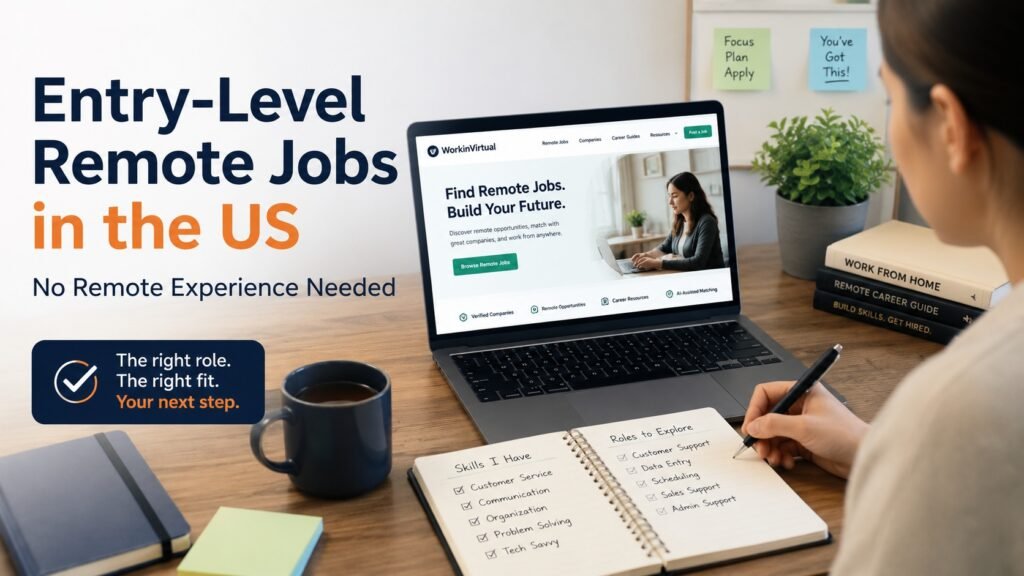
Yes, you can qualify for some entry-level remote jobs in the United States without previous remote-work experience or direct experience in the exact role. But “no experience” rarely means “no skills required.” Employers may still expect strong communication, organization, computer skills, problem solving, schedule availability, work authorization or evidence that you can perform the essential duties.
The most useful approach is not to ask only, “Does this job require experience?” Ask three separate questions:
- Am I eligible to work in this role?
- Can I meet its essential requirements?
- Can I prove that with experience I already have?
That experience does not always have to come from another remote job. Retail, hospitality, office work, volunteering, school projects, customer-facing work and other responsibilities can provide transferable evidence when they involve comparable skills.
This guide explains the types of entry-level remote work worth investigating in the US and, more importantly, how to decide whether a particular opening is actually a sensible application for you.
What Does “No Experience” Really Mean in a Remote Job?
Job seekers often use “no experience” to describe several very different situations.
| Situation | What it actually means |
|---|---|
| No remote-work experience | You have worked before, but not from home or in a distributed team. |
| No direct role experience | You have not held that exact job title, but may have performed similar tasks elsewhere. |
| Limited professional experience | You may be entering the workforce, returning after a gap or changing careers. |
| No relevant evidence | You currently cannot demonstrate the skills or essential requirements of the role. |
The first three situations can still lead to realistic entry-level opportunities. The fourth is different.
If an employer requires accurate written communication, for example, you do not necessarily need a previous title such as “Remote Customer Support Representative.” You do need some credible way to demonstrate that you can communicate accurately in writing.
Similarly, an employer describing previous experience as preferred creates a different situation from an employer making two years of specific experience required.
Read the actual requirements rather than relying on labels such as “entry level,” “beginner friendly” or “no experience.”
Entry-Level Remote Role Families Worth Exploring
The following role families can contain entry-level opportunities where transferable experience matters. They are search directions, not claims that every job in these categories requires no experience or is currently hiring. Requirements vary by employer and by individual opening.
1. Customer Support
Remote customer support can involve answering questions, documenting interactions, resolving routine problems, escalating complex cases and communicating through phone, email, chat or ticketing systems.
Previous remote support experience may not always be necessary if you can demonstrate relevant customer-facing skills.
Transferable evidence could come from:
- retail or hospitality customer service;
- handling customer questions or complaints;
- explaining information clearly;
- documenting customer interactions;
- resolving problems while following a process;
- working calmly with dissatisfied customers.
Do not assume every customer support position is entry level. Some require product knowledge, industry experience, specific software knowledge, evening or weekend availability, or previous contact-center experience.
2. Administrative and Operations Support
Administrative and operations roles can involve maintaining records, coordinating information, preparing documents, updating systems, following processes and supporting a distributed team.
A candidate who has never been a “Remote Operations Assistant” may still have relevant evidence from office administration, education, community organizations, small businesses or other coordination work.
Useful evidence could include maintaining accurate records, preparing documents, tracking tasks, organizing information or coordinating work between several people.
3. Scheduling and Appointment Support
Scheduling roles may involve arranging appointments, managing calendars, confirming availability, communicating changes and keeping records accurate.
Relevant experience does not have to come from a dedicated scheduling job. Reception work, clinic administration, hospitality, office coordination or any position involving appointments and calendars may provide transferable evidence.
Pay particular attention to required working hours. A remote scheduling position may need coverage during a specific US time zone even though employees work from home.
4. Sales Development and Sales Support
Some entry-level sales roles focus on prospect research, initial outreach, qualifying potential customers, updating CRM records or arranging meetings for sales teams.
Customer-facing experience can sometimes transfer well because the work requires communication, listening, persistence and accurate record keeping.
However, distinguish between an entry-level sales-support opportunity and a position requiring an established sales record, industry relationships or specialist product knowledge.
Also check how compensation works. Some sales roles include variable or commission-based compensation, so never infer guaranteed earnings from an advertised potential figure.
5. Claims and Intake Support
Healthcare, insurance, legal and other service organizations can use intake or claims-support staff to collect information, maintain records, communicate with customers or clients and route cases through established processes.
Customer service, administrative accuracy and experience handling sensitive information may be relevant.
These roles can also involve regulated information, licensing requirements or industry-specific procedures. Treat any mandatory requirement in the current posting as a genuine condition rather than assuming that “entry level” overrides it.
6. Recruiting Coordination
Recruiting coordinators and recruiting-support roles can involve interview scheduling, candidate communication, record updates and coordination between recruiters, candidates and hiring teams.
Scheduling, professional communication, administration and handling confidential information can provide useful transferable evidence.
A recruiter role responsible for sourcing strategy, specialist hiring or managing the full recruitment process may require substantially more experience, so compare the responsibilities rather than relying on the job title alone.
7. Data Operations and Record Support
Entry-level data-oriented work can include reviewing records, updating information, checking accuracy, classifying information or maintaining databases and spreadsheets.
The strongest evidence is not simply saying that you are “detail oriented.” Show where accuracy mattered.
For example, you might have maintained inventory records, checked invoices, updated customer information, prepared spreadsheets, reviewed forms or identified errors before information was submitted.
Be especially cautious with vague advertisements promising unusually easy money for simple “data entry.” Verify the employer and application route independently before sharing personal information.
8. Entry-Level Technical Support
Some technical support positions focus on common user problems, documented troubleshooting procedures, account issues and escalating more complex cases.
You may not need previous remote-work experience, but employers can still require technical knowledge.
Useful evidence might come from troubleshooting software or devices, helping customers use technology, following technical procedures or learning comparable systems.
If a posting names a specific platform you have never used, determine whether it is mandatory expertise or simply one of the employer’s tools. Experience with comparable software plus evidence that you learn systems quickly can sometimes establish a credible bridge—but it should never be presented as experience you do not have.
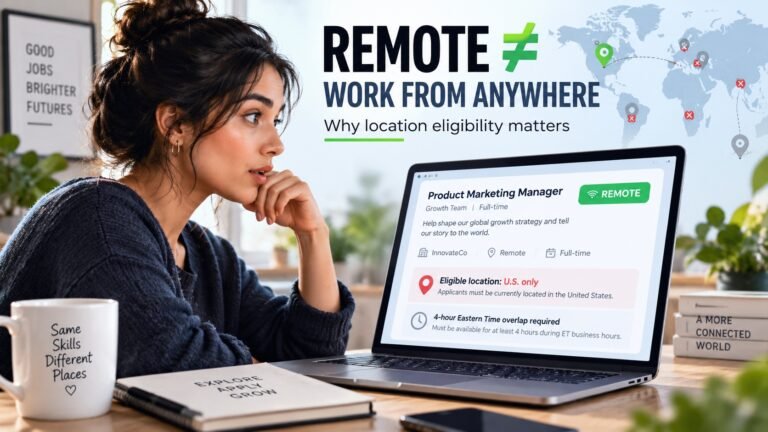
Remote Does Not Automatically Mean You Can Work From Anywhere
This is one of the most important checks in a US remote-job search.
A job can be fully remote and still restrict where the employee may live or work.
Before applying, check the current posting for:
- Country requirements: Is the opportunity limited to people working in the United States?
- State restrictions: Does the employer hire remotely only in particular states?
- Residence requirements: Must you live within a defined area?
- Work authorization: Are you legally authorized for the employment described?
- Time-zone requirements: Must you work Eastern, Central, Mountain or Pacific hours?
- Training: Is initial training scheduled at fixed times or in a particular location?
- Payroll eligibility: Can the employer employ workers where you are located?
- Travel: Does the position occasionally require meetings, training or customer visits?
For US employees, federal law generally requires employers to verify the identity and employment authorization of new employees through Form I-9. Immigration and work-authorization circumstances vary, so use current official government guidance when determining your own status.
A remote label therefore describes where the work is performed; it does not erase the employer’s location, employment or eligibility requirements.
How to Turn Transferable Experience Into Evidence
Many candidates undersell themselves because they compare job titles instead of comparing responsibilities.
Suppose an employer needs someone who can communicate with customers, document interactions and resolve routine problems.
A candidate who worked in a hotel, restaurant or retail store may already have performed all three activities—even though their previous title looks completely different from the remote role.
| Remote-job requirement | Possible transferable evidence |
|---|---|
| Customer communication | Retail, hospitality, reception or other customer-facing work |
| Scheduling | Managing appointments, calendars, reservations, shifts or meetings |
| Written communication | Professional email, chat, reports, customer records or documented instructions |
| Problem solving | A specific example of resolving a customer or operational problem |
| Record accuracy | Inventory, orders, forms, spreadsheets, invoices or customer records |
| Software or CRM use | Comparable systems plus evidence of successfully learning new tools |
| Working independently | Tasks you owned, prioritized and completed without continuous supervision |
The important word is evidence.
Instead of writing:
“Excellent problem-solving skills.”
prepare an example that explains the problem, what you personally did and what happened afterward.
Instead of:
“Quick learner.”
identify a system, process or responsibility you had to learn and explain how you became capable of using it.
You do not need to manufacture remote experience. You need to make relevant existing experience understandable.
Use a Three-Level Fit Check Before You Apply
For each important requirement in a job posting, classify your evidence as:
- Direct: you have already performed substantially the same responsibility;
- Transferable: you have comparable experience that demonstrates the underlying capability;
- Missing: you currently cannot demonstrate the requirement.
Then determine whether the requirement itself is essential or preferred.
If a preferred software platform is unfamiliar but you have used comparable systems, that may be a reasonable transferable gap.
If the employer requires you to work a schedule you cannot work, hold a mandatory license you do not possess, reside in an eligible state or satisfy an essential work-authorization condition, that is not a resume-writing problem.
It is an eligibility or qualification mismatch.
This distinction can save you from spending time tailoring applications for jobs you cannot actually accept.
A Practical Application Checklist
Before submitting an application for an entry-level US remote job:
- Confirm that the opening is current. Do not rely on an old article, social-media post or search result as proof that a vacancy remains available.
- Read the location carefully. Confirm country, state, residence and time-zone requirements.
- Check work authorization and other eligibility conditions.
- Separate essential requirements from preferred qualifications.
- Identify your direct and transferable evidence.
- Do not claim tools or experience you do not have. Explain comparable experience instead.
- Tailor your resume around the responsibilities that genuinely match your background.
- Check schedule, training and travel requirements.
- Verify the employer and application route.
- Save the job description and the resume version you submitted.
Be Careful With “No Experience” Remote-Job Scams
Remote and work-from-home opportunities are also used as bait in employment scams.
The Federal Trade Commission warns that scammers may impersonate legitimate employers, advertise fake work-from-home jobs, request money or personal information, or send fraudulent checks connected with supposed employment.
A legitimate-looking company name or job description is not enough to establish that the person contacting you actually represents that organization.
Be particularly cautious when someone:
- asks you to pay to get a job;
- sends a check and asks you to return or forward part of the money;
- demands payment through gift cards, cryptocurrency, wire transfer or similar methods;
- promises unusually high earnings for very little work;
- asks for sensitive financial or identity information before you can verify the employer and hiring process.
If you discover an opportunity elsewhere, look for the same vacancy through the employer’s legitimate recruiting channel before proceeding.
So, Can You Get a Remote Job Without Experience?
You can qualify for some entry-level remote jobs without previous remote-work experience or without having held the exact job before.
What matters is whether the particular employer accepts your level of experience and whether you can demonstrate the skills, transferable evidence and eligibility the role actually requires.
Do not eliminate yourself simply because your previous job title is different. But do not treat “no experience” as permission to ignore mandatory requirements either.
A stronger remote-job search looks for the intersection of four things:
- the work you want to do;
- the skills and evidence you already have;
- the gaps you can realistically learn;
- the jobs for which you are actually eligible.
That is a much better basis for an application than sending the same resume to every position containing the word “remote.”
Ready to look for an opportunity that fits? Browse remote jobs on WorkinVirtual and check each listing’s requirements, location and eligibility information before applying.
Choose your next step
Keep your momentum with practical tools and verified remote-work opportunities.
Related guides for your next step
A fresh, topic-aware mix from the WorkinVirtual library. Suggestions rotate regularly.



Discuss this guide
Ask a useful question, share relevant experience, or add a practical correction. Helpful contributions publish immediately after automated safety checks.
Start a thoughtful discussion
Be the first member to add a question or practical insight about this topic.
Join the discussion
Sign in with your verified WorkinVirtual account to contribute. Automated safety checks keep posting quick and protect the community.
Sign in to contribute