

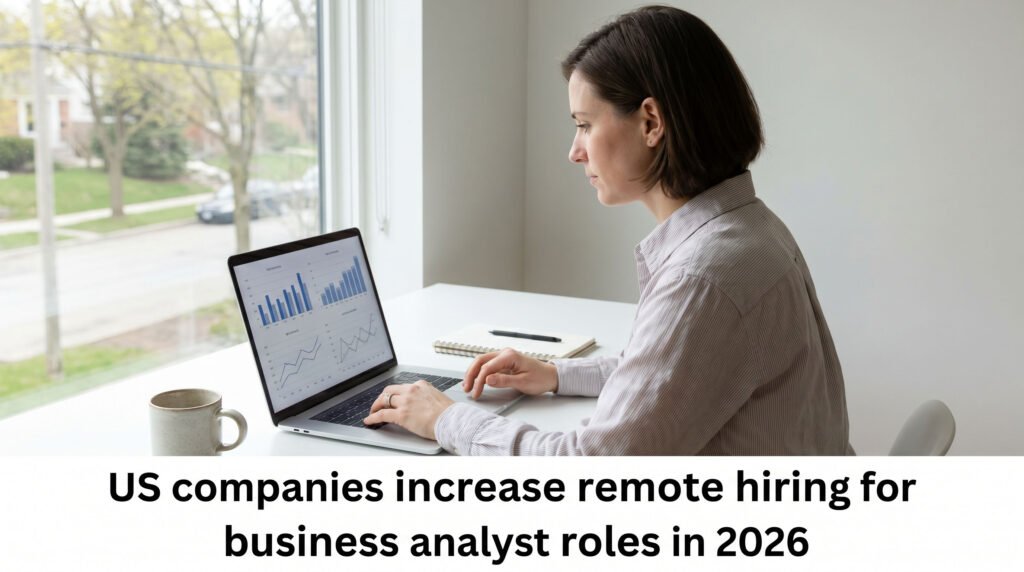
A remote business analyst turns an unclear operating problem into shared requirements, decisions, process changes and testable outcomes. The role may involve interviews, process mapping, data checks, user stories, acceptance criteria, documentation, change support and facilitation across time zones. Titles vary: some postings are closer to systems analysis, product operations, reporting or management consulting. Start by choosing a target family, then create a sanitized case that traces a problem from stakeholder evidence to an approved future state and measurable result. Verify industry, location, travel and tool requirements on the exact official posting; broad occupational projections do not establish remote availability.
Evidence that demonstrates fit or progress
Create an invented workflow problem. Document stakeholder groups, current-state process, evidence sources, pain points, constraints, risks and a clear problem statement. Produce a future-state map, prioritized requirements, acceptance criteria, decision log and one simple data check. Show how conflicting requests were resolved and how success would be measured after launch. Add a traceability table linking each requirement to source, owner, test and status. Use fictional or authorized data; remove customer names, employee records, credentials and proprietary rules. The artifact should demonstrate reasoning and change control, not decorative diagrams.
Build a requirement-to-evidence matrix with requirement, proof, result and gap columns. Copy a current requirement or operating need into the first column. Add one truthful example and a verifiable result. Label missing proof as a gap instead of hiding it with keywords. Legal status, health, safety, schedule, location, privacy, accessibility or security mismatches require a decision.
Write two short cases containing context, constraint, personal action, quality or safety check and result. Reduce each to one résumé, plan or portfolio bullet. Keep confidential clients, systems, employees, health information and security details out. A credible sanitized example is stronger than detail that should not be public.
How to apply or use the guidance
Sample ten official postings in one industry and classify them as process, systems, data, product or consulting oriented. Record required domain knowledge, tools, residence, office cadence, travel and repeated deliverables. Tailor the résumé with evidence of discovery, documentation, facilitation, analysis, testing and measurable improvement. In interviews, ask who owns requirements, how decisions are approved, how analysts work with product and engineering, and what successful adoption looks like. Apply only when mandatory criteria fit; use official portals and reject requests for money, bank access or private identity documents before a verified hiring process.
Verification checklist
- Open the official employer, government or primary source.
- Confirm current status, document or requisition ID and the date checked.
- Record legal, location, eligibility, deadline, privacy and work-model constraints.
- Compare mandatory criteria with evidence that can be substantiated.
- Identify one decisive gap before spending more time or money.
- Save the source, decision, accountable owner and fallback.
- Stop when payment, secrets, unsafe access or unofficial transfer of sensitive information is demanded.
Practical exercise and decision aid
Create a next-48-hours card with one verification, one evidence improvement and one communication action. At the end, mark completed, learned and changed. This creates a return reason and keeps the page useful when a legacy vacancy, product claim or simplistic promise is removed.
Use a stop/continue table. Continue when the official source is current, core requirements fit and the next cost is reasonable. Pause when legal status, health, location, accessibility, safety, security, privacy or money is unclear. Stop when an accountable party is hidden, payment is demanded for a job, or normal verification is bypassed.
Safety and stale-content cleanup
Remove the unsupported narrative that employers broadly increased remote analyst hiring in 2026. Do not publish volatile vacancy counts or compensation without a dated, comparable source. Avoid claiming that a tool certificate substitutes for stakeholder judgment or domain knowledge. Delete active-job urgency and any implication that “business analyst” has a universal duty set. Keep the owner evergreen, self-canonical and Article-based; refresh projections and role examples while preserving the distinction between occupational demand and remote work mode.
- Replace urgency and guaranteed outcomes with dated verification.
- Do not infer remote work from a digital role or site brand.
- Keep employer, government, manager, worker and tool roles distinct.
- Put official or primary sources ahead of copied pages.
- Do not collect identity, bank, health, immigration or security data.
- Recheck canonical, robots, schema, outbound links and dates in QA.
- Keep unpublished if the intent cannot be served honestly.
Frequently asked questions
Is a business analyst the same as a data analyst?
No. Some duties overlap, but business analysis often centers on requirements, processes, decisions and change.
Do I need SQL?
Some roles require it and others do not; verify repeated requirements in your chosen role family.
What portfolio evidence is useful?
A sanitized case with discovery evidence, process maps, requirements, acceptance criteria, decisions and outcome measures.
Can the role be fully remote?
Sometimes, but residence, client travel and office cadence must be checked on the official posting.
Official and primary sources
- BLS Management Analysts — official or primary evidence for scope, status, safeguards or application.
- O*NET Management Analysts — official or primary evidence for scope, status, safeguards or application.
- BLS Data Scientists — official or primary evidence for scope, status, safeguards or application.
- BLS Business Career Options — official or primary evidence for scope, status, safeguards or application.
- FTC Work-from-Home Job Scams — official or primary evidence for scope, status, safeguards or application.
Research checked 2026-08-09. Organization and guidance pages establish context; only an accountable live source establishes a current vacancy, rule, price or individual recommendation. Evidence is applied within its limits and does not guarantee outcomes.
Choose your next step
Keep your momentum with practical tools and verified remote-work opportunities.
Related guides for your next step
A fresh, topic-aware mix from the WorkinVirtual library. Suggestions rotate regularly.
Discuss this guide
Ask a useful question, share relevant experience, or add a practical correction. Helpful contributions publish immediately after automated safety checks.
Start a thoughtful discussion
Be the first member to add a question or practical insight about this topic.
Join the discussion
Sign in with your verified WorkinVirtual account to contribute. Automated safety checks keep posting quick and protect the community.
Sign in to contribute