

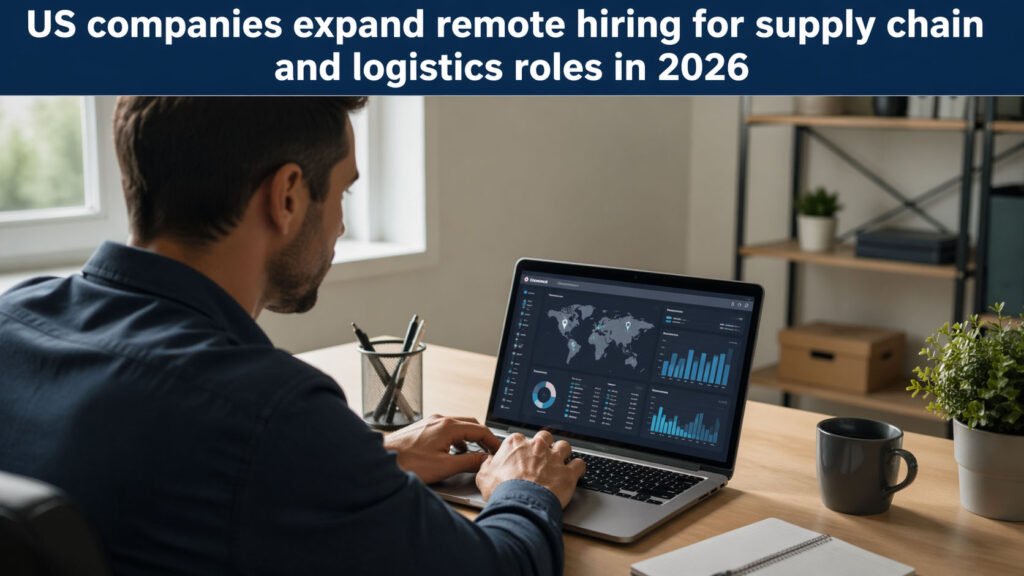
Remote supply-chain work is most plausible when the core output is planning, analysis, procurement coordination, inventory policy, supplier management or network design. Warehouse supervision, transportation control and facility operations often remain tied to sites, shifts or travel. A job title alone cannot decide the work mode. Verify where physical exceptions are handled, whether the role supports a defined facility or territory, required time-zone coverage and expected visits. Demonstrate fit with a sanitized planning or disruption case using service, cost, inventory and risk measures. BLS projects strong growth for logisticians, but occupational growth is not proof that remote openings are increasing.
Evidence that demonstrates fit or progress
Build a fictional disruption scenario with demand, supplier lead times, inventory, transport capacity and service targets. Create a baseline, identify the constraint, compare two responses and quantify effects on fill rate, delay, cost, working capital and operational risk. Add assumptions, data-quality checks, a decision owner and a contingency trigger. A second artifact can map a purchase-to-delivery process and show handoffs, systems and exception ownership. Do not reveal real supplier terms, facility vulnerabilities, customer volumes, customs details or security-sensitive routes. Label simulation data and limitations clearly.
Build a requirement-to-evidence matrix with requirement, proof, result and gap columns. Copy a current requirement or operating need into the first column. Add one truthful example and a verifiable result. Label missing proof as a gap instead of hiding it with keywords. Legal status, health, safety, schedule, location, privacy, accessibility or security mismatches require a decision.
Write two short cases containing context, constraint, personal action, quality or safety check and result. Reduce each to one résumé, plan or portfolio bullet. Keep confidential clients, systems, employees, health information and security details out. A credible sanitized example is stronger than detail that should not be public.
How to apply or use the guidance
Choose planning, procurement, logistics analytics, supplier management or operations leadership as the target. Review official descriptions and capture facility attachment, territory, travel, shift coverage, systems, regulated goods and performance measures. Match résumé evidence to forecasting, inventory, sourcing, vendor coordination, process improvement and disruption handling without claiming team outcomes as personal results. Ask who handles physical exceptions, how often sites are visited, what hours cover the network and which systems are accessible remotely. Apply through verified employer domains and never move money, reship goods or receive packages as an “employment test.”
Verification checklist
- Open the official employer, government or primary source.
- Confirm current status, document or requisition ID and the date checked.
- Record legal, location, eligibility, deadline, privacy and work-model constraints.
- Compare mandatory criteria with evidence that can be substantiated.
- Identify one decisive gap before spending more time or money.
- Save the source, decision, accountable owner and fallback.
- Stop when payment, secrets, unsafe access or unofficial transfer of sensitive information is demanded.
Practical exercise and decision aid
Create a next-48-hours card with one verification, one evidence improvement and one communication action. At the end, mark completed, learned and changed. This creates a return reason and keeps the page useful when a legacy vacancy, product claim or simplistic promise is removed.
Use a stop/continue table. Continue when the official source is current, core requirements fit and the next cost is reasonable. Pause when legal status, health, location, accessibility, safety, security, privacy or money is unclear. Stop when an accountable party is hidden, payment is demanded for a job, or normal verification is bypassed.
Safety and stale-content cleanup
Delete claims that digital operations automatically make logistics jobs remote or that all supply-chain hiring is increasing. Remove unsupported pay ranges, vacancy counts and availability. A role using cloud software can still require a warehouse, port, plant or customer location. Avoid presenting a simulated optimization as universal business advice. Keep safety, trade, customs and labor requirements within qualified employer processes, date-check official projections and remove active JobPosting schema from the evergreen owner.
- Replace urgency and guaranteed outcomes with dated verification.
- Do not infer remote work from a digital role or site brand.
- Keep employer, government, manager, worker and tool roles distinct.
- Put official or primary sources ahead of copied pages.
- Do not collect identity, bank, health, immigration or security data.
- Recheck canonical, robots, schema, outbound links and dates in QA.
- Keep unpublished if the intent cannot be served honestly.
Frequently asked questions
Which supply-chain roles are most remote-compatible?
Planning, analysis, sourcing coordination and network design may travel better than facility or shift operations.
Does strong occupational growth mean more remote jobs?
No. Growth and work mode are separate claims requiring separate evidence.
What should a portfolio show?
A sanitized planning or disruption decision with assumptions, tradeoffs, controls and measurable outcomes.
What scam is specific to logistics searches?
Never accept a job that asks you to reship goods, receive packages or move employer money.
Official and primary sources
- BLS Logisticians — official or primary evidence for scope, status, safeguards or application.
- BLS Transportation Storage and Distribution Managers — official or primary evidence for scope, status, safeguards or application.
- BLS 2024–34 Projections Overview — official or primary evidence for scope, status, safeguards or application.
- OSHA Warehousing Safety — official or primary evidence for scope, status, safeguards or application.
- FTC Work-from-Home Job Scams — official or primary evidence for scope, status, safeguards or application.
Research checked 2026-08-09. Organization and guidance pages establish context; only an accountable live source establishes a current vacancy, rule, price or individual recommendation. Evidence is applied within its limits and does not guarantee outcomes.
Choose your next step
Keep your momentum with practical tools and verified remote-work opportunities.
Related guides for your next step
A fresh, topic-aware mix from the WorkinVirtual library. Suggestions rotate regularly.





Discuss this guide
Ask a useful question, share relevant experience, or add a practical correction. Helpful contributions publish immediately after automated safety checks.
Start a thoughtful discussion
Be the first member to add a question or practical insight about this topic.
Join the discussion
Sign in with your verified WorkinVirtual account to contribute. Automated safety checks keep posting quick and protect the community.
Sign in to contribute