

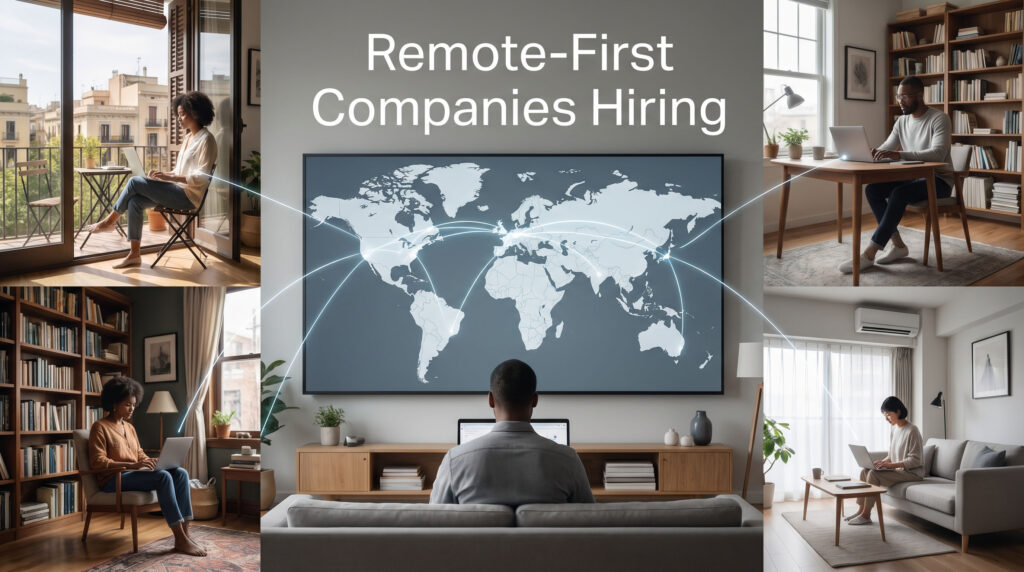
The safest way to find remote-first companies hiring in the U.S. is to monitor owned career pages and verify each role’s state, time-zone and work-authorization limits before applying. Automattic and GitLab are strong starting points because their distributed models and official job routes are public, but neither name guarantees a suitable opening today. This guide should display a fresh check date beside every employer.
What “remote-first” actually tells you
Remote-first usually means distributed work is a default operating model, not a special exception. It can imply written communication, asynchronous decisions and intentional documentation. It does not mean work from any country, work from every U.S. state, no travel, or flexible hours without overlap.
Use four labels in the maintained table: fully distributed, remote-first, remote-friendly and hybrid. Define them visibly. For each employer record the official career URL, regions allowed, whether openings are live, date checked and the wording used by the employer. If the career page provides no suitable role, say “monitor” rather than “hiring you now.”
Employers worth monitoring
Automattic: its official Work With Us page describes a remote-first culture and links current roles. Its hiring guide explains written communication and a paid trial for relevant candidates. Availability and geography still vary by opening.
GitLab: use the official jobs page and read location eligibility on the requisition. GitLab’s public remote-work reputation makes it a common list entry, but applicants still need role fit and an allowed hiring jurisdiction.
Zapier, Doist, Buffer and other distributed employers: include only after verifying an owned career page on the check date. Do not recycle a competitor’s counts, salary ranges or “global” label. A company can be distributed while one position is restricted to a region.
The maintained article can start with eight employers, but accuracy matters more than reaching a number. Remove an employer from “currently hiring” when the official page has no relevant vacancy; retain it in a clearly labeled watchlist if its remote-first evidence remains valid.
Remote-eligibility filter
Before investing in an application, answer: Is the role open now? Does it allow my residence? Does it require U.S. work authorization? Are any states excluded? Is time-zone overlap stated? Is travel required? Is the arrangement permanent or team-dependent? Can I verify the role on the employer’s domain?
Track answers in a simple worksheet with columns for employer, role, official URL, checked date, geography, schedule, top requirements, application date and follow-up. This engagement device prevents repeated applications to roles you cannot legally or practically perform.
Skills remote-first employers test
Remote-first hiring often makes written communication unusually visible. Show concise project updates, documented decisions and independent problem solving. Prepare examples of asking for context early, making progress asynchronously, handling handoffs across time zones and surfacing risk without waiting for a meeting.
Do not write “excellent communicator” without evidence. Explain a document, decision log or process you improved and its result. For technical roles, add a work sample only when the employer invites it and you can share it safely.
How to apply
- Start at the employer’s official career page, not a copied vacancy.
- Confirm the role is live and your state or country is eligible.
- Tailor the résumé to the role, including one remote-work evidence story.
- Follow the employer’s requested process; do not bypass it with unsolicited sensitive material.
- Record the requisition, date and confirmation in the tracker.
- Recheck the official page before interviews because status can change.
Never pay for equipment or an interview. Verify recruiter domains and resist requests for financial data before a legitimate hiring process. The FTC warns that scammers impersonate well-known employers and can send polished offers.
Quick questions
Does remote-first mean work from anywhere? No. Legal entities, payroll, time zones and role needs can restrict locations.
Which company is hiring now? The article must show check dates, but the official career page is always authoritative.
Should I apply when I miss one preferred skill? Distinguish required from preferred qualifications and present honest transferable evidence.
How often should this list be refreshed? Verify live-status claims at least monthly and before prominent promotion.
Choose your next step
Keep your momentum with practical tools and verified remote-work opportunities.
Related guides for your next step
A fresh, topic-aware mix from the WorkinVirtual library. Suggestions rotate regularly.


Discuss this guide
Ask a useful question, share relevant experience, or add a practical correction. Helpful contributions publish immediately after automated safety checks.
Start a thoughtful discussion
Be the first member to add a question or practical insight about this topic.
Join the discussion
Sign in with your verified WorkinVirtual account to contribute. Automated safety checks keep posting quick and protect the community.
Sign in to contribute