

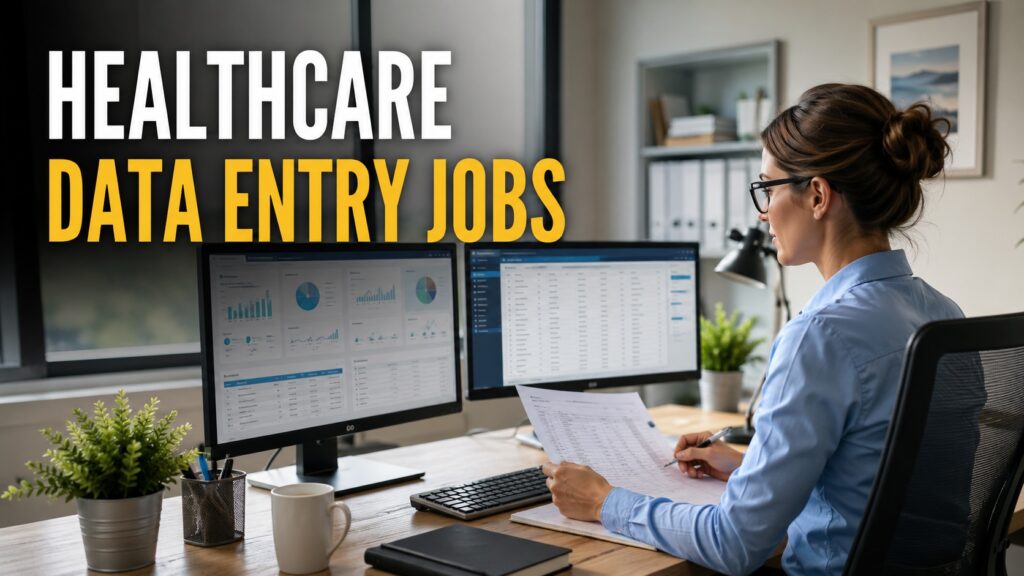
Remote healthcare data-entry work is usually advertised as medical-records, health-information, claims, patient-access or coding support—not simply “data entry.” Legitimate roles require accuracy, privacy awareness and often healthcare terminology or credentials. Search established occupational titles, verify the opening on the employer’s official site, and never use real patient information in a portfolio or unapproved tool.
Translate “data entry” into real role families
Medical-records specialists maintain and classify health information, review documentation and support accurate retrieval and reporting. Claims or billing support roles work with insurance and service records. Patient-access staff can verify demographics, appointments and coverage. Registry and data-quality roles may validate information for analysis or reporting. Medical coding is more specialized than basic entry and can require recognized training or credentials.
BLS explains that medical-records specialists use electronic systems and perform data-entry and recordkeeping tasks, but the occupation also involves confidentiality, classification and quality. This is why a search for “easy remote typing jobs” often produces scams or poor matches. Search the work actually performed.
Know what employers assess
Accuracy comes first because an incorrect identifier, date or code can affect billing, care or reporting. Employers may assess medical terminology, record systems, keyboarding, spreadsheet use, written communication and the ability to follow procedures. Remote roles also require a private workspace, secure equipment practices and timely escalation when a record is unclear.
The HIPAA Privacy Rule establishes protections for certain health information, but a candidate should follow the employer’s exact policies and training rather than treating a short summary as legal advice. Never copy protected information into a personal email, portfolio, consumer AI system or unapproved storage location.
Choose an entry route
A general administrative applicant can target patient scheduling, intake support or records coordination when the listing provides training. A candidate with medical terminology or health-information education may fit medical-records roles. Coding and registry work can demand more specialized preparation.
Read the education and credential requirements on each listing. Industry credentials can help for some pathways, but they are not universal tickets to employment. Confirm that a program is recognized for the target role before paying. Compare curriculum, exam requirements, continuing education and total cost.
Build an accuracy-and-privacy portfolio
Create a fictional dataset of 25 records with invented names, dates and categories. Add five deliberate problems: a duplicate, a missing field, an invalid date, an inconsistent category and a mismatched identifier. Document how you found each issue, what you would correct directly and what you would escalate.
Then write a one-page procedure covering authorized access, minimum necessary information, secure storage, quality checks and incident escalation. Label every item “fictional training data.” This demonstrates process discipline without exposing patient or employer information.
Use a role translator beside the portfolio. Map “entered data” to a stronger, truthful description such as “validated 25 fictional records against defined rules and documented exceptions.” Do not invent accuracy percentages from work you did not measure.
Search and verify openings
Try medical records specialist, health information specialist, patient access representative, claims data specialist, medical billing support, registry coordinator and data quality analyst. Add remote and the eligible state or country. Some jobs handle health information but must be performed at a facility; the exact requisition controls.
Verify the listing through the employer’s official careers page or applicant system. Research staffing firms independently. The FTC warns that fake employers may use realistic remote titles, checks and equipment purchases. Do not pay a fee, deposit a check and return money, or provide banking details before verified onboarding.
Application process: tailor the application
Lead with accuracy, privacy-sensitive work, healthcare terminology and the systems named in the listing when they are genuinely part of your experience. Quantify volume or error reduction only when documented. Customer-service, insurance, pharmacy or office experience can transfer if you explain the relevant workflow.
Prepare an interview story about finding incomplete information. Explain how you paused, verified the source, followed the procedure, documented the issue and escalated appropriately. In health information work, recognizing what not to guess is a valuable skill.
FAQ
Are all healthcare data-entry jobs remote?
No. Some require access to on-site systems, records or teams. Confirm the work arrangement and eligible location on the current listing.
Is medical coding the same as data entry?
No. Coding applies classification systems to clinical documentation and can require specialized knowledge and credentials.
Can I use sample patient records in a portfolio?
Use only clearly fictional data you created. Never use real patient or employer information without explicit authorization.
Internal-link recommendations
- Link to WorkinVirtual’s remote data-entry verification guide in the search section.
- Link to the resume evidence tool after the portfolio exercise.
- Link to a future health-information careers hub rather than rotating employer lists.
Choose your next step
Keep your momentum with practical tools and verified remote-work opportunities.
Related guides for your next step
A fresh, topic-aware mix from the WorkinVirtual library. Suggestions rotate regularly.




Discuss this guide
Ask a useful question, share relevant experience, or add a practical correction. Helpful contributions publish immediately after automated safety checks.
Start a thoughtful discussion
Be the first member to add a question or practical insight about this topic.
Join the discussion
Sign in with your verified WorkinVirtual account to contribute. Automated safety checks keep posting quick and protect the community.
Sign in to contribute