

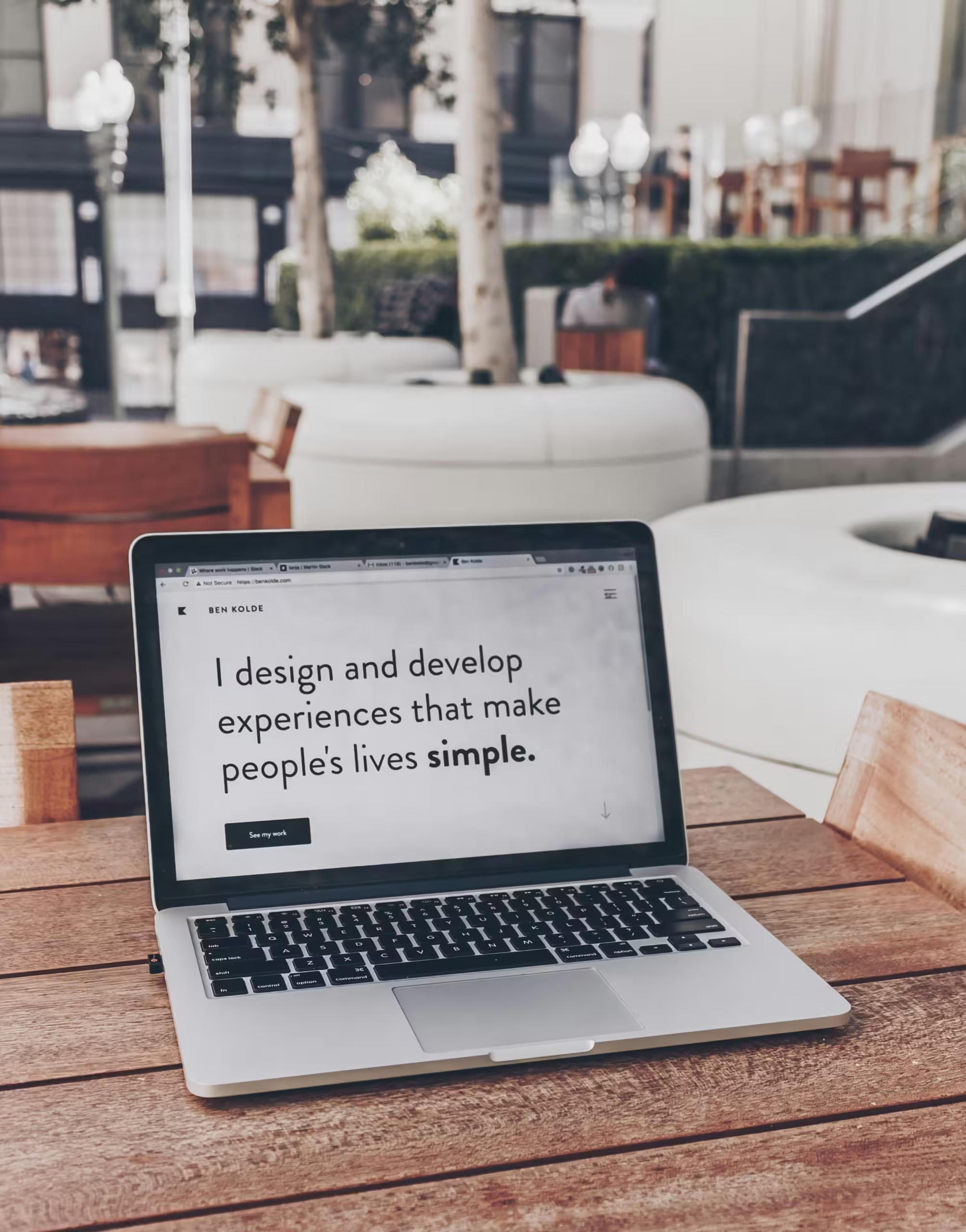
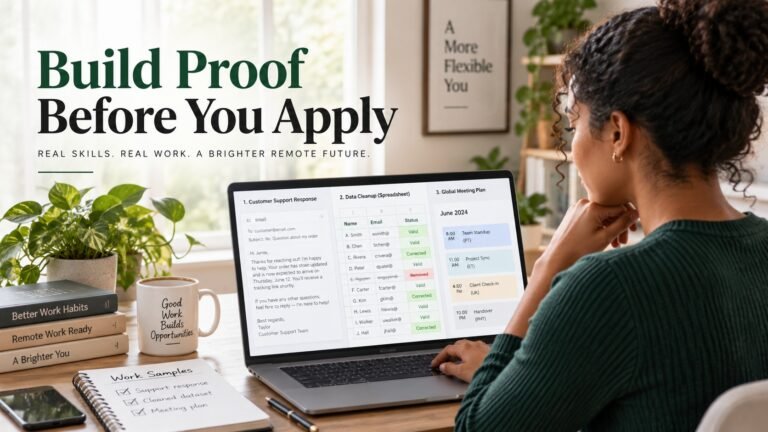
A useful career portfolio shows a small number of role-relevant projects with enough context to judge your thinking: problem, constraints, your contribution, process, result and reflection. Use public, synthetic or explicitly permitted material. Remove customer, employee, security and proprietary information, and confirm copyright or employer ownership before publishing. Make navigation, text alternatives and file formats accessible. A portfolio supports a resume; it does not replace required application information.
Show a visible last verified date. Separate durable guidance from volatile vacancy status, employer, job ID, location, work mode, schedule, pay, benefits and deadline. Reopen each volatile field on its exact official source on publication day. WorkinVirtual is an independent information service; it does not receive applications, represent an employer or guarantee employment, pay, legal status, ranking or career results.
Decision and retained evidence
Before release, obtain at least 16 months of GSC page/query data and page-level GA4 reporting. Audit backlinks, referring domains, internal links, citations and saves. Content gap: The legacy page needs case-study anatomy, audience and role alignment, copyright and work-made-for-hire boundaries, privacy, accessibility, platform portability, maintenance and non-design examples.
The evidence-backed proposal is rebuild, preserving owner 4717. Analytics, current official evidence, specialist review and owner approval may still change it.
What readers need to know
CareerOneStop defines a portfolio as a collection of work samples showing skills and qualifications and recommends describing the project, contribution and result.
Copyright ownership may belong to an employer for work made within employment scope, while other commissioned work depends on written agreements and law.
Permission is often the safest route for using someone else’s protected work; removing a logo does not automatically create permission.
A reviewer should be able to understand the case without an account, proprietary software or inaccessible visual-only explanation when practical.
Relevant roles or stakeholders include job seeker, portfolio reviewer, designer, analyst, developer, copyright owner. These examples support navigation; they do not prove a vacancy, credential or legal authority. The exact employer notice, government source, licensing authority and jurisdiction control. Avoid latest, best, guaranteed, high-paying and now hiring unless narrowly sourced and date-bounded.
Application and decision steps
- Choose the target role and identify three capabilities the portfolio must prove.
- Select two to five projects with distinct evidence rather than many similar artifacts.
- Confirm ownership and permission; replace sensitive material with synthetic or redacted examples.
- Write each case as problem, constraints, options, contribution, result, limitations and learning.
- Add captions, alt text, readable contrast, transcripts and accessible downloadable formats.
- Test links and viewing on mobile, keyboard and a signed-out browser.
- Review quarterly and remove stale, unauthorized or weak examples.
Start each application from the verified official domain. Record the legal entity, job ID, final destination, work location, schedule and evidence date. Do not rely on a copied form, paid-access page, recruiter message or stale aggregator when the official source differs. Recheck the posting before every interview.
Skills and evidence
Priority evidence includes case-study writing, artifact selection, contribution attribution, redaction, accessibility, portfolio maintenance. Present claims as requirement → context → action → measurable result → proof, defining the metric, denominator, time period and personal versus team contribution. Use public, synthetic or explicitly permitted material. Never invent employment, credentials, licenses, clearance, pay, results or selection probability, and never expose customer, patient, employee, source-code, legal, security or commercial secrets.
A strong portfolio states the problem, inputs, constraints, alternatives, decision, test, outcome, limitations and what changed. A weak portfolio is a tool list, unexplained percentage, employer screenshot or artifact the reviewer cannot safely inspect.
Engagement design
Offer a case-study planner and privacy checklist that stays local. Include permission status, artifact owner, redaction, accessibility and last-tested date; never upload employer files automatically.
Useful next actions include opening an official source, completing a checklist, saving a role, tailoring a resume, practicing an interview or recording a verification date. Instrument only after consent and analytics governance. Avoid fake countdowns, live-looking vacancy counts, forced registration, dark patterns and tools that predict hiring, income, compliance, legal status or health outcomes.
Verification, privacy and safety
Remove stale availability, urgency, compensation, benefits and trend claims unless a current exact source supports them. Match recruiter domain, job ID, legal entity and application destination. Reject fees, cryptocurrency, gift cards, fake checks, equipment purchases and messaging-only recruitment. FTC job-scam guidance provides general warning signs, but the verified employer route controls.
Minimize personal data, use least privilege, document retention and protect confidential evidence. Current official sources override this draft. Employment, licensing, tax, privacy, security, accessibility or compensation claims need qualified review when they cross into regulated advice.
FAQ
Do I need a portfolio if I am not a designer?
It can help analysts, writers, developers, educators, operators and others when work can be shown safely through cases, samples or process evidence.
Can I include work made for an employer?
Only after checking ownership, confidentiality and permission. Use a synthetic case or general description when sharing the original is unsafe.
How many projects should I show?
A few relevant, well-explained cases are usually more useful than a large gallery without context.
Should my portfolio require a login?
Avoid unnecessary friction. If access control is needed for legitimate privacy, explain it and offer an accessible review route.
Official and primary sources
- CareerOneStop portfolios — https://cloudfront.careeronestop.org/JobSearch/Resumes/portfolios.aspx
- CareerOneStop resume work-experience guide — https://cloudfront.careeronestop.org/JobSearch/Resumes/ResumeGuide/work-experience.aspx
- U.S. Copyright Office copyright overview — https://www.copyright.gov/what-is-copyright/
- U.S. Copyright Office ownership and work made for hire — https://www.copyright.gov/title17/92chap2.html
- U.S. Copyright Office fair-use FAQ — https://www.copyright.gov/help/faq/faq-fairuse.html
- NIST Privacy Framework — https://www.nist.gov/privacy-framework
These official and primary sources establish occupational patterns, public guidance, technical standards or regulatory context. They do not prove a legacy vacancy is open or a tactic guarantees results. Reopen and date-stamp each source on release day; remove claims it no longer supports.
Choose your next step
Keep your momentum with practical tools and verified remote-work opportunities.
Related guides for your next step
A fresh, topic-aware mix from the WorkinVirtual library. Suggestions rotate regularly.


Discuss this guide
Ask a useful question, share relevant experience, or add a practical correction. Helpful contributions publish immediately after automated safety checks.
Start a thoughtful discussion
Be the first member to add a question or practical insight about this topic.
Join the discussion
Sign in with your verified WorkinVirtual account to contribute. Automated safety checks keep posting quick and protect the community.
Sign in to contribute