

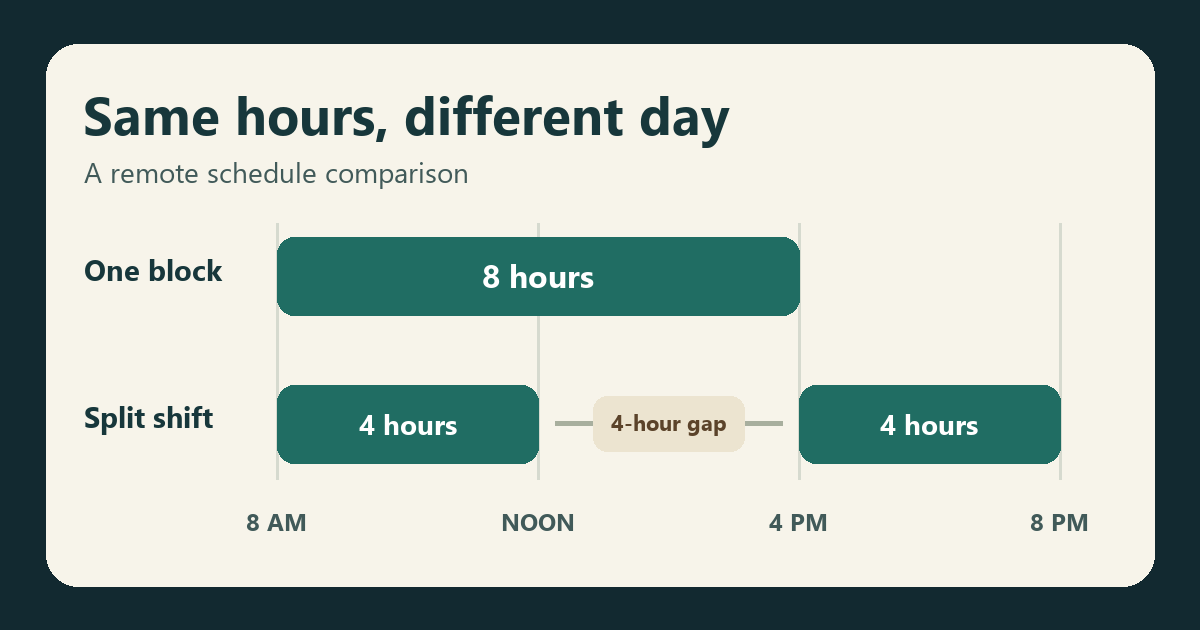
If a remote job says you will work a split shift, ask for both start and end times. Eight hours can run from 8 a.m. to 4 p.m. on a calendar, or stretch from 8 a.m. to 8 p.m. with a four-hour gap. Before deciding whether the job fits, find out who sets the blocks, what you can do between them, and how training fits.
Find out who chooses the work blocks
A split schedule has two or more separate work periods in the same day. An assigned split shift might require morning and evening coverage. Self-scheduling can also produce a day with two blocks if you choose them, but the choice depends on which hours the program actually offers.
XACT’s careers page describes split shifts as one of several scheduling options and lists eligible locations for its work-from-home program. Ask whether a specific role offers a split schedule and who assigns the hours. Liveops’ customer service opportunity page describes an independent-contractor arrangement with self-selected 30-minute blocks and a list of U.S. states where it accepts applications. Its scheduling model illustrates what choosing blocks can look like. Confirm your own location and the hours available for the program you are considering.
Put both work blocks on your calendar
Use one date and one time zone before you compare the blocks. The example uses Eastern Time and assumes that each work block contains the scheduled hours shown. It is a planning example with fictional hours.
- One continuous block, 8 a.m. to 4 p.m. Eight scheduled hours across an eight-hour span.
- Two blocks, 8 a.m. to noon and 4 p.m. to 8 p.m. Four hours plus four hours. The gap is four hours, and the elapsed time from first start to last finish is 12 hours.
Put the blocks and the gap on a calendar set to your local time. Then ask for a sample week. An evening block that fits on Tuesday could clash with a standing commitment on Thursday, and a single day cannot tell you which weekends you will cover. Confirm whether the schedule follows a named time zone year-round and check a date on both sides of a clock change if your location and the team change clocks differently.
Ask what happens in the gap
Confirm whether you can log off, leave your workstation, or make plans that take you away from your phone. If you must respond during the gap, ask for the expected response time and how that period is recorded and compensated. The calendar tells you when your time is spoken for. The offer or contract should explain how time and pay are counted.
Send a request you can compare against your calendar.
Could you send a sample week with both blocks in the scheduling time zone? Please confirm which blocks I choose, whether I’m completely off duty between them, and whether training or meetings have separate hours.
When the answer arrives, mark the hours you will work, the hours you can count on being free, and the total span from first start to final finish. If a block or the gap is still unclear, ask for those details before accepting. For a separate training schedule, use the training-hours calendar check.
Choose your next step
Keep your momentum with practical tools and verified remote-work opportunities.
Related guides for your next step
A fresh, topic-aware mix from the WorkinVirtual library. Suggestions rotate regularly.





Discuss this guide
Ask a useful question, share relevant experience, or add a practical correction. Helpful contributions publish immediately after automated safety checks.
Start a thoughtful discussion
Be the first member to add a question or practical insight about this topic.
Join the discussion
Sign in with your verified WorkinVirtual account to contribute. Automated safety checks keep posting quick and protect the community.
Sign in to contribute