


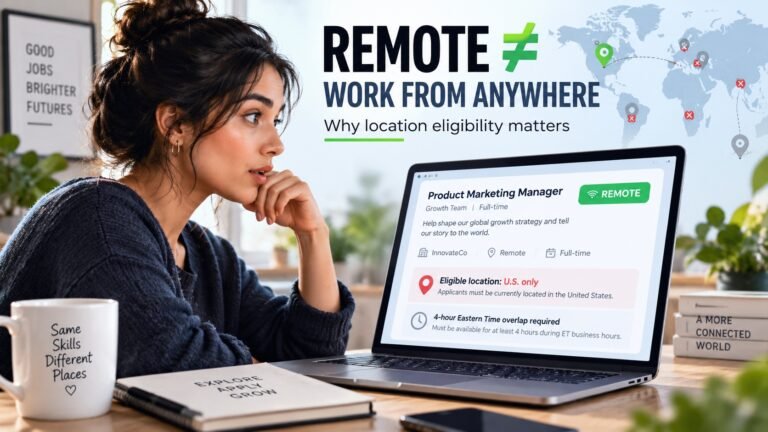
Imagine a candidate whose experience appears to match almost everything in a remote vacancy. The skills align. The responsibilities feel familiar. But the employer can hire only within a country where the candidate does not live.
Should that really count as a strong match?
The résumé may be relevant. The opportunity may still be unavailable.
That distinction sits at the heart of WorkinVirtual’s approach to structured remote hiring: relevance and eligibility answer different questions. A useful recommendation needs to address both before asking someone to invest time applying.
What Does Job Matching Actually Mean?
Job matching means comparing a candidate’s circumstances, qualifications, skills and preferences with an employer’s job requirements to determine whether an opportunity is viable and relevant.
It is more than finding familiar words in two documents.
A good match is not simply a job that looks similar to someone’s résumé. It is an opportunity they can realistically take, are sufficiently qualified for and have a meaningful reason to consider.
How should remote-job matching work? A better system evaluates compatibility in layers:
This order matters. A high relevance score cannot resolve a mandatory location restriction or make an incompatible schedule workable.
Eligibility and Job Fit Are Different
Remote-job eligibility concerns the conditions that determine whether someone can realistically take a position: location, work authorization, schedule and employment arrangement, alongside other genuine constraints.
Job fit concerns how well the opportunity aligns with their abilities, experience, interests and working preferences.
Someone can be professionally well suited to a role but unable to accept its employment arrangement. Another candidate may meet every eligibility condition while lacking an essential qualification.
Neither situation becomes a strong match because the job title looks right.
As WorkinVirtual explains in The Job Says Remote. So Why Can’t You Apply From Anywhere?, the remote label alone does not establish eligibility. A candidate profile and a job listing both need enough information for a meaningful comparison.
Hard Constraints Need Different Treatment From Soft Signals
A hard constraint is a genuine condition that must be satisfied for the opportunity to work. A mandatory hiring location, required professional license or non-negotiable working schedule may qualify.
A soft signal helps assess relative suitability. Preferred industry experience, familiarity with a particular tool or an adjacent job title may strengthen a recommendation without determining eligibility.
The word “preferred” should not silently become “required.”
A candidate with transferable skills may deserve consideration despite a different title. Someone without a mandatory license presents a different issue.
Requirements also need clarity. Missing information should be identified as unknown rather than automatically interpreted as incompatibility. When a condition is ambiguous, clarification is more useful than false certainty.
Why Job Recommendations Can Feel Irrelevant
Job recommendations can be irrelevant when a system recognizes professional similarity but misses practical incompatibility, relies on incomplete information or gives too much weight to weak signals.
Titles vary between employers. Similar titles can describe different responsibilities; different titles can describe closely related work. Résumé keywords reveal vocabulary, but they do not necessarily establish capability, availability or permission to work under a particular arrangement.
Textual similarity can therefore identify something worth investigating without establishing candidate-job fit.
Modern job platforms may combine many signals. The issue is how those signals are interpreted and ordered. Even sophisticated skills matching can disappoint when eligibility remains unresolved beneath a persuasive relevance score.
The Direction Behind WorkinVirtual’s Structured Data
WorkinVirtual’s platform architecture is designed around more structured candidate and job information, rather than treating every résumé and vacancy as undifferentiated blocks of text.
Relevant signals can include candidate location, job location eligibility, experience, skills, work arrangement, time-zone availability, employment type, compensation, travel requirements and candidate preferences.
The platform model connects structured remote hiring with candidate/job compatibility: distinguish what someone can do from the conditions under which an opportunity could work.
This describes an architectural direction, not a claim that every matching stage is already automated or live.
It also extends the thinking in What Should a Reusable Remote-Work Profile Actually Contain? WorkinVirtual’s Remote Work Passport direction centers on reusable candidate information. That information becomes more useful when job requirements are structured too. A detailed profile cannot compensate for a vacancy that leaves essential conditions unstated.
A Better Remote-Job Match Asks These Questions in Order
1. Can I actually take this job?
Check eligible locations, authorization requirements, schedule and employment arrangement. Include mandatory travel or attendance conditions where relevant.
2. Do I meet the essential requirements?
Compare genuine skills, experience, certifications and other must-haves with evidence from your background. Separate essentials from preferences.
3. How relevant is the role to my background?
Consider occupation, industry, seniority and transferable skills. Look beyond identical titles.
4. Does it fit what I want?
Review compensation, schedule, employment type and career direction. An available job is not automatically a desirable one.
5. Only then: how highly should it rank?
Give greater prominence to viable opportunities with stronger alignment, while making unresolved conditions visible.
Where AI Can Help—and Where Human Judgment Belongs
AI job matching can help organize information, identify potential compatibility, detect apparent mismatches, summarize qualifications and rank large sets of opportunities.
Its usefulness depends on the quality and completeness of the underlying information. A polished summary cannot supply an employer requirement that was never disclosed.
Should AI decide who gets hired? Final hiring decisions should remain human-led. Matching is decision support, not the hiring decision itself. Candidates still choose which opportunities to pursue, and employers retain responsibility for evaluating applicants and making final hiring decisions.
Better Matching Means Fewer Wasted Applications
The goal of remote job matching should not simply be the largest possible set of vacancies. It should be a clearer set of opportunities worth considering.
Good matching should reduce noise for candidates and obviously incompatible applications for employers.
Explore current opportunities on WorkinVirtual Remote Jobs, and review the available eligibility, work-arrangement and role information before investing time in an application.
Better information does not replace human hiring decisions. It helps candidates and employers reach those decisions with less unnecessary friction.
Choose your next step
Keep your momentum with practical tools and verified remote-work opportunities.
Related guides for your next step
A fresh, topic-aware mix from the WorkinVirtual library. Suggestions rotate regularly.





Discuss this guide
Ask a useful question, share relevant experience, or add a practical correction. Helpful contributions publish immediately after automated safety checks.
Start a thoughtful discussion
Be the first member to add a question or practical insight about this topic.
Join the discussion
Sign in with your verified WorkinVirtual account to contribute. Automated safety checks keep posting quick and protect the community.
Sign in to contribute