

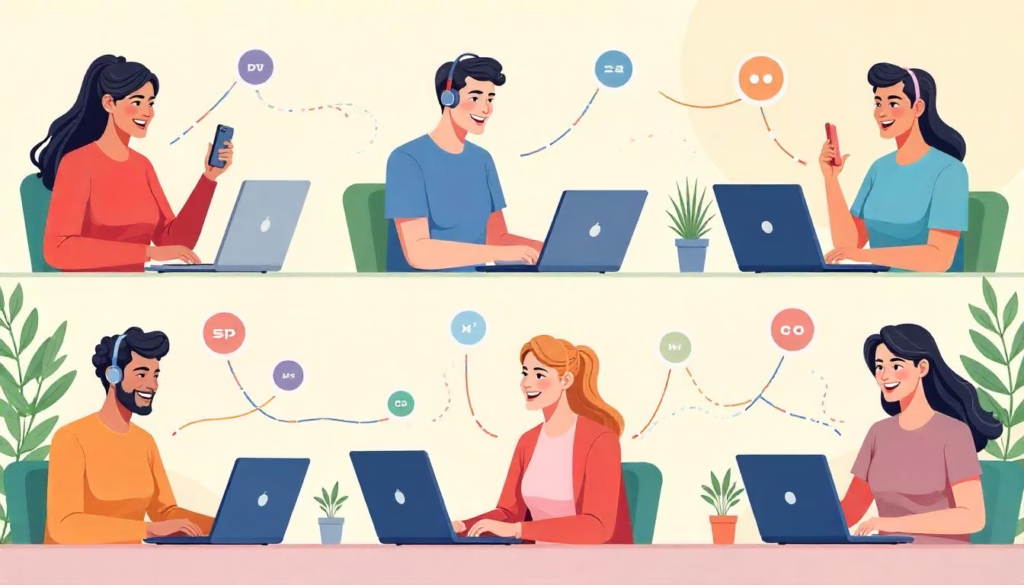
Healthy remote connection is not the number of meetings or chat messages. It is reliable access to people who provide task help, trust, mentoring, belonging and companionship—at work and outside it. Workers can name which form is missing and take one low-pressure step; managers must improve job design, onboarding, communication, voice and inclusion rather than assign connection as extra labor. Use opt-in formats, multiple channels and predictable times. Protect focus and off-hours. A person who prefers fewer interactions is not a problem to fix, and workplace practices do not replace mental-health care.
Evidence that demonstrates fit or progress
Use a five-part connection inventory: practical help, feedback, mentoring, belonging and nonwork community. Mark adequate, missing or unwanted. Teams can examine new-hire access, meeting airtime, documentation, response norms, peer help, manager one-to-ones and cross-time-zone equity. Measure whether help is available and trust improves, not how often someone posts. Qualitative check-ins, aggregated anonymous surveys and retention or onboarding signals can help, but small groups require privacy care and no individual health inference.
Build a requirement-to-evidence matrix with requirement, proof, result and gap columns. Copy a current requirement or operating need into the first column. Add one truthful example and result. Label missing proof as a gap rather than masking it with keywords. Legal status, health, safety, schedule, location, privacy or accessibility mismatches require a decision.
Write two short cases containing context, constraint, personal action, quality or safety check and result. Reduce each to one résumé, plan or portfolio bullet. Keep confidential clients, systems, employees, health information and security details out. A credible sanitized example is stronger than detail that should not be public.
How to apply or use the guidance
Choose one missing connection function. Ask a specific person for a bounded interaction: a 15-minute problem review, monthly mentoring conversation, project debrief or walk with a friend. Managers should offer a menu—buddy, office hours, interest channel, in-person option, async introduction—and ask which is useful. Remove recurring activities that create burden without connection. Review after four weeks: Did support become easier to access, relationships feel safer and off-hours stay protected?
Verification checklist
- Open the official employer, government or primary source.
- Confirm current status, document or requisition ID and date checked.
- Record legal, location, eligibility, deadline and work-model constraints.
- Compare mandatory criteria with evidence you can substantiate.
- Identify one decisive gap before spending more time or money.
- Save the official source, agreement or confirmation.
- Stop when someone demands payment, secrets or unofficial transfer of sensitive information.
Practical exercise and decision aid
Create a next-48-hours card with one verification, one evidence improvement and one communication action. At the end, mark completed, learned and changed. The loop supports a return visit and keeps the page useful when a legacy vacancy or simplistic promise is removed.
Use a stop/continue table. Continue when the official source is current, core requirements fit and the next cost is reasonable. Pause when legal status, health, location, accessibility, safety, security or money is unclear. Stop when an accountable party is hidden, payment is demanded for a job, or normal verification is bypassed.
Safety and stale-content cleanup
Remove universal claims that remote work is isolating, camera use creates trust or extroversion is the ideal. Correlation does not prove a particular work arrangement causes loneliness. Do not label workers, force personal disclosure or make social attendance a performance signal. Connection outside work matters and employers should respect it. If someone reports crisis, self-harm or severe distress, use qualified local support or emergency resources rather than peer coaching alone.
- Replace urgency and guaranteed outcomes with dated verification.
- Do not infer remote work from a digital role or site brand.
- Keep employer, government, health, manager and worker roles distinct.
- Put official or primary sources ahead of copied pages.
- Do not collect identity, bank, health, immigration or security data.
- Recheck canonical, robots, schema, outbound links and dates in QA.
- Keep unpublished if the intent cannot be served honestly.
Frequently asked questions
How much interaction does a remote worker need?
There is no universal amount; focus on desired quality and support functions.
Should cameras be mandatory?
Not as a connection shortcut; consider privacy, bandwidth, disability and task needs.
What can a manager change first?
Make help, one-to-ones, onboarding, decision norms and worker voice reliably accessible.
What should be measured?
Access to support, trust and inclusion—not chat volume or personal disclosure.
Official and primary sources
- NIOSH Social Connection and Worker Well-Being — official or primary evidence for scope, status, safeguards or application.
- HHS Workplace Well-Being Framework — official or primary evidence for scope, status, safeguards or application.
- HHS Social Connection Advisory — official or primary evidence for scope, status, safeguards or application.
- NIOSH Healthy Work Design — official or primary evidence for scope, status, safeguards or application.
Research checked 2026-08-09. Organization and guidance pages establish context; only the accountable live source establishes a current vacancy, rule, price or individual recommendation. Evidence is applied within its limits and does not guarantee outcomes.
Choose your next step
Keep your momentum with practical tools and verified remote-work opportunities.
Related guides for your next step
A fresh, topic-aware mix from the WorkinVirtual library. Suggestions rotate regularly.






Discuss this guide
Ask a useful question, share relevant experience, or add a practical correction. Helpful contributions publish immediately after automated safety checks.
Start a thoughtful discussion
Be the first member to add a question or practical insight about this topic.
Join the discussion
Sign in with your verified WorkinVirtual account to contribute. Automated safety checks keep posting quick and protect the community.
Sign in to contribute