

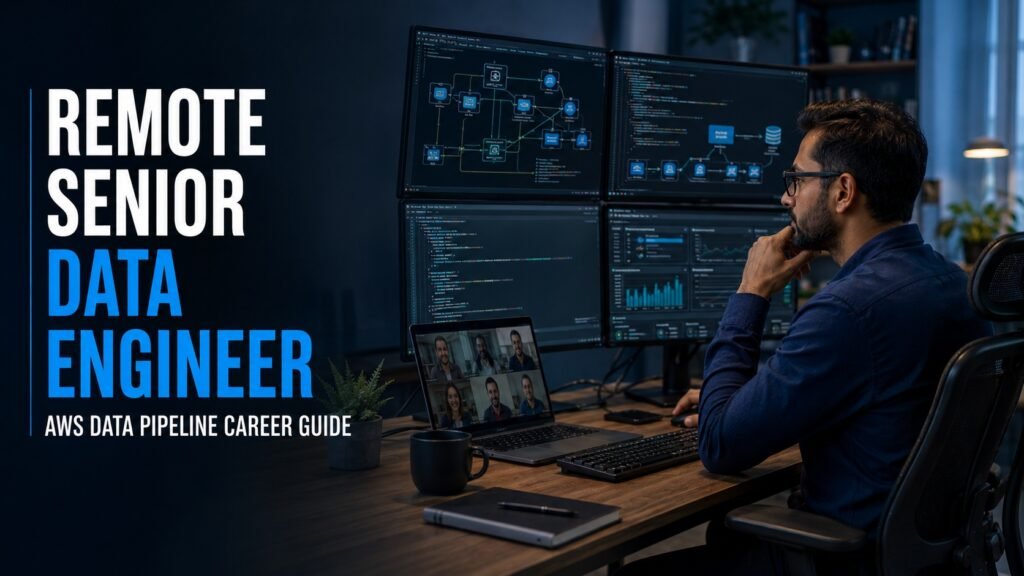
Remote Senior Data Engineer jobs remain among the fastest-growing opportunities for experienced data professionals who enjoy designing scalable data platforms, building reliable ETL pipelines and helping organizations transform raw information into meaningful business decisions.
Historical vacancy notice: The original Tyler Technologies Senior Data Engineer position referenced by this page was published in 2025 and may no longer be accepting applications. This article has been rebuilt as a long-term career guide to help job seekers prepare for similar opportunities while directing applicants to Tyler Technologies’ official careers website for current openings.
The historical vacancy advertised a salary range of $93,547–$135,000 per year. That compensation applied only to the original position and should not be interpreted as standard pay for every Senior Data Engineer role. Compensation varies by employer, technical specialization, location, experience and total rewards.
If you are interested in remote data engineering careers involving AWS, cloud data platforms, Python, SQL and large-scale ETL systems, this guide explains what employers expect, how to prepare your resume, how interviews are structured and where to find legitimate remote opportunities.
Browse Current Remote Data Engineer Jobs
Discover active remote Data Engineering, Analytics Engineering and Cloud Data Platform opportunities from trusted employers hiring across the United States.
Browse Remote JobsContents
What Does a Senior Data Engineer Do?
A Senior Data Engineer designs, develops and maintains the infrastructure that allows organizations to collect, process, store and analyze large volumes of data efficiently. Their work supports business intelligence, analytics, reporting, artificial intelligence and operational decision-making across the organization.
Unlike entry-level data engineers, senior professionals typically influence platform architecture, mentor engineers, optimize performance and establish engineering standards that improve reliability and scalability.
Organizations in healthcare, government technology, finance, cloud services, manufacturing and software all rely on experienced data engineers to keep mission-critical information flowing securely and efficiently.
Typical responsibilities include
- Designing scalable data pipelines
- Building ETL and ELT workflows
- Managing enterprise data warehouses
- Optimizing SQL performance
- Supporting cloud-based analytics platforms
- Integrating multiple data sources
- Maintaining data quality
- Improving pipeline reliability
- Automating data workflows
- Collaborating with software engineering, analytics and business teams
Many employers use similar titles including:
- Senior Data Engineer
- Cloud Data Engineer
- Big Data Engineer
- Data Platform Engineer
- Analytics Engineer
- Data Warehouse Engineer
- ETL Engineer
- Data Infrastructure Engineer
Although responsibilities vary between employers, the core objective remains the same: delivering reliable, accurate and scalable data systems that support business operations.
Modern Data Engineering Responsibilities
Today’s Senior Data Engineers spend far less time writing isolated scripts than they did a decade ago. Modern organizations expect engineers to build complete data ecosystems capable of handling millions of records while supporting analytics, machine learning and operational reporting.
Projects often involve designing highly available cloud architectures, automating data movement, improving performance and ensuring that business users receive accurate information when they need it.
Common areas of responsibility
- Enterprise data architecture
- Pipeline orchestration
- Data warehouse optimization
- Data governance support
- Monitoring and observability
- Performance tuning
- Infrastructure automation
- Cloud migration projects
- Production support
- Documentation and knowledge sharing
Senior engineers frequently collaborate with data analysts, software developers, DevOps engineers, product managers and executive stakeholders to ensure that technical solutions align with business objectives.
The historical Tyler Technologies position emphasized cloud-based public sector data platforms. Similar future opportunities may focus on different industries or technologies, so applicants should always review the current job description carefully.
Career insight: Employers increasingly value engineers who understand both technical implementation and business outcomes. Demonstrating how your work improved reporting accuracy, reduced processing time or increased platform reliability can significantly strengthen your application.
AWS, ETL & Data Pipeline Skills
Cloud-first organizations increasingly build modern data platforms using Amazon Web Services and similar cloud environments. Senior Data Engineers are expected to understand how data moves through ingestion, transformation, storage and analytics pipelines while maintaining security and reliability.
Rather than focusing on individual tools alone, employers look for engineers who understand complete data workflows from source systems to business reporting.
Core technical capabilities
- ETL and ELT pipeline development
- Workflow orchestration
- Data integration
- Cloud storage architecture
- Data quality validation
- Pipeline monitoring
- Automation and scheduling
- Performance optimization
Strong data engineers understand not only how to build pipelines, but also how to make them reliable, scalable and cost-effective over time.
End of Part 1A. Part 1B continues with Cloud Data Platforms, SQL & Python, Data Modeling and modern enterprise engineering practices.
Cloud Data Platforms
Senior Data Engineers increasingly work across cloud platforms that combine storage, compute, orchestration, transformation and analytics services. Employers may use Amazon Web Services, Microsoft Azure, Google Cloud Platform or a combination of on-premises and cloud infrastructure.
A strong candidate does not need experience with every platform. However, senior-level applicants should understand how cloud architecture affects scalability, security, reliability and cost.
Cloud data responsibilities may include
- Designing storage layers for structured and unstructured data
- Building ingestion workflows from applications, databases and APIs
- Creating transformation pipelines for analytics and reporting
- Managing permissions and access controls
- Monitoring pipeline failures and processing delays
- Optimizing cloud resources and data-processing costs
- Supporting disaster recovery and business continuity
- Documenting architecture and operational procedures
For AWS-focused data engineering positions, employers may mention services such as Amazon S3, Redshift, Glue, Lambda, Athena, Kinesis, EMR, RDS or Step Functions. The exact stack varies by company, and applicants should avoid presenting limited exposure as advanced expertise.
Interviewers often care less about whether you memorized every cloud service and more about whether you can select appropriate tools for a specific business problem.
Data warehouse versus data lake
A data warehouse generally stores structured, organized information prepared for reporting and analytics. A data lake can store larger volumes of raw or semi-structured data before it is transformed for specific uses.
Modern organizations may combine both approaches. Senior Data Engineers should be prepared to explain how data moves between operational systems, storage layers, transformation processes and reporting tools.
Reliability and observability
Cloud data pipelines must be monitored like any other production system. Engineers need to know when a workflow fails, when data arrives late or when a transformation produces unexpected results.
Useful observability practices may include:
- Automated failure alerts
- Pipeline health dashboards
- Data freshness checks
- Schema-change detection
- Row-count and reconciliation checks
- Processing-time monitoring
- Cost and resource alerts
- Clear incident documentation
Reliable data engineering is not only about moving information quickly. It is also about ensuring that users can trust the final result.
SQL, Python and Data Modeling
SQL and Python remain two of the most valuable skills for remote Senior Data Engineer jobs. SQL supports data extraction, transformation, validation and performance analysis, while Python is widely used for automation, orchestration and custom data-processing tasks.
Advanced SQL skills
Senior applicants should be comfortable working with complex queries, joins, window functions, aggregations, common table expressions and query optimization.
Employers may also assess whether you can:
- Identify inefficient queries
- Improve indexing strategies
- Reduce unnecessary data scans
- Validate transformed data
- Work with large datasets
- Troubleshoot inconsistent results
- Explain SQL logic to analysts and engineers
During interviews, it is common to receive a practical SQL exercise or a scenario involving duplicate records, missing data, slowly changing dimensions or poor query performance.
Python for data engineering
Python may be used to build ingestion jobs, automate repetitive tasks, interact with APIs, validate files and support data-processing frameworks.
Employers may expect familiarity with:
- Data structures and functions
- Error handling
- Logging
- API integration
- File processing
- Testing
- Package management
- Scheduling and automation
Senior engineers should write maintainable code rather than one-time scripts that are difficult for other team members to understand or support.
Data modeling
Data modeling defines how information is organized, connected and prepared for use. A strong model can improve reporting performance, simplify analysis and reduce confusion across the organization.
Common concepts include:
- Fact and dimension tables
- Star and snowflake schemas
- Normalization and denormalization
- Primary and foreign keys
- Slowly changing dimensions
- Historical data tracking
- Business definitions and metrics
Data modeling decisions should reflect how the organization plans to use the information. A model optimized for transactional processing may not be appropriate for analytics and reporting.
Data quality and validation
Senior Data Engineers are often responsible for preventing inaccurate or incomplete information from reaching business users.
Validation may include:
- Checking required fields
- Confirming expected data types
- Detecting duplicate records
- Monitoring unexpected volume changes
- Comparing source and destination totals
- Testing business rules
- Identifying late-arriving data
Employers value engineers who treat data quality as part of pipeline design rather than an issue to investigate only after users report a problem.
Working With Public-Sector and Regulated Data
The historical Tyler Technologies vacancy involved technology supporting public-sector organizations. Data engineers working in government technology, healthcare, finance or other regulated sectors may need to manage additional security, privacy and documentation requirements.
Responsibilities can include:
- Protecting sensitive or confidential information
- Applying access controls
- Maintaining audit records
- Documenting data lineage
- Supporting retention requirements
- Following approved change-management processes
- Coordinating with security and compliance teams
Applicants do not need to claim regulatory expertise unless they have it. However, experience working with controlled data, security reviews or documented operational procedures can strengthen an application for public-sector data engineering roles.
Communicating with non-technical stakeholders
Senior engineers regularly work with analysts, program managers, product teams and business leaders who may not understand technical architecture.
Strong communication includes explaining:
- Why a pipeline failed
- How long remediation may take
- What data can be trusted
- Why an architecture change is necessary
- How cost, speed and reliability trade-offs affect a project
Clear communication helps prevent technical problems from becoming larger operational or decision-making risks.
Experience and Qualifications Employers May Expect
Current requirements vary by employer, but senior-level data engineering positions commonly ask for several years of experience building and maintaining production data systems.
Employers may look for:
- Professional data engineering experience
- Advanced SQL ability
- Python or another programming language
- Cloud data platform experience
- ETL or ELT pipeline development
- Data warehouse design
- Performance tuning
- Workflow orchestration
- Data quality and testing practices
- Experience collaborating with analysts and software engineers
Do you need a computer science degree?
Some employers require or prefer a degree in computer science, information systems, engineering, mathematics or a related field. Others accept equivalent professional experience.
Applicants without a directly related degree can strengthen their application through relevant project experience, technical training, cloud certifications and measurable achievements in production environments.
Can a Data Analyst move into Data Engineering?
Yes, but the transition normally requires stronger programming, pipeline and infrastructure skills.
A Data Analyst moving toward engineering should build experience with:
- Advanced SQL
- Python
- Data modeling
- ETL workflows
- Cloud storage and warehouses
- Version control
- Automated testing
- Pipeline orchestration
Highlight projects where you improved data preparation, automated reporting workflows or built reusable datasets rather than only producing dashboards.
Can a Software Engineer move into Data Engineering?
Software engineering experience can transfer well, especially when the applicant has worked with databases, distributed systems, APIs or cloud infrastructure.
The resume should demonstrate knowledge of data architecture, pipeline reliability, analytics use cases and data quality rather than presenting the role as ordinary application development.
End of Part 1B. Part 1C continues with resume preparation, interview guidance, current remote job-search steps, Tyler Technologies’ official careers pathway and practical next actions.
How to Prepare a Senior Data Engineer Resume
Your resume should demonstrate measurable business impact instead of simply listing programming languages or cloud services. Hiring managers want evidence that you have successfully designed, improved and maintained production-grade data platforms.
Start with a focused professional summary
Your opening summary should clearly communicate your specialization, years of experience and strongest technical capabilities. Mention experience with cloud platforms, data pipelines, SQL, Python and enterprise-scale analytics where appropriate.
Highlight measurable achievements
Recruiters respond better to quantified accomplishments than task lists. Whenever possible, include measurable outcomes such as:
- Reduced pipeline execution time.
- Improved data quality.
- Migrated workloads to cloud platforms.
- Built reusable ETL frameworks.
- Improved reporting performance.
- Automated manual data processes.
- Reduced infrastructure costs.
- Supported enterprise-scale analytics.
Tailor every application
Every employer uses a different technology stack. Carefully review the job description and align your experience with the required cloud platform, database technologies, programming languages and business domain without exaggerating your expertise.
Update Your Data Engineering Resume
Create or improve your WorkinVirtual resume before applying for remote Data Engineering opportunities.
Upload Your ResumePreparing for Senior Data Engineer Interviews
Senior Data Engineer interviews typically combine technical discussions, architecture scenarios and behavioural questions. Employers want to understand not only your technical knowledge but also how you approach reliability, scalability and collaboration.
Architecture discussions
You may be asked to explain how you would design a modern cloud-based data platform, improve an existing pipeline or migrate legacy workloads into a scalable architecture.
Technical topics commonly covered
- Advanced SQL optimization
- Python programming
- ETL and ELT architecture
- Cloud data services
- Data warehouse design
- Pipeline orchestration
- Data modeling
- Performance tuning
- Monitoring and observability
- Data quality validation
Behavioural questions
Expect questions about cross-functional collaboration, handling production incidents, prioritizing technical debt, mentoring engineers and communicating with non-technical stakeholders.
Use real project examples whenever possible. Employers generally value structured problem-solving more than memorized technical definitions.
Finding Current Remote Senior Data Engineer Jobs
Because this article is based on a historical vacancy, applicants should not assume the original position is still available.
Instead, search for current openings using job titles such as:
- Senior Data Engineer
- Cloud Data Engineer
- Data Platform Engineer
- Data Warehouse Engineer
- Analytics Engineer
- Big Data Engineer
- ETL Engineer
- Data Infrastructure Engineer
Review each opportunity carefully for remote eligibility, required cloud platforms, work authorization requirements and preferred technical skills.
Official Tyler Technologies Careers
Tyler Technologies regularly recruits professionals across software engineering, cloud services, cybersecurity, customer success and data engineering. Always verify current openings through the company’s official recruitment website before applying.
Visit Official Tyler Technologies CareersPlanning Your Long-Term Data Engineering Career
Experienced Data Engineers often progress into Staff Engineer, Principal Engineer, Data Platform Architect or Engineering Manager positions. Building expertise in cloud architecture, distributed systems, automation and leadership can expand future career opportunities.
Continuous learning remains important because cloud platforms, orchestration tools and analytics technologies continue to evolve rapidly.
Professionals who combine strong engineering fundamentals with communication skills and business understanding remain highly valuable across healthcare, finance, government technology, manufacturing and enterprise software organizations.
Explore More Remote Data Engineering Opportunities
Browse current remote Data Engineering, Analytics Engineering and Cloud Platform roles and compare employers before submitting your application.
Browse Remote JobsEditorial note: WorkinVirtual is not affiliated with Tyler Technologies. The original Senior Data Engineer vacancy may no longer be accepting applications. Responsibilities, compensation, locations and hiring requirements may change over time. Always verify current opportunities through Tyler Technologies’ official careers website before applying.
Choose your next step
Keep your momentum with practical tools and verified remote-work opportunities.
Related guides for your next step
A fresh, topic-aware mix from the WorkinVirtual library. Suggestions rotate regularly.



Discuss this guide
Ask a useful question, share relevant experience, or add a practical correction. Helpful contributions publish immediately after automated safety checks.
Start a thoughtful discussion
Be the first member to add a question or practical insight about this topic.
Join the discussion
Sign in with your verified WorkinVirtual account to contribute. Automated safety checks keep posting quick and protect the community.
Sign in to contribute