


A remote-work cover letter should show why you can solve the employer’s problem, not why you want to avoid commuting. Name the role, connect two requirements to truthful evidence, demonstrate one remote-relevant behavior such as written coordination or independent delivery, and close with a clear next step. Keep it specific and easy to scan.
Research before writing
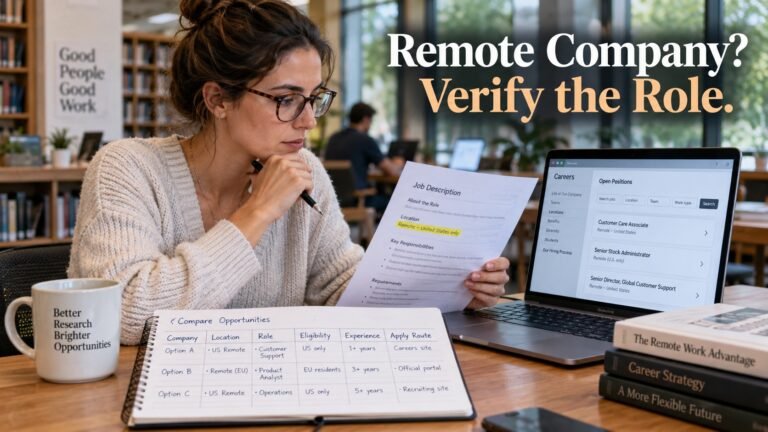
Verify the role on the official employer careers site and save its requisition. Highlight the top five requirements and identify the two you can demonstrate most strongly. Read the company’s product, customer and team information from first-party pages. Avoid repeating slogans or pretending to know internal culture.
Decide whether a cover letter is requested, optional or prohibited. Follow the application instructions and file format. An optional letter is useful when it can explain a career change, location eligibility or evidence not obvious from the resume; it should not repeat every bullet.
Four-paragraph worksheet
Opening: Name the exact role and lead with fit. Example structure: “I am applying for [role] because my experience in [relevant area] has prepared me to [central outcome].” Avoid “I have always dreamed of working remotely.”
Evidence one: Connect a central requirement to a concrete situation, action and outcome. Use numbers only when supportable. Explain enough context for the result to mean something.
Evidence two and remote behavior: Show another requirement plus clear communication, documentation, ownership, asynchronous handoff or time-zone coordination. Previous home-based employment is not the only evidence; a distributed project or dependable independent work can qualify.
Close: State the value you would discuss and thank the reader. Do not demand a meeting or promise impossible results.
The final letter will often fit between roughly 250 and 400 words, but employer instructions control. Clarity and evidence matter more than reaching a universal length.
Requirement-to-proof matrix
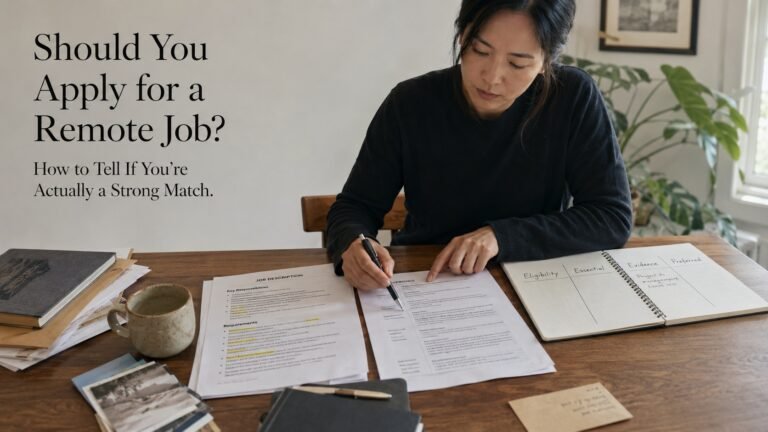
Create three columns: posting language, your evidence and the sentence it supports. If you cannot fill the evidence column, do not hide the gap with adjectives. Use the resume for breadth and the letter for two connected examples. A phrase such as “excellent communicator” should become a real decision record, customer explanation or cross-team handoff.
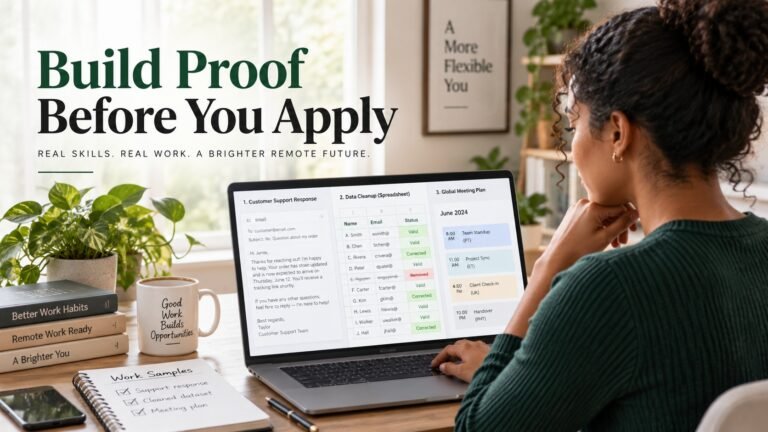
Remote relevance belongs in the work, not a list of apps. Instead of “proficient in Slack,” explain how you documented a blocker and handed a project across time zones. Tool names can support an example when relevant, but employers hire outcomes and judgment.
Adapt to common situations
For a career change, connect transferable tasks and recent proof rather than apologizing. For a location question, state eligibility precisely without offering sensitive data. For an employment gap, explain briefly only if useful and return to evidence. For an entry-level role, use coursework, service, volunteer or personal projects honestly.
Never invent a referral or claim to have used a product you have not used. Do not paste generated text without checking facts, tone and privacy. AI can help identify repetition, but you remain responsible for every claim and should never upload confidential information.
How to apply safely
Navigate to the official vacancy, confirm title, location and requisition, then follow its document instructions. Save the final resume and letter with the application date. Verify recruiter messages independently and keep identity or bank data out of informal conversations.
Never pay for a vacancy, letter review required by a supposed employer, equipment or guaranteed interview. Reject requests for gift cards, cryptocurrency, fake-check deposits or remote access. A professional-looking letter request does not make a copied job legitimate.
Ten-point self-edit checklist
Confirm the right employer and title; two matched requirements; two truthful examples; one remote-relevant behavior; no unsupported claim; no copied posting text; readable paragraphs; correct names; requested format; and an official submission route. Read it aloud once and remove filler that could apply to any company.
Stale-claim cleanup
Remove “ultimate,” commute-focused persuasion, universal templates and claims that a cover letter guarantees attention. Delete outdated software lists and invented hiring-manager preferences. Keep examples role-neutral and label them as structures, not text to copy verbatim.
Frequently asked questions
Should I mention that I want to work from home?
Only as relevant to confirmed location or arrangement. Lead with role value and evidence.
What if I have never worked remotely?
Show written coordination, independent delivery, learning and responsible escalation from other settings.
Can I reuse one letter?
Reuse a framework, not the claims. Match evidence to each role and employer.
Should the cover letter repeat the resume?
No. Use it to connect selected evidence to the employer’s central problem.
Choose your next step
Keep your momentum with practical tools and verified remote-work opportunities.
Related guides for your next step
A fresh, topic-aware mix from the WorkinVirtual library. Suggestions rotate regularly.



Discuss this guide
Ask a useful question, share relevant experience, or add a practical correction. Helpful contributions publish immediately after automated safety checks.
Start a thoughtful discussion
Be the first member to add a question or practical insight about this topic.
Join the discussion
Sign in with your verified WorkinVirtual account to contribute. Automated safety checks keep posting quick and protect the community.
Sign in to contribute