

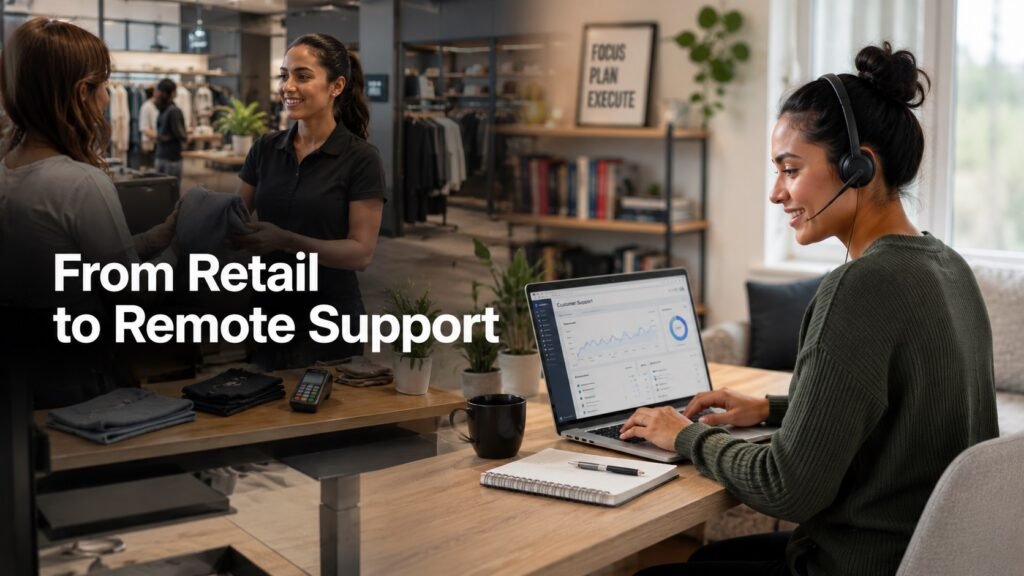
Many people interested in remote customer support jobs assume they are not qualified because they have never worked in a call center, help desk, or customer service department.
But here is something many hiring managers already know:
Some of the strongest customer support professionals come from retail stores, restaurants, hotels, hospitality businesses, and front-facing service roles.
If you have spent years helping customers, solving problems, handling complaints, answering questions, and staying calm under pressure, you may already have many of the skills employers want in remote customer support jobs.
The challenge is learning how to present those skills in a way employers recognize.
Why Employers Value Retail and Hospitality Experience
Customer support is ultimately about helping people solve problems.
Whether someone is standing at a retail counter, checking into a hotel, or contacting a software company through live chat, the core need is often the same.
- They need help.
- They want answers.
- They expect professionalism.
- They appreciate empathy.
Retail and hospitality professionals deal with these situations every day.
That experience often translates surprisingly well into remote customer support careers.
Transferable Skills You Already Have
Many career changers underestimate how valuable their existing experience really is.
Communication
Explaining products, answering questions, and handling customer concerns builds communication skills that are essential for chat, email, and phone support roles.
Problem Solving
Finding solutions for unhappy customers is a daily part of both retail and hospitality work.
Patience
Support teams regularly assist frustrated customers. Remaining calm and professional is one of the most valuable workplace skills.
Multitasking
Managing multiple customers, tasks, and priorities prepares you for busy support environments.
Conflict Resolution
Many employers specifically look for candidates who can de-escalate difficult situations professionally.
How a Hiring Manager May View Your Experience
Imagine two candidates applying for the same remote customer support position.
The first candidate has no work history involving customers.
The second candidate spent three years working at a hotel front desk or retail store.
Even without direct support experience, the second candidate often has a significant advantage because they have already demonstrated:
- Customer communication
- Issue resolution
- Professional behavior
- Team collaboration
- Workplace reliability
These qualities are difficult to teach and highly valuable in support teams.
What Additional Skills Should You Learn?
While your customer-facing experience is valuable, learning a few modern support tools can strengthen your applications.
Popular platforms include:
You do not need to become an expert immediately.
Simply understanding what these tools do can make interviews easier and help you speak the language of customer support teams.
How to Rewrite Your Resume for Customer Support Roles
A common mistake is listing job duties instead of highlighting transferable achievements.
For example:
Instead of:
“Worked as cashier at a retail store.”
Try:
“Assisted customers daily, resolved product inquiries, handled customer concerns professionally, and maintained high service standards in a fast-paced environment.”
The second example immediately demonstrates customer support skills.
What Do Entry-Level Customer Support Salaries Look Like?
Compensation varies by company, industry, location, and responsibilities.
Many beginner-friendly remote customer support roles offer opportunities to grow into:
- Senior Support Specialist
- Technical Support Representative
- Customer Success Specialist
- Quality Assurance Analyst
- Support Team Lead
- Customer Success Manager
Support careers often provide clearer advancement paths than people initially expect.
Common Mistakes Career Changers Make
- Assuming they are unqualified.
- Ignoring transferable skills.
- Submitting generic resumes.
- Failing to prepare customer-service examples for interviews.
- Not learning basic support software terminology.
Most successful transitions happen when candidates clearly connect their previous experience to the needs of support teams.
Your First Step Into Customer Support
If you are coming from retail, hospitality, food service, tourism, hotels, or customer-facing sales, you may already be closer to a customer support career than you think.
The goal is not to start over.
The goal is to reposition the skills you already have.
Many successful support professionals began their careers helping customers in stores, restaurants, hotels, and service businesses before moving into remote work.
Ready to Explore Customer Support Opportunities?
Browse current remote jobs, explore our guide to remote customer support jobs, learn about entry-level remote careers, and upload your resume to employers through WorkinVirtual Resume Upload.
Browse Remote JobsChoose your next step
Keep your momentum with practical tools and verified remote-work opportunities.
Related guides for your next step
A fresh, topic-aware mix from the WorkinVirtual library. Suggestions rotate regularly.


Discuss this guide
Ask a useful question, share relevant experience, or add a practical correction. Helpful contributions publish immediately after automated safety checks.
Start a thoughtful discussion
Be the first member to add a question or practical insight about this topic.
Join the discussion
Sign in with your verified WorkinVirtual account to contribute. Automated safety checks keep posting quick and protect the community.
Sign in to contribute