


Still using the traditional methods for career success? It’s high time to change your way, because having a just business degree is no longer the entire equation. Nowadays, the future belongs to those who understand innovation, technology, and the relentless drive that fuels new ventures. The convergence of corporate structure with an entrepreneurial mindset has created a goldmine of high-value Business and Entrepreneurship Jobs. Consider them launching pads for a fulfilling career built on impact and significant earnings potential. So, let’s find out more!
What Are the Highest-Paying Business and Entrepreneurship Jobs?
Salaries across the business landscape show remarkable variation, but a clear pattern emerges around roles that drive growth and digital transformation. Positions focused on strategic expansion, technological integration, and cutting-edge data analysis consistently rank at the top of the earnings charts. These high-paying positions demand a blend of analytical rigor and creative problem-solving, making them challenging yet incredibly rewarding.
For instance, an Entry-Level Business Development Associate often serves as the engine of the pipeline, making them indispensable. In the United States, the average annual compensation for an early-career Business Development Associate, with one to four years of experience, is roughly $164,123. It demonstrates the high value placed on individuals who can successfully identify and capture new market opportunities. The earning potential only multiplies with experience, showing why this is one of the most promising Business and Entrepreneurship Jobs.
Also Read: Entrepreneurship Skills and Careers Defining the Future of Work in 2026
What Skills Define a Successful Entrepreneur in the Modern Economy?
Becoming a successful entrepreneur or landing a top-tier business role requires far more than financial acumen. The most valuable professionals possess a potent mix of both hard and soft skills. Technical knowledge, like data analysis and digital marketing, is crucial, but it only gets you through the door. The ability to lead, adapt, and persevere is what builds empires, or at least a thriving career.
Successful business leaders master the art of effective communication, which is the bedrock of all successful negotiations and team management. They also cultivate extreme adaptability, as the modern market shifts at a dizzying pace. An entrepreneur’s ability to pivot quickly and learn from both success and failure becomes a critical survival mechanism. They must be perpetual students, continuously updating their knowledge base, especially in emerging technologies such as Artificial Intelligence.
The Entrepreneurial Edge: The Rise of Solopreneurship
Many people dream of starting their own company, moving beyond the standard corporate structure. They often wonder, Is it better to be an employee or an entrepreneur? The answer depends on your appetite for risk and your level of control. Traditional employment offers stability and a clear career ladder. Entrepreneurship offers maximum freedom, high reward potential, and the chance to build something entirely new. However, it also carries substantial risk.
One fascinating evolution is the rise of solopreneurship. This model is perfect for those seeking ultimate control without the complexity of managing a large team. Take the case of Justin Welsh, a business consultant who built a successful practice leveraging his personal brand and expertise in sales and marketing. His model shows that a thriving, high-income business does not always require a massive headcount. It requires focused effort, a deep understanding of customer needs, and the discipline to execute consistently. Solopreneurship transforms the traditional idea of Business and Entrepreneurship Jobs into a single, high-leverage role.
Why Do So Many Small Businesses Fail in the First Few Years?
The path of entrepreneurship is notoriously tricky. Understanding the pitfalls is just as important as knowing the potential rewards. The reality is stark, as about 20% of small businesses close their doors within the first year of operation. This figure climbs dramatically to roughly 50% failing by the end of their fifth year. By the tenth year, an estimated 70% of small businesses are no longer in operation.
These figures, while intimidating, are not a verdict on all ventures but rather a powerful cautionary tale. The most common causes of failure are not glamorous. They include a lack of market demand for the product, cash shortages, and poor financial management.
Many founders start a business because they love an idea, but they do not adequately research whether anyone else loves it enough to pay for it. That is why clear vision and a well-researched market fit are non-negotiable foundations for success, and pursuing a role as a Business Strategy Consultant, where you help companies avoid these common mistakes, can be a particularly high-impact career choice.
What are the Most In-Demand Business and Entrepreneurship Jobs for the Future?
Looking ahead, several specific career paths are poised for explosive growth due to global economic shifts and technological advances. These roles blend core business principles with new-age demands.
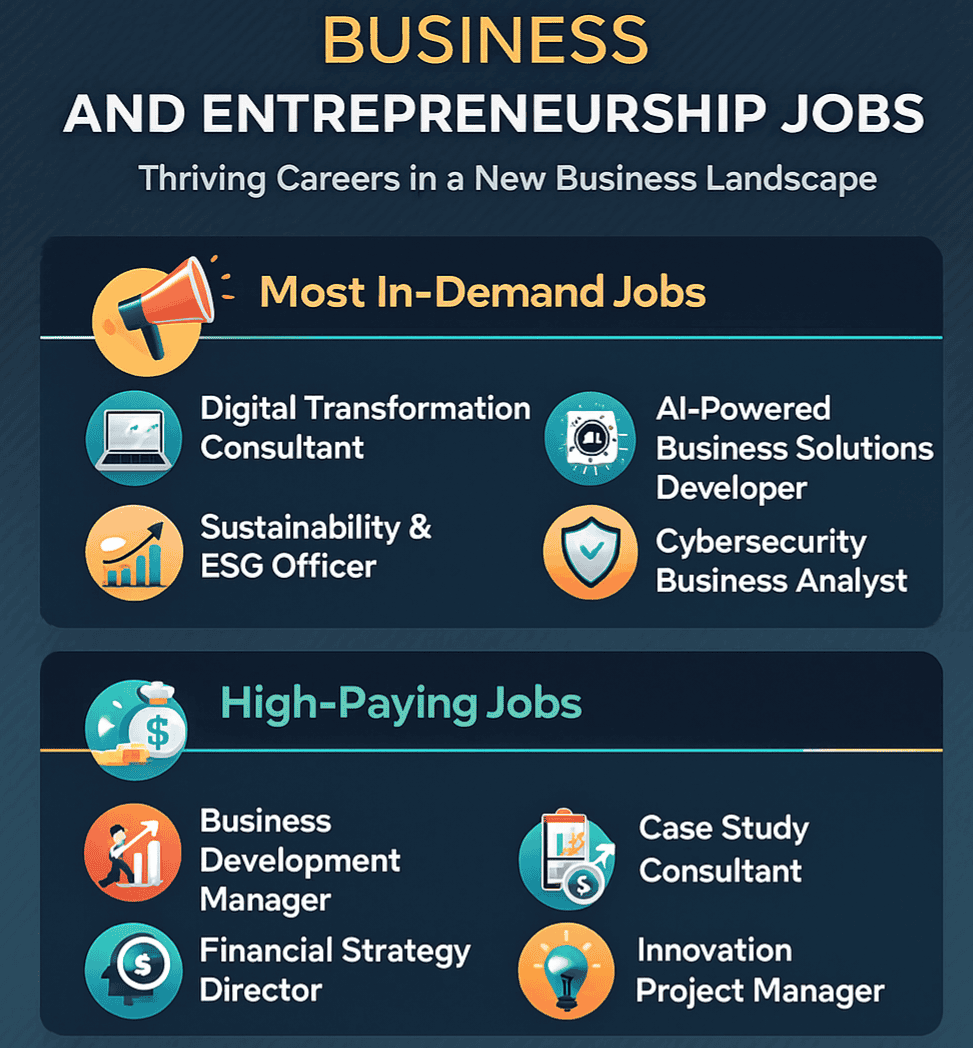
- Digital Transformation Consultant: Businesses are constantly seeking experts to guide their adoption of new technology. It is a high-level strategic role that offers considerable autonomy and compensation.
- AI-Powered Business Solutions Developer: As artificial intelligence moves from novelty to necessity, professionals who can build and deploy custom AI agents for internal business tasks will be in high demand.
- Sustainability and ESG Officer: Corporate responsibility is no longer optional. Companies need dedicated professionals to manage Environmental, Social, and Governance (ESG) strategies, directly tying business ethics to financial performance.
- Cybersecurity Business Analyst: Every data breach is a business crisis. The individuals who bridge the gap between technical security teams and the executive leadership are essential. They translate risk into business terms, protecting the company’s bottom line.
How Can I Start My Career in Business Development with No Experience?
Starting a career in one of the coveted Business and Entrepreneurship Jobs without prior experience is certainly possible, but it requires strategic effort. You will need to build your own knowledge and demonstrate a proactive, results-oriented mindset.
- Seek Out Internships and Apprenticeships: These provide structured learning and a clear path to a full-time offer. Even unpaid experiences offer invaluable networking and skill development.
- Develop a Portfolio of Personal Projects: Start a small side hustle, such as a modest e-commerce store or a simple consulting service for local businesses. This hands-on experience demonstrates entrepreneurial flair, a trait highly valued by employers. It shows you can generate revenue and handle pressure.
- Master Specific, High-Value Skills: Focus on learning skills that are immediately applicable, such as SEO, Google Analytics, or a specific Customer Relationship Management (CRM) platform. This makes you a productive asset from day one.
- Network Relentlessly: Every successful career is built on relationships. Attend industry events and connect with people on LinkedIn. Ask for informational interviews, not just jobs. People are often willing to share their time and knowledge.
Case Study: The Importance of Strategic Adaptation
Consider the remarkable success of Sara Blakely, the founder of Spanx. She started with a unique idea and only $5,000 in personal savings. Her journey underscores the power of perseverance and an obsessive focus on the customer. She did not rely on large-scale manufacturing or traditional distribution from day one. Instead, she sold her product herself, learning directly from her customers. This focused, iterative approach, a hallmark of lean entrepreneurship, allowed her to secure the right partnerships and scale a business that eventually became a global brand. Her story shows that a clear vision, combined with the ability to adapt to real-world feedback, can turn a simple idea into a highly profitable business.
Also Read: 6 Best Entrepreneurship Courses Online to Learn in 2026 (Free + Paid)
Future-Proofing Your Career: The Continuous Learning Loop
The one constant in all Business and Entrepreneurship Jobs is change. Technology, consumer behavior, and global events continually reshape the market. Therefore, the most critical career strategy is committing to lifelong learning. Whether you are aiming for a C-suite role or launching your next startup, your relevance depends on your willingness to acquire new knowledge.
Embrace online courses, certifications, and industry conferences. For instance, understanding the ethics and practical application of generative AI will be a non-negotiable skill for every marketing, sales, and strategy role in the next five years. You are investing in a future where you remain indispensable, transforming market challenges into lucrative opportunities. The journey is an exciting one, full of risk, reward, and the satisfaction of building something truly valuable.

Choose your next step
Keep your momentum with practical tools and verified remote-work opportunities.
Related guides for your next step
A fresh, topic-aware mix from the WorkinVirtual library. Suggestions rotate regularly.






Discuss this guide
Ask a useful question, share relevant experience, or add a practical correction. Helpful contributions publish immediately after automated safety checks.
Start a thoughtful discussion
Be the first member to add a question or practical insight about this topic.
Join the discussion
Sign in with your verified WorkinVirtual account to contribute. Automated safety checks keep posting quick and protect the community.
Sign in to contribute