

Tiny Typo Terrorizes Tech Giants. Sophisticated Phishing Campaign Exploits Visual Trickery to Breach Corporate and Personal Accounts.
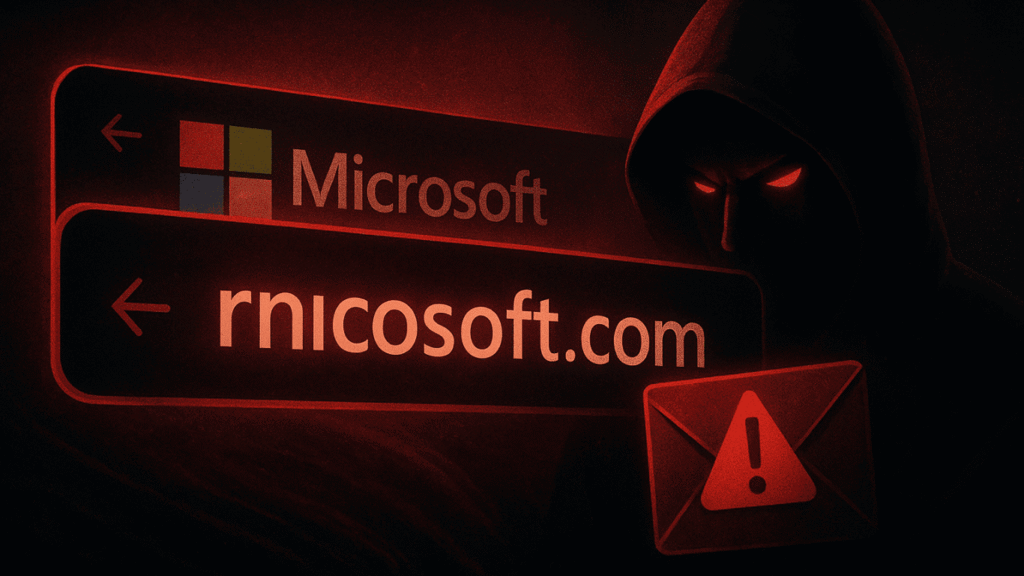
Cybercriminals engineered a strikingly effective new phishing campaign. They target Microsoft users, stealing sensitive login credentials through a simple yet ingenious visual deception. This advanced scam, a form of typosquatting, replaces the letter ‘m’ in ‘microsoft.com’ with the adjacent letters ‘r’ and ‘n’. The resulting fake domain, appearing as ‘rnicrosoft.com,’ mimics the official site with chilling accuracy.
The Deceptive Trick: ‘rn’ Masquerade
This method exploits how fonts display on screens and how the human brain processes familiar words. At a glance, especially in standard sans-serif fonts, ‘rn’ placed closely together looks virtually identical to ‘m’. Our brains prioritize pattern recognition, thus quickly auto-correcting the visual discrepancy. Users, accustomed to seeing ‘Microsoft’ daily, overlook the subtle, deceptive substitution. This clever use of homoglyph attacks demonstrates a concerning evolution in cyber threat sophistication.
The phishing emails associated with this campaign are compelling. They mirror genuine Microsoft communications perfectly, adopting the official logo, layout, and even corporate tone. Security experts confirm the high effectiveness of this trick. Harley Sugarman, CEO of Anagram, noted that these realistic lures make detection incredibly difficult for the average user.
Also Read: The Future of Work: Microsoft’s Shocking Offer
Mobile Devices: The Critical Vulnerability
The threat magnifies significantly on mobile devices. Smaller screens often hide or truncate the full URL in the address bar. Consequently, the fraudulent ‘rnicrosoft.com’ appears more legitimate on a smartphone. People frequently check emails on their phones while multitasking or distracted. This combination of visual concealment and reduced user focus dramatically increases the attackers’ success rate.
Once users fall for the ruse, they click a malicious link. This link directs them to a meticulously replicated login page. The moment they enter their credentials, the attackers steal the information. Alternatively, these emails prompt users to download harmful attachments that install malware on their devices. Attackers continue to innovate, employing similar visual attacks like substituting the letter ‘o’ with the number ‘0’ or adding extra characters to domain names.
The Alarming Scope of Phishing Attacks
The financial impact of such credential theft is staggering. According to a report from the FBI’s Internet Crime Complaint Center (IC3), phishing accounted for the most significant number of reported cybercrimes in 2023. Victims reported over 300,000 incidents of phishing, smishing, and vishing, accounting for a substantial share of all recorded complaints. The total potential loss from these and other business email compromise (BEC) incidents reached $2.9 billion in 2023 alone. Such statistics underscore the necessity of advanced user vigilance.
Furthermore, a Proofpoint study found that 86% of organizations experienced successful email-based phishing attacks in 2022—the vast majority of which targeted credential theft. The ‘rn’ trick is designed to bypass traditional security filters that often flag common typos. It capitalizes on the human element, which remains the weakest link in any security chain.
Essential Steps for User Defense
Users must adopt a defensive mindset to counter these sophisticated attacks. Relying solely on automated spam filters is no longer sufficient. Cybersecurity specialists recommend several non-negotiable practices.
- Always inspect the full sender’s email address and the domain name before clicking.
- On a desktop, hover over any link to view the full URL in the browser’s status bar.
- On mobile devices, long-press the link to preview the target address.
- Be suspicious of unexpected password reset notifications. Do not click the embedded link. Instead, manually type the official website’s correct address into a new browser tab.
- Organizations must prioritize regular, focused employee training to recognize these subtle visual and contextual phishing cues.
In this digital age, attention to detail has become the primary line of defense. A simple pair of letters, ‘rn’, now poses a significant threat to global digital security. Staying alert is the single most effective safeguard against these increasingly clever cyber threats.
