

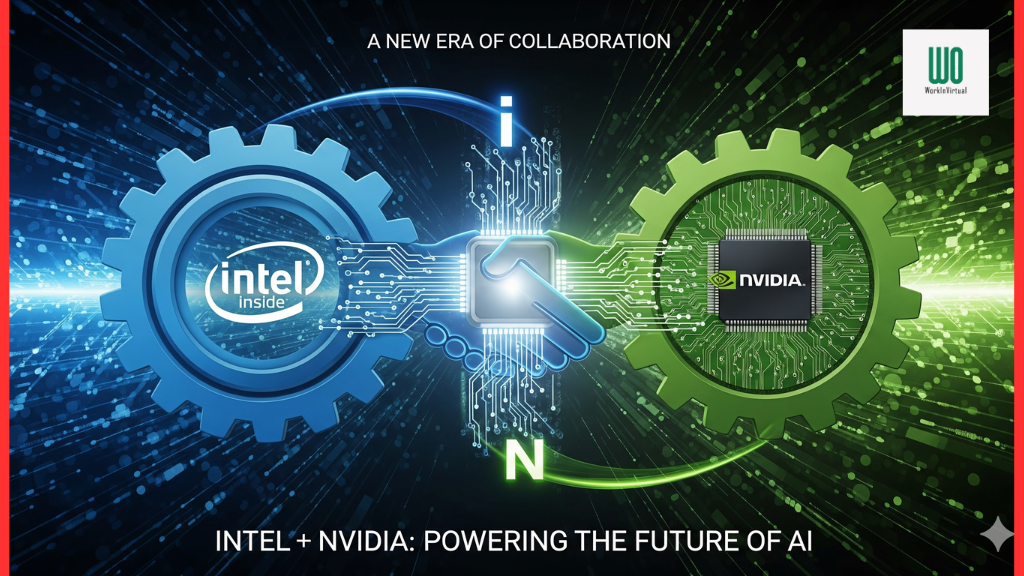
In a stunning turn of events that has sent shockwaves through the tech industry, artificial intelligence leader Nvidia has made a monumental move to invest a staggering $5 billion into Intel. This landmark deal is far more than a simple capital infusion. It represents a strategic pivot of epic proportions, a fusion of two giants that were once fierce rivals and a lifeline for a legacy company in the midst of a historic transformation.
The move comes just weeks after the United States government made its own substantial investment in Intel, a deal that underscored the national importance of a robust domestic chip manufacturing base. Now, with both the public sector and a dominant industry player throwing their support behind Intel, the stage is set for a dramatic revival. The collaboration is a powerful testament to the recognition that the future of computing and AI is a shared endeavor.
Intel, the company that for decades defined the personal computing era, has faced significant challenges in the age of AI. While its processors powered countless devices, the company was slower to embrace the specialized chips and parallel processing that have become the foundation of artificial intelligence. This allowed Nvidia to seize the moment, becoming the undisputed leader in a market that has exploded with the rise of large language models and other AI applications.
Nvidia’s investment, which includes buying a substantial stake in Intel’s common stock, is a bold statement of confidence in Intel’s future. The partnership is not just financial. It is a technological collaboration aimed at creating next-generation products for data centers and personal computers. The companies will collaborate to design custom processors that seamlessly integrate Nvidia’s cutting-edge AI technology with Intel’s established CPU and x86 architecture.
A key part of the deal involves Intel’s commitment to adopting Nvidia’s proprietary NVLink technology. This new technology will enable Intel CPUs and Nvidia GPUs to communicate with each other at an extremely high speed. It will create powerful “superchips” that are much faster than current connections. This kind of technological convergence is a game-changer for the industry and could accelerate innovation at an unprecedented pace.
The implications of this deal extend far beyond the two companies. It could disrupt the entire semiconductor ecosystem. Taiwan Semiconductor Manufacturing Company (TSMC), which currently manufactures Nvidia’s flagship chips, now faces a powerful new competitor for future business. The collaboration between Intel and Nvidia could signal a shift toward greater domestic chip production and reduce reliance on overseas supply chains. It is the key goal for the U.S. government.
For Intel, this is a much-needed injection of capital and expertise. The company has been undergoing a major turnaround, investing heavily in its manufacturing capabilities and seeking to establish its foundry business as a key player. While this initial agreement does not involve Intel’s foundry making Nvidia’s most advanced chips, it is a significant step toward proving its capabilities and attracting other major customers.
The alliance is a win-win situation. Nvidia secures a strategic partner with deep expertise in CPUs and a global footprint. While Intel gains access to the resources and AI technology it needs to regain its footing within the market. The move is a recognition that the demands of modern computing require a level of collaboration that was once unthinkable. This unprecedented alliance may serve as a blueprint for the next chapter of technological evolution, where former adversaries unite to shape the future.