

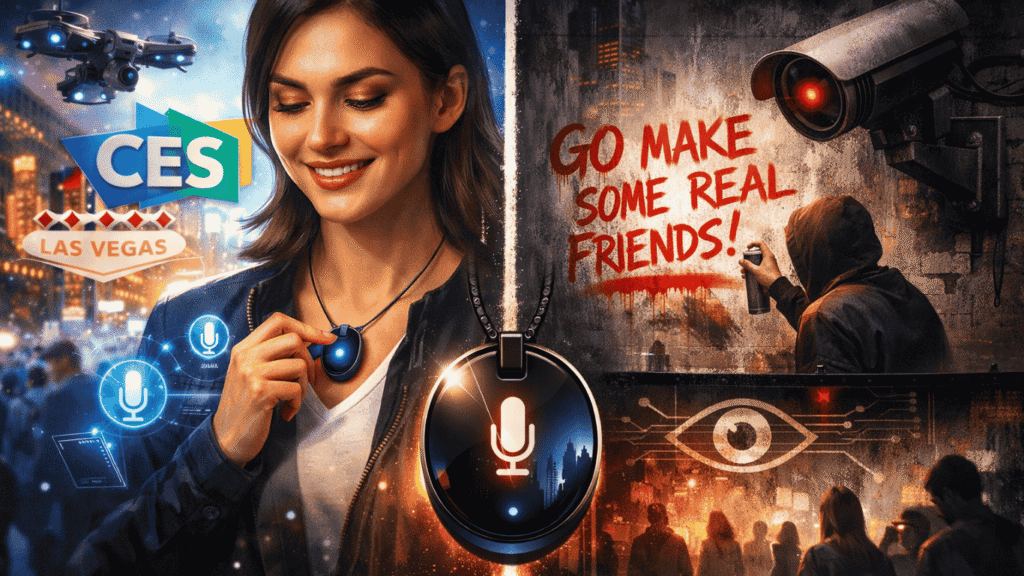
Forget the Smartphone: Tech Giants Bet Big on Always-Listening Wearables, Igniting a New Era of Digital Companionship and Controversy
Is big tech watching and listening to our every move, and are we now eager to let it happen? The Consumer Electronics Show (CES) in Las Vegas recently became the surprising stage for a significant technology revival, the ‘AI pendant.’ Just a year after the highly publicized market failure of the much-hyped Humane AI Pin, these body-worn devices are back, transforming from niche gadgets into a central battleground for the future of personal technology. Their prominence signals a bold, perhaps risky, bet by industry heavyweights on “always-on” AI companions.
The Phoenix Rises: A Flurry of New AI Wearables
The comeback is a full-scale assault on the traditional smartphone’s dominance. Major players and innovative startups are flooding the market with diverse form factors. Lenovo’s Motorola subsidiary debuted a prototype AI pendant allowing hands-free interaction with its intelligent assistant, Qira.
Furthermore, the industry is seeing significant consolidation, as demonstrated by Amazon’s acquisition of the wearable AI startup Bee and Meta’s acquisition of Limitless. These strategic moves underline the immense value tech giants place on establishing an early foothold in this rapidly evolving space. The devices are evolving past simple notification systems, leveraging technical advances like superior chips to overcome early hurdles of poor battery life and clunky, non-conversational software.
Privacy Fears vs. Convenience Craze
However, this push into omnipresent, body-worn AI is far from universally accepted. A distinct and visceral public anxiety exists, as seen in the “Go make some real friends” graffiti protest against a brand of AI pendants in New York City. The core conflict is apparent: the unparalleled convenience of hands-free note-taking, memory capture, and instantaneous information access clashes directly with the deeply rooted concern of “surveillance capitalism.”
The fact is, the lines between personal assistant and personal spy are becoming dangerously blurred. According to a 2024 Pew Research Center survey, almost 80% of Americans feel they have little to no control over the data companies collect about them. This statistic highlights the massive trust deficit new surveillance-adjacent technology must overcome to achieve mass adoption.
Redefining the Human-Machine Relationship
Companies are keenly aware of privacy skepticism and are seeking to frame their products as solutions to digital fatigue. Yin Haitian, founder of Chinese startup iBuddi, showcased a companion medallion intended to replace phone interactions, not add another screen. He insists the device “reacts to the moments that matter instead of continuously recording everything,” positioning the tech as a tool for presence rather than surveillance. This approach stands in stark contrast to devices like the Looki L1, which continuously captures the wearer’s point of view, summarizing the day and offering real-time advice.
Despite the apprehension, market analysts believe consumer expectations are undergoing a fundamental shift. Techsponential analyst Avi Greengart points out that people are already willingly surrounded by surveillance from smartphones, city cameras, and smart home devices. The wearable AI will likely not replace the smartphone anytime soon. Still, it is poised to become a routine and expected addition to a user’s digital ecosystem, alongside smart watches and glasses.
Moreover, the dramatic return of the AI pendant at CES confirms one thing: the future of personal technology will be hands-free, voice-activated, and fundamentally challenging to our established notions of digital privacy.
