


Why do some people seem to turn their skills into a six-figure income while others struggle to make ends meet? The truth is, your expertise is a hidden goldmine, but most people never cash in on it. Millions of valuable professionals often ask, ‘how to sell your skills for maximum profit,’ yet only a few know how to package and sell them for top dollar. Instead, they’re stuck trading hours for dollars, capping their own earning potential.
It is high time to stop thinking like an employee and start acting like a strategic business owner. Want to know the secret? It lies in positioning, packaging, and marketing your skills effectively. In this step-by-step guide, you’ll learn how to price your expertise based on real value, attract high-paying clients, and finally earn what your skills are truly worth.
Also Read: Entrepreneurship Skills and Careers Defining the Future of Work in 2026
1. Identify Your Most Valuable Skill: The Rarity Factor
Not all skills are created equal when it comes to profit. The first crucial step is shifting your focus from “what I can do” to “what problem I solve.”
Your most profitable skill sits at the intersection of three things: high expertise, high market demand, and relative rarity. For instance, a basic WordPress site setup is rare. Conversely, creating custom, high-converting checkout funnels for high-growth e-commerce companies is a rare, high-value skill.
Ask yourself these three questions to pinpoint your highest-value offering:
- Which skill do I genuinely enjoy and already excel at?
- Which skill has an existing, willing market that is currently paying for solutions?
- Which skill can directly solve a painful, expensive problem for businesses or affluent individuals?
Think of an average content writer charging $50 per blog post. Now consider the conversion copywriter who charges $2,000 for a single landing page because they increase sign-ups by 5%. The fundamental skill is writing, but the application, the high-value outcome, is what commands the maximum profit, so focus on results, not tasks.
2. Package Your Skills for Value, Not Time
Once your high-value skill is evident, you must package it to appeal to clients who buy outcomes. Clients do not want graphic design. They want more sales, reduced churn, and a stronger brand image, with measurable results.
Reframing your service is essential to maximizing profits.
- Instead of saying, “I do general social media management.”
- Say: “I create targeted Instagram campaigns that increase your brand’s qualified engagement by 30% in 90 days.”
Feel the difference. One is a task, while the other is a guaranteed, measurable result.
You need to break your services into clear, results-driven offerings and avoid quoting hourly rates. Develop tiered packages, such as Basic, Standard, and Premium, each offering progressively higher value and deeper results. This strategy anchors the client’s perception of what they receive, moving the conversation away from cost and toward ROI.
3. Choose Your Selling Platforms Strategically
Where you market your skills directly impacts the caliber of clients you attract and the prices you can charge. Mixing platforms is a powerful strategy, but prioritize those that attract clients willing to pay for value.
- Freelance Marketplaces (Upwork, Fiverr): Excellent for starting, gaining quick reviews, and understanding project demand. Be aware that these platforms often attract clients seeking lower rates.
- Professional Networking (LinkedIn, Niche Groups): This is where high-value clients and recruiters look for talent. An impressive 90% of job seekers use LinkedIn for their search, and nearly all recruiters use it to find candidates. This platform is non-negotiable for securing long-term contracts.
- Content Platforms (Medium, Personal Blog, YouTube): These build authority. Publishing insightful content positions you as an expert, making clients come to you. This reverses the dynamic from pitching to consulting.
4. Stop Charging Hourly, Start Pricing the Value
Most people dramatically undercharge because they fear losing a client. This fear locks them into the damaging “time-for-money” trap. You must stop thinking in hours and start thinking in terms of the financial impact you deliver.
The key to maximum profit is Value-Based Pricing.
Your Price = Client’s Expected Gain x Your Value Percentage
Research indicates that the average freelancer globally earns about $21 per hour. However, specialized freelancers who successfully implement strong value-based pricing models earn three times the industry average by focusing on quantifiable outcomes rather than just their time.
To implement value pricing:
- Determine Client Impact: If your work will save a client $20,000 in monthly ad spend, or generate $50,000 in new sales, your service is worth thousands, not hundreds.
- Anchor High: Structure your tiered packages so the middle option is the most attractive.
- Example Tiered Pricing:
- Basic ($750): 3 SEO-Optimized Articles, no outreach.
- Standard ($1,950): 5 Articles, complete SEO optimization, image sourcing, and content performance reports. (The most common choice)
- Premium ($3,500): 10 Articles, everything in Standard, plus a dedicated monthly strategy session and social media promotion snippets.
Clients will readily pay more for reduced risk, faster results, and demonstrated expertise.
5. Market Your Skills with Social Proof and Credibility
Marketing is not optional, but the engine that drives your high-ticket sales. Your focus must be on demonstrating results and establishing credibility before the client ever speaks to you.
- Case Studies are Gold: Do not just show pretty designs or written words. Showcase transformations. “Reduced client X’s website bounce rate from 55% to 32%, resulting in a 15% increase in lead generation.”
- Testimonials: Gather clear, specific feedback from past clients. “The new launch copy led to a 40% higher conversion rate than our previous best attempt.”
- Create Value-Driven Content: Give away your best knowledge for free. This builds trust and positions you as the authority. Think of a short guide or a tutorial on a complex topic in your field. This practice attracts clients who value your insight.
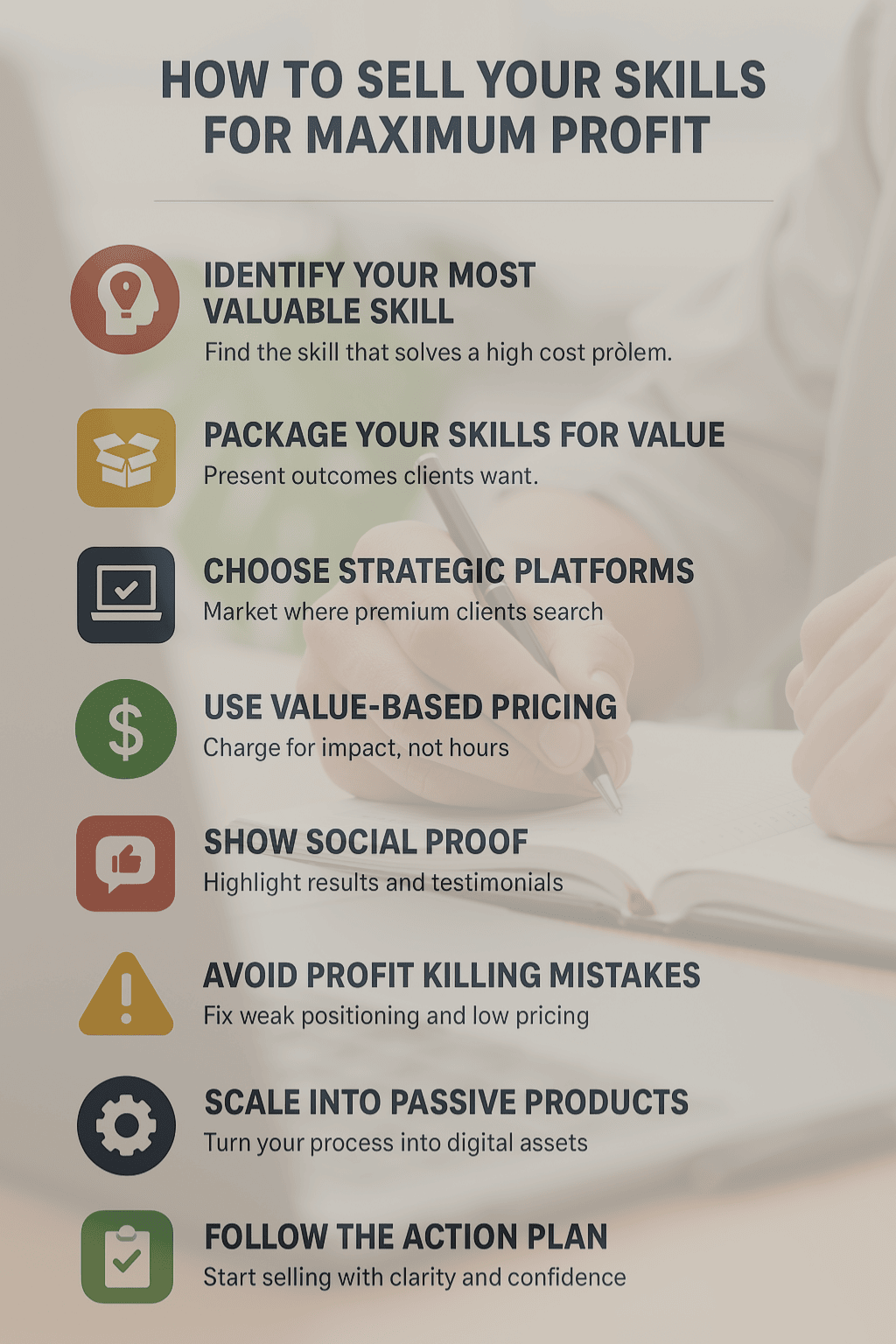
6. Avoid the Common Profit-Killing Mistakes
Many skilled professionals stall their growth by making avoidable errors. Maximum profit requires strategic discipline.
- Undervaluing Expertise: As noted, fearing a client saying “no” often leads to pricing based on poverty rather than potential. Low prices attract low-quality, demanding clients.
- Ignoring Pain Points: Never sell a feature. Sell the cure for the client’s chronic headache. A feature is “I provide cloud migration services.” A cure is “I transition your legacy systems to the cloud, eliminating the 40+ hours of monthly maintenance costs that have been crippling your IT budget.”
- Sticking to a Single Income Stream: Relying only on one-on-one client work is not scalable. Explore every possible platform to find potential clients.
7. Scale Your Services into Passive Products
The ultimate step toward maximum profit is decoupling your income from your time. Once you have validated your skill through high-ticket services, you can turn that knowledge into scalable digital products.
- The Scale Opportunity: The global e-learning market is experiencing massive growth, projected to reach approximately $320 billion in 2025. This market is ideal for monetizing expertise without having to repeat the work.
Products to Create:
- Online Courses or Workshops: Package your entire process for a single, high-value fee.
- Templates or Tools: Sell the exact spreadsheets, code snippets, or design templates you use in your client work.
- Membership Services: Offer recurring revenue through exclusive communities, private mentorship, or continuous access to updated resources.
Case Study: Scaling from Service to Product
Jane, a social media designer, initially earned $300 for a week of designing static Instagram feed visuals for one client. She realized the most significant pain point was consistency.
- Service to Template: She compiled her top-performing layouts into themed Instagram template packs, selling them on Gumroad for $50 each.
- Authority Building: She shared successful case studies and testimonials on LinkedIn.
- Productization: Using the market demand data from her template sales, she built a high-quality online course that teaches businesses how to use the templates and understand the strategy behind them. She priced the course at $499.
Within six months, Jane earned over $10,000, primarily from course and template sales, without increasing her one-on-one working hours. She successfully leveraged her high-value skill into scalable, passive income.
8. The Action Plan to Start Selling Today
Maximum profit is a formula executed with confidence and clarity. Use this action plan to begin positioning your skills today:
- Define Your Niche: Pinpoint the one skill and one client problem you solve best.
- Create Tiered Packages: Design three distinct, results-focused packages anchored by value.
- Set Value-Based Pricing: Calculate your prices based on the financial impact on the client, not the hours worked.
- Launch Your Authority Hub: Choose one platform, such as LinkedIn, to consistently share your expertise and case studies.
- Focus on Outreach: Target potential clients who need the specific transformation you offer. Follow up with value.
Selling your skills for maximum profit requires a change in mindset, as the market consistently rewards clarity, confidence, and measurable results. If you commit to solving genuine problems and showcasing clear, undeniable outcomes, clients will pay top dollar for the expertise only you can deliver.


