


Table of Contents
When a self-driving car slows down near a fire hydrant or a chatbot answers a complex question in seconds, we often credit brilliant engineers or advanced processors. Yet behind those polished interfaces lies something far more human, i.e., digital labor.
Every day, millions of workers around the world quietly perform tasks that make modern technology possible. They label images so artificial intelligence can recognize objects, filter disturbing content to keep social platforms safe, and evaluate search results, tag datasets, and train machine-learning systems to behave more intelligently. Most users never see this workforce.
Digital labor operates inside the infrastructure of the internet itself. It hides behind algorithms, platform dashboards, and automated systems that appear fully autonomous. However, in reality, modern AI and digital platforms rely heavily on human input. Tasks such as data annotation, content moderation, clickwork, and platform-mediated gig work all fall under the umbrella of digital labor.
What appears automated often depends on thousands of invisible workers scattered across the globe. As the digital economy grows, this hidden workforce has become one of the most politically and economically important labor forces of the 21st century.
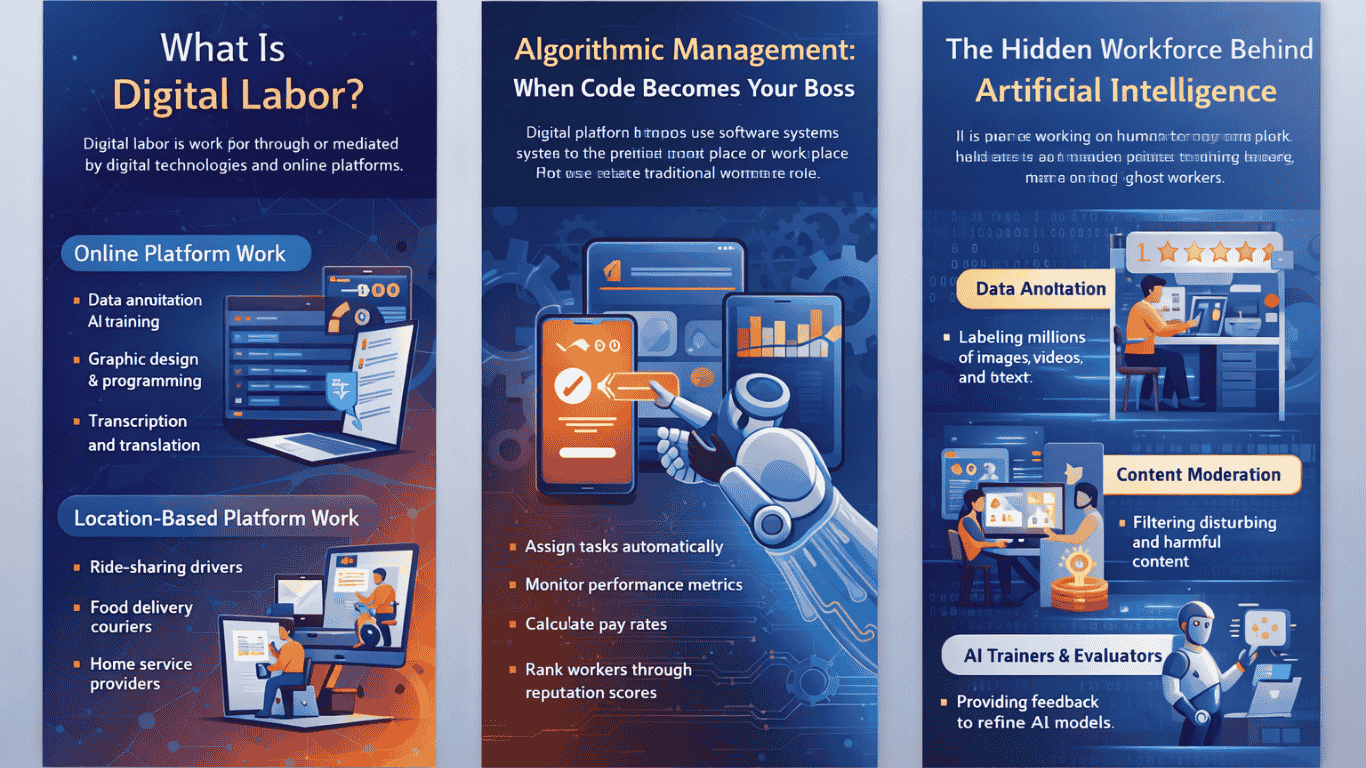
What Is Digital Labor?
Digital labor refers to work performed through or mediated by digital technologies and online platforms. This work includes both highly skilled remote freelancing and low-paid microtasks executed through global crowdsourcing systems.
More formally, economists describe digital platform work as any paid activity conducted through a digital platform or mobile application that organizes tasks, distributes work, and processes payments between workers and clients.
This definition covers two main categories of work:
1. Online Platform Work
These jobs happen entirely online and can be performed from anywhere. Examples include:
- Data annotation for AI training
- Graphic design or programming via freelancing platforms
- Transcription and translation tasks
- Search engine evaluation
- Content moderation
Workers in this sector often complete tasks remotely for companies located in other countries.
2. Location-Based Platform Work
This category includes app-based jobs that happen in the physical world but rely on digital coordination.
Examples include:
- Ride-sharing drivers
- Food delivery couriers
- Home service providers
Digital labor platforms now play a major role in organizing this type of work worldwide.
Together, these systems have transformed how companies hire talent, how workers find income, and how labor markets operate globally.
The Rise of the Global Platform Economy
The expansion of digital labor did not happen overnight. Over the past decade, digital labor platforms have grown fivefold, creating new employment opportunities while also reshaping the structure of global labor markets.
Several forces have driven this growth:
- Global Connectivity
Internet access and smartphones have connected workers across continents. A company in San Francisco can hire a freelancer in Nairobi, Cairo, or Manila within minutes.
- Lower Barriers to Entry
Unlike traditional employment, many digital platforms require minimal credentials. Workers can often start with nothing more than a laptop and an internet connection.
- On-Demand Business Models
Companies increasingly prefer flexible workforces that scale up or down quickly. Platform labor allows them to access talent without maintaining permanent payroll structures.
This system creates clear advantages for businesses. Firms gain access to a global labor pool, reduce overhead costs, and distribute tasks efficiently through digital systems. For workers, however, the story becomes more complicated.
Algorithmic Management: When Code Becomes Your Boss
Traditional workplaces rely on managers, supervisors, and human resource departments. Digital platforms often replace those roles with algorithms. This process is known as algorithmic management.
Platforms use software systems to:
- Assign tasks automatically
- Monitor performance metrics
- Calculate pay rates
- Rank workers through reputation scores
- Suspend or remove accounts.
Workers rarely speak to human supervisors. Instead, they interact with dashboards, automated notifications, and algorithm-driven decisions. While this model can increase efficiency, it also introduces serious challenges.
Algorithms rarely explain their reasoning. If a worker’s rating drops or their account becomes suspended, the decision may appear arbitrary and difficult to contest. The result is a new type of employment relationship where workers answer to data rather than people.
The Hidden Workforce Behind Artificial Intelligence
Artificial intelligence may look autonomous, but it relies heavily on human labor. Researchers often describe this workforce as “ghost workers.”
These individuals perform tasks that machines still struggle to handle, including:
Data Annotation
Machine-learning systems learn from examples. Humans must label those examples first.
Workers may spend hours:
- Drawing boxes around pedestrians in traffic footage
- Tagging emotions in voice recordings
- Categorizing objects in millions of images
Without this training data, AI systems cannot function.
Content Moderation
Social media platforms rely on moderators who review disturbing material so ordinary users never have to see it.
Moderators remove:
- Violence and harassment
- Hate speech
- Graphic or illegal content
This job often exposes workers to psychologically damaging material.
AI Trainers and Evaluators
Large language models require human feedback to improve their outputs. Skilled workers evaluate answers, rewrite text, and rank responses so AI systems learn what “good” output looks like. Although AI receives the credit, humans quietly shape the intelligence behind the machine.
The Geography of Digital Labor
Digital labor markets operate globally, but they do not distribute opportunity equally.
Many companies outsource digital tasks to workers in lower-income economies where wages remain significantly lower. This practice allows firms to scale AI development and platform services at minimal cost.
For example, investigations into AI training supply chains have shown that some data annotation workers in developing economies earn only a few dollars per hour while performing demanding tasks such as moderating violent content.
This geographic imbalance creates a digital hierarchy:
- High-income countries design platforms and AI systems
- Mid-income countries provide skilled remote freelancers
- Lower-income regions often supply microtask labor
At the same time, digital platforms can still provide meaningful opportunities in places where traditional employment options remain limited. In regions with high youth unemployment, platform work may serve as an important source of income. The challenge lies in ensuring that these opportunities come with fair compensation and worker protections.
The Myth of the Fully Democratized Workplace
Early advocates of the internet believed digital platforms would flatten economic hierarchies. The theory sounded simple: if everyone can connect online, talent will compete on equal footing regardless of geography.
Reality tells a different story.
Studies of online freelancing markets reveal persistent inequalities tied to gender, race, and location. Researchers have found that digital labor platforms can reinforce stereotypes and bias within online marketplaces.
Workers from certain regions may face lower pay expectations. Women often encounter additional barriers, including unequal ratings, occupational segregation, and increased domestic responsibilities while working remotely.
In other words, digital infrastructure does not automatically erase structural inequality. Instead, it often replicates it in new forms.
Privacy, Surveillance, and Data Control
Digital labor platforms depend heavily on data collection. Every click, response time, rating, and interaction generates information that platforms use to optimize their systems.
This data serves several purposes:
- Tracking productivity and performance
- Training recommendation algorithms
- Improving automated decision-making systems
While these systems increase efficiency, they also raise concerns about worker privacy.
Continuous monitoring can create a form of digital surveillance in which workers feel constantly evaluated by invisible metrics. In many cases, workers cannot access or challenge the data used to judge their performance.
As governments begin to recognize these risks, policymakers increasingly push for algorithmic transparency and fairness.
The Regulation Debate: Who Protects Digital Workers?
For years, regulators struggled to keep pace with the platform economy. Digital labor platforms grew rapidly, often operating across borders where traditional labor laws did not clearly apply.
Today, that situation is beginning to change. International institutions and governments increasingly recognize that platform workers require clear protections.
Key policy debates focus on:
- Worker Classification
Should gig workers count as independent contractors or employees? This classification determines whether workers receive benefits such as minimum wage protections, unemployment insurance, or health coverage.
- Algorithm Transparency
Workers increasingly demand the right to understand how algorithms evaluate performance and determine pay.
- Social Protection Portability
Because many workers operate across multiple platforms, policymakers are exploring portable benefits systems that follow workers from job to job.
The International Labour Organization has even placed decent work in the platform economy on the agenda of major global labor discussions, reflecting the growing importance of these issues.
The Future of Digital Labor
Digital labor will not disappear. In fact, it will likely expand. Artificial intelligence, automation, and digital services continue to grow rapidly across industries. Yet most of these systems still require human guidance, oversight, and training. It means the future of work will increasingly blend human intelligence and machine automation.
However, the long-term sustainability of this system depends on several reforms:
- Greater Transparency
Workers must understand how algorithms evaluate their work and determine compensation.
- Human Oversight in AI Systems
High-risk automated decisions, such as job terminations or wage adjustments, should be subject to human review.
- Fair Pay Structures
Platforms must ensure that global labor markets do not become race-to-the-bottom pricing systems.
- Portable Benefits
Workers who earn income from multiple digital platforms should still access healthcare, retirement benefits, and social security protections.
Without these reforms, digital labor could create a massive global workforce that remains economically essential yet legally invisible.
The Bottom Line: The Human Engine of the Digital Economy
The digital world often presents itself as frictionless and automated. Apps deliver services instantly. AI systems respond in milliseconds. Platforms scale across continents with minimal physical infrastructure.
But none of this technology operates in isolation. Behind every dataset, recommendation algorithm, and chatbot response stands a vast network of human workers performing the tasks machines cannot yet handle.
Digital labor represents the human infrastructure of the internet economy. The question is no longer whether this workforce exists. It clearly does. The real question is whether society will finally recognize, regulate, and fairly compensate the people quietly feeding the machine.


