

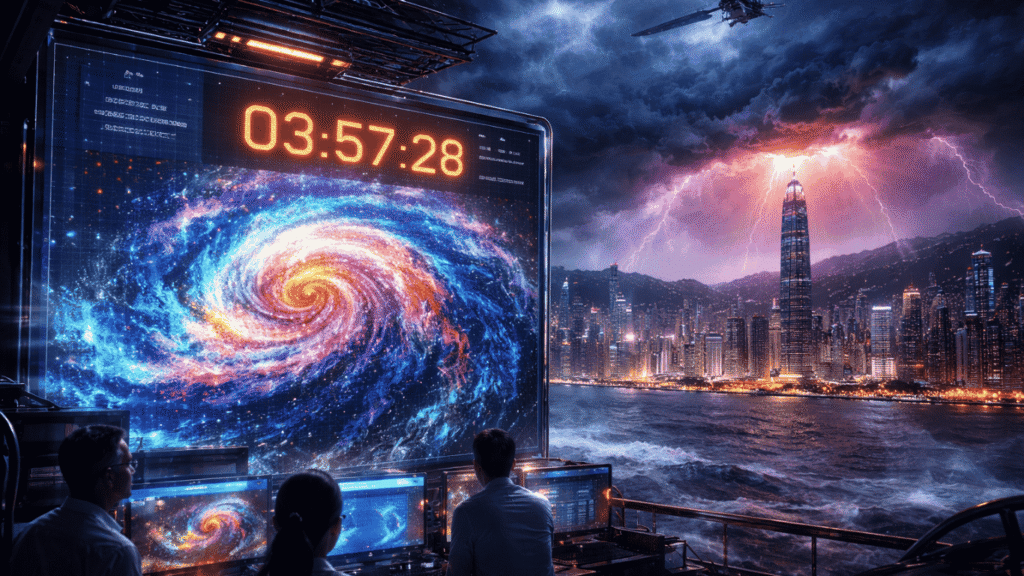
Scientists deploy generative “diffusion” tech to shatter forecasting limits, offering a four-hour lifeline against flash floods and chaos.
The sky above Hong Kong often transforms from a tranquil blue to a bruising violet in mere minutes, leaving millions at the mercy of sudden, violent downpours. Traditionally, our defense against these atmospheric ambushes relied on a narrow 120-minute window of predictability. That era of uncertainty is ending, as a team of visionary researchers has unveiled an artificial intelligence framework that predicts extreme weather events with greater accuracy, doubling the warning time.
THE ARCHITECTURE OF ANTICIPATION
Nature operates on chaos, yet this new system, known as the Deep Diffusion Model based on Satellite Data (DDMS), finds order within the storm. By utilizing generative AI techniques similar to those that create digital art, the model learns to “de-noise” complex atmospheric data. It reconstructs potential weather patterns with startling clarity. While older systems struggled to see beyond the immediate horizon, DDMS extends the horizon to a full four hours. This extra time provides a critical buffer for emergency services to clear drainage systems and for citizens to seek shelter before the first drop falls.
FROM ORBIT TO THE STREETS
Ground-based radar has long been the gold standard for tracking rain, but it can only see what is already there. The Hong Kong team pivoted its gaze upward, tapping into infrared data from China’s Fengyun-4 satellite. These celestial eyes detect cloud formation and subtle temperature shifts that signal an impending disaster, long before radar detects moisture.
Recent evaluations of the system show significant performance improvements. The AI-driven approach has improved forecast precision by roughly 17% compared with the legacy models used by regional authorities. Furthermore, the system is relentless, refreshing its data every quarter-hour to ensure that no sudden shift in wind or pressure goes unnoticed.
A REGIONAL SHIELD AGAINST CLIMATE CHAOS
Global weather patterns are becoming increasingly erratic, with the intensity of “once-in-a-century” storms now occurring with frightening regularity. In response, the Hong Kong Observatory and the China Meteorological Administration are fast-tracking the integration of this AI into their daily operations. The collaboration aims to create a unified digital shield across the Greater Bay Area.
Data suggests that early warning systems can reduce damage costs by up to 30% during severe weather events. By providing a four-hour lead time, the DDMS model could save billions in infrastructure losses and, more importantly, countless lives. This breakthrough signals a shift in our relationship with the climate. We are no longer merely reacting to the clouds, but finally staying a step ahead of them.
