


In a world where remote work has become the new normal, companies are seeking a competitive edge. The secret weapon for high-performing, globally distributed teams is asynchronous work. This modern way of working allows team members to manage their own schedules and communicate at their own pace, regardless of time zones. It’s a fundamental shift in how we collaborate, putting trust, autonomy, and transparency at the forefront. Consider it a long-term, more sustainable way to work that is redefining the very structure of the modern workplace.
According to a 2023 McKinsey Global Survey, a staggering 58% of knowledge workers now have the option to work remotely at least one day a week. As this trend accelerates, the need for new, more effective communication models becomes paramount. Asynchronous work is the answer, moving away from constant interruptions and toward a more intentional and focused approach.
Asynchronous Work vs. Synchronous Work
To appreciate the power of async, you must first understand its counterpart. The core difference between asynchronous work vs. synchronous work is time.
Synchronous communication unfolds in the immediate, demanding the simultaneous presence and attention of all involved parties. Imagine the dynamic energy of a live team meeting, the instant connection of a spontaneous video call, or the rapid-fire exchange on a chat platform. This mode of interaction is often hailed for its ability to foster real-time collaboration and resolve urgent issues with unparalleled speed. However, its very nature is also its greatest weakness. The constant expectation of immediate response can be a profound source of interruption and distraction, fragmenting focus and derailing deep work. A groundbreaking study from the University of California, Irvine, revealed that it takes an average of 25 minutes and 26 seconds for an individual to regain their full concentration after a single interruption. This significant cognitive cost highlights the hidden inefficiency of synchronous tools. When a notification chimes or a meeting pops up, it steals a quarter of an hour of productivity. Therefore, while indispensable for certain tasks, relying too heavily on this communication style can lead to a state of perpetual distraction, undermining both individual output and organizational efficiency. It’s a powerful tool, but one that must be wielded with mindful intention to avoid a constant state of cognitive whiplash.

Asynchronous communication offers a powerful alternative to the always-on pressure of real-time interaction. Unlike its synchronous counterpart, it liberates individuals from the expectation of an immediate reply, fostering a more deliberate and considered exchange. This communication model thrives on a foundation of written and recorded information, with tools like emails, project management platforms, and pre-recorded video messages serving as its backbone. It’s an approach that prioritizes clarity and thoughtfulness over speed, allowing people the time and space to formulate comprehensive responses without interruption. This freedom is a game-changer for productivity, as it enables individuals to work in focused blocks, attending to messages and updates when they align with their workflow rather than when a notification demands their attention. By decoupling communication from time, asynchronous methods reduce the cognitive load of constant context-switching and empower teams to collaborate effectively across different time zones. The core value of this style lies in its ability to support deep work, ensuring that communication becomes a tool for enhanced productivity rather than a source of constant distraction.
Many global teams are now adopting a hybrid communication model, blending synchronous brainstorms with asynchronous documentation and execution. This balance creates agility and reduces stress, allowing remote workers to thrive.
The Benefits of Asynchronous Work for Remote Teams
Asynchronous work directly addresses and solves many of the problems created by traditional, synchronous workflows. By shifting to an async-first culture, companies can realize significant gains in productivity, well-being, and global reach. These are the key benefits of asynchronous work for remote teams:
1. Increased Productivity and Deep Work
Endless meetings and constant interruptions are not only inefficient but also detrimental to high-quality work. Async productivity frees up valuable time, allowing employees to enter a state of “deep work,” focused, uninterrupted cognitive effort. According to a study, remote workers save up to two hours daily by reducing commutes and live meetings. This saved time can be reinvested into tackling complex tasks, upskilling, or personal growth.
2. Reduced Burnout and Improved Work-Life Balance
The pressure to be “always on” can quickly lead to burnout. Asynchronous work allows employees the flexibility to work when they are most productive, whether that’s early mornings, late nights, or short bursts throughout the day. This flexibility directly enhances work-life balance, which boosts employee satisfaction and retention. A recent study by Miro found that 61% of knowledge workers revealed that async work reduces the chances of burnout. Moreover, a survey found that 75% of employees believe that remote work (fueled by asynchronous communication) improves their work-life balance. It indicates that asynchronous work is crucial and the need of the hour.
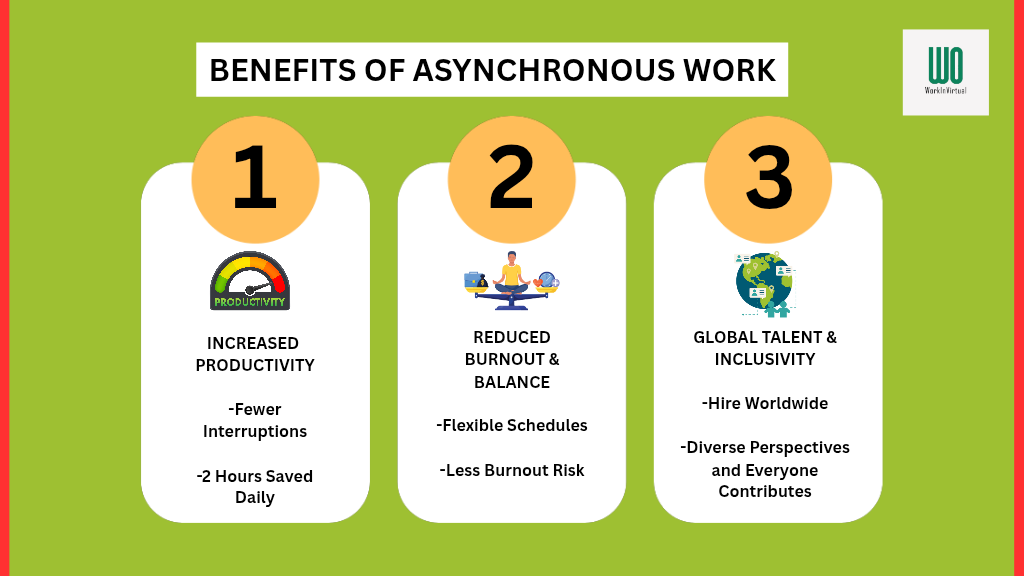
3. Global Talent and Inclusivity
Asynchronous work dismantles geographical barriers, allowing companies to recruit top global talent without being limited by time zones. This opens up a wider talent pool and promotes a more diverse workforce. Beyond recruitment, async collaboration also boosts inclusivity within existing teams. In live meetings, the loudest voices often dominate the conversation. Async communication gives everyone, from introverts to non-native English speakers to deep thinkers, an equal chance to contribute ideas thoughtfully and without pressure. Miro’s research shows 66% of knowledge workers feel more comfortable sharing ideas asynchronously with their managers or higher authorities.
4. Enhanced Documentation and Knowledge Sharing
Distributed teams’ communication relies on documentation, which is the bedrock of success. Everything from project plans and team norms to meeting summaries should be written down and made accessible. This practice eliminates information silos, ensuring all team members have the context to succeed, regardless of their location. Strong documentation also streamlines onboarding. Instead of relying on synchronous training calls, new hires can learn at their own pace through a centralized knowledge base. According to Harvard Business Review, 71% of senior managers feel that meetings are unproductive. By moving decisions and updates into async documents, remote-first companies reclaim valuable time and improve productivity.
Asynchronous Work Best Practices
Switching from synchronous to asynchronous communication isn’t about eliminating all meetings. It’s about creating a “default to async” work culture where meetings are held only when truly necessary. Here are some key asynchronous work best practices to make this transition a success:
- Embrace Video Messages: Tools like Loom and Zight are revolutionizing asynchronous communication by allowing teams to record short video updates. These messages, typically under a few minutes, add a valuable human element and tone that can be lost in text-based communication. This approach enables colleagues to share complex ideas, provide detailed feedback, or give quick project updates with a personal touch, all without the logistical hassle of scheduling a live call. It’s an efficient way to foster stronger team bonds and ensure clarity, bridging the gap between a written message and a full-fledged meeting.
- Use Project Management Tools: Platforms like Asana, Trello, and Monday.com help make effective asynchronous teams. These tools provide a single, transparent source of truth for all tasks, deadlines, and project status updates. By housing all project-related information in one place, they eliminate the need for constant status update meetings and back-and-forth emails. Team members can independently check progress, assign tasks, and track their own work, allowing everyone to stay aligned and accountable without the interruptions of constant check-ins, thereby fostering greater autonomy and efficiency.
- Set Clear Expectations: A successful shift to asynchronous work hinges on establishing clear, agreed-upon communication norms. It is crucial to define explicit response times, such as “within 24 hours” or “by the end of the business day.” This simple practice relieves employees from the pressure of feeling obligated to reply instantly, fostering a healthy work-life balance and a sense of psychological safety. By setting these expectations, organizations cultivate a culture of trust and autonomy, where individuals are empowered to manage their time and focus on deep work without the anxiety of being constantly available.
- Prioritize Clarity Over Speed: In an asynchronous environment, the quality of communication far outweighs the speed of delivery. A well-structured email, a detailed project brief, or a thoughtful document can save countless hours of clarifying questions and fragmented conversations. Taking the time to craft a clear, concise, and comprehensive message upfront ensures that the recipient has all the necessary information to proceed without needing a follow-up. This “think first, write once” approach prevents miscommunication and reduces the need for constant clarification, making the entire team’s workflow smoother and more efficient.
How to Manage Asynchronous Work Across Time Zones
One of the most common challenges for global workforce management is dealing with multiple time zones. However, with the right strategies, asynchronous work is the most effective solution for this challenge. Here’s how to manage asynchronous work across time zones:
- Structured Hand-offs: One of the most effective strategies for managing a global team is implementing a structured hand-off process. This ensures continuity and clarity as work transitions from one time zone to another. A well-documented process can involve a summary document detailing project status and next steps, a short video message from the departing team member, or a comprehensive update within a project management tool. A study on shift handovers in a different industry found that structured, clear handovers are crucial for reducing errors and ensuring that the incoming team member has all the necessary information to succeed, a principle that applies perfectly to distributed knowledge work.
- Leverage Technology: Technology is the cornerstone of managing global asynchronous work. Utilize tools with built-in time zone converters and encourage everyone to update their shared calendars with their working hours. Platforms that offer “set your working hours” features are invaluable, as they prevent colleagues from sending messages at 3 a.m. This thoughtful use of technology not only simplifies scheduling and coordination but also builds a culture of respect for personal time. By making everyone’s availability transparent, you empower the team to plan their work and communication more effectively, avoiding unnecessary delays.
- Define “Core Hours” (Sparingly): While the goal is to default to asynchronous work, a brief, 1-2 hour overlap window can be a powerful tool for connection and synchronous problem-solving. It’s not a demand for constant availability but a designated time for real-time collaboration. Research shows that while flexible hours are highly valued, some synchronous time can be beneficial. For instance, a study found that a designated period for live meetings can enhance team connection and streamline complex discussions. This core-hours strategy should be used judiciously, perhaps a few times a week, to maintain a balance between flexibility and effective teamwork across different continents.
- Build Empathy: The biggest challenge in asynchronous, global teams is the potential for disconnection. Empathy is the antidote. Encourage team members to be mindful of their colleagues’ working hours and cultural differences. Simple gestures such as starting a message with “Good morning from my side, hope your evening is going well!” or adding a time zone to a deadline can build rapport and understanding. This human-centered approach is a critical component of successful remote work. It fosters psychological safety and mutual respect, which ultimately strengthens team cohesion and ensures that a physical distance doesn’t lead to emotional detachment.
Examples of Asynchronous Work in Global Teams
Moving from theory to practice requires concrete examples. Here are a few examples of asynchronous work in global teams:
- Engineering: A developer in London records a video walkthrough of a new feature to be reviewed by a QA team in Tokyo and a product manager in New York. Instead of having a live meeting, someone leaves their feedback on a shared online platform, like a project management tool. They write their comments directly on the specific task or file. The developer then sees these comments when they start their workday and can respond to them. This allows both people to work on their own schedule without having to interrupt each other. It’s a way to communicate that values flexibility and independent work over immediate responses.
- Marketing: A marketing team uses a shared document to brainstorm campaign ideas. Team members in different regions add their thoughts and suggestions throughout the day, building on each other’s ideas without needing a live meeting.
- Customer Support: A support team uses a shared knowledge base and a ticketing system to manage customer inquiries. A team member in India might resolve a ticket, document the solution, and that information is immediately available to a colleague in Brazil who faces a similar issue later.
Productivity Tips for Asynchronous Workers
For individuals, thriving in an asynchronous work culture requires a shift in personal habits. Here are some productivity tips for asynchronous workers:

- Time Blocking: To thrive in an asynchronous environment, a structured approach to your day is essential. Studies show that multitasking, or context switching, can reduce productivity by as much as 40%. By using time blocking, you can protect yourself from this cognitive drain. Dedicate specific, uninterrupted periods, ideally 90-120 minutes, for deep, focused work, where you turn off all notifications. Similarly, allocate separate blocks for communication and administrative tasks, ensuring these activities don’t bleed into your high-concentration periods. This method brings a sense of routine and discipline to your flexible work life, allowing you to maximize your output and maintain a healthier work-life balance.
- Batch Communication: Constantly reacting to every new message is a sure way to fragment your attention and derail your productivity. The average knowledge worker is interrupted roughly every six minutes. It led to an overwhelming state of constant context-switching. Instead, practice batch communication by setting aside specific times of the day, for instance, a 30-minute window in the morning and another in the afternoon, to check and respond to all your emails and messages at once. This strategy drastically reduces the number of interruptions, allowing you to focus on your primary tasks without the constant distraction of notifications. By training yourself not to react immediately, you reclaim control over your time and attention, protecting your valuable “deep work” periods.
- Be a Great Documenter: The backbone of successful asynchronous work is a comprehensive and accessible knowledge base. Before asking a question, make it a habit to check your team’s shared documents, wikis, or project notes first to see if the answer already exists. When you do find a solution or discover a new process, take the initiative to document it clearly and thoroughly. This not only reinforces your own understanding but also builds a valuable resource for your future self and your colleagues, reducing repetitive questions and fostering a more efficient, self-sufficient team culture.
- Maintain Personal Accountability: The flexibility of asynchronous work is a great privilege, but it comes with a significant responsibility to manage your own time effectively and meet deadlines without constant supervision. To stay on track, you must become your own project manager. Utilize personal task managers or to-do lists to break down large projects into manageable steps and track your progress. Setting clear, personal deadlines and communicating your progress proactively with your team is crucial. Embracing this level of self-discipline ensures that the freedom of asynchronous work translates into reliable productivity and results.
The Future Is Asynchronous
The pandemic only accelerated a trend that was already in motion. The future of work is not limited to remote but also asynchronous. Companies that are succeeding today are building new models of remote collaboration based on trust, employee autonomy in remote work, and async-first communication.
As technology evolves, tools for asynchronous work will become even more seamless, and organizations that invest in an async culture will not only attract top global talent but also build resilient, agile, and innovative teams. In fact, a study by Owl Labs found that companies with strong async work cultures report 25% higher employee retention rates. It builds a better, more sustainable foundation for long-term success.


